
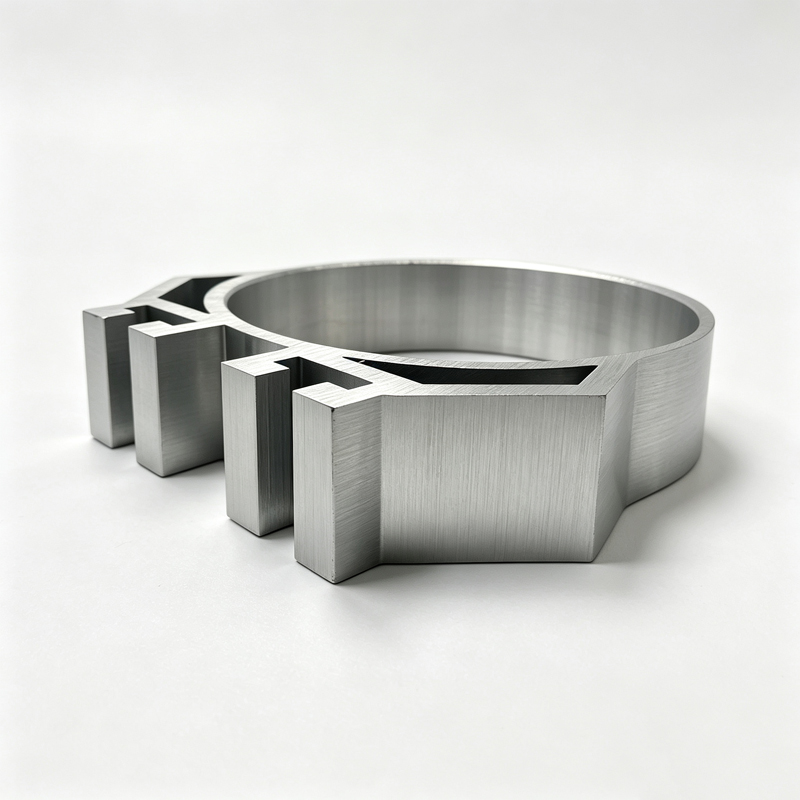
Custom Aluminum Profiles
Mold making of aluminum profiles for medical equipment
Product applications: CT frame and slip ring system profiles, MRI equipment frames and patient access structures, ultras
Product Details
Product applications: CT frame and slip ring system profiles, MRI equipment frames and patient access structures, ultrasound diagnostic equipment racks, DR/CR digital X-ray equipment structural components, surgical robot structural parts, monitor/ventilator equipment frames, laboratory analytical instrument structural parts, rehabilitation equipment profiles, operating table/examination bed structural components, medical cart/instrument cart frames, medical monitor brackets, medical gas pipeline brackets
Process: extrusion, mold making, CNC precision machining, clean-grade surface treatment
Extrusion length: 20M
Standards: GB/T 6892-2023, ISO9001, ISO13485 (compatible)
Product Details:
Medical equipment aluminum profiles are indispensable foundational materials in medical device manufacturing. With the acceleration of population aging, rising incidence of chronic diseases, and continuous advancement of medical technology, the global medical equipment market is seeing sustained growth in demand for high-performance aluminum alloy profiles. Aluminum profiles offer extremely high processing flexibility and can be customized according to customer needs to meet the special requirements of different medical devices.
Unlike ordinary industrial equipment, medical equipment requires aluminum profile structural components to meet standards far above conventional standards—precision assembly positions must have micron-level accuracy (suitable for high-precision alignment of imaging chains), surface treatment must meet sterile operating environment and high-frequency disinfection scenarios, and materials must have good biocompatibility and corrosion resistance.
This product focuses on the core requirements for medical device aluminum profiles for "high precision, clean-grade surfaces, structural stability, and biocompatibility," providing a full-process one-stop service from cross-sectional structure optimization, mold development, high-precision extrusion molding to CNC precision machining and medical-grade surface treatment.
01 Quality starts from raw materials using A00 primary aluminum ingots for production, contains no scrap aluminum, and features a pure material with a dense structure. Depending on the application scenario of medical equipment, 6063-T5 (general medical device frame, rehabilitation equipment), 6061-T6 (high-precision medical imaging device structural parts, surgical robot structural parts), and 5083 (corrosion-resistant medical components, medical gas pipelines) can be selected.
02 The precision of structural components in medical-grade high-precision controlled medical imaging equipment (CT/MRI/DR) directly affects imaging quality. Using high-precision molds and slow wire precision machining technology, the dimensional tolerances of key assembly positions for medical-grade aluminum profiles can be stably controlled between ±0.02mm and ±0.03mm. CNC machining accuracy can reach ±0.01-0.005mm, straightness ≤ 0.2mm/m, and flatness ≤ 0.03mm/300mm.
03 Clean-grade Surface Treatment: Medical equipment surface treatment must meet special requirements such as sterile environments, high-frequency disinfection, and biocompatibility. Compatible with various medical-grade surface treatment processes: clean-grade anodizing (resistant to disinfectant corrosion, high surface hardness), biocompatible coatings (compliant with ISO 10993 standards), and antibacterial coatings (inhibiting bacterial growth).
04 One-stop delivery service: From extrusion, CNC precision machining to clean-grade surface treatment, the entire process is delivered in one stop, with customers only needing to connect with one supplier. It can meet the requirements of ISO13485 medical device quality management systems, providing coordinate measuring full-scale inspection reports, material inspection reports, and surface treatment inspection reports for each batch.
Machining capability parameters:
| Project | Parameters/Description |
|---|---|
| Applicable scenarios | CT/MRI/ultrasound imaging equipment, surgical robots, monitoring instruments, rehabilitation equipment, medical carts |
| Optional materials | 6063-T5 (universal frame), 6061-T6 (high-precision structure), 5083 (corrosion-resistant medical components) |
| Extrusion equipment | 600T-12500T extruders |
| The largest circumscribed circle | 600-700mm |
| Key assembly position tolerances | ≤± 0.02mm to ±0.03mm |
| CNC machining accuracy | ±0.01-0.005mm |
| Straightness | ≤0.2mm/m |
| Flatness | ≤0.03mm/300mm |
| Maximum processing length | 6500mm |
| Surface treatment | Clean-grade anodizing, biocompatible coatings, antibacterial coatings, powder coatings |
| Implement standards | GB/T 6892-2023, ISO9001, ISO13485 (compatible) |
| Mold opening cycle | Standard structures take 7-10 days to emerge |
| Bulk delivery times | Delivery takes 10-15 days after sample confirmation |
| Minimum order quantity | Supports 50kg scale R&D prototyping |
| Production area | Qingpu, Shanghai |
Typical application scenarios for aluminum profiles in medical equipment:
| Equipment type | Application areas | Key requirements |
|---|---|---|
| CT computed tomography equipment | Frame structure and slip ring system profiles | Ultra-high precision, image chain alignment, long-term stability |
| MRI magnetic resonance imaging equipment | Equipment frame and patient access structure | Non-magnetic materials, high precision, and stable structure |
| Ultrasound diagnostic equipment | Frames and probe brackets | Lightweight, high-precision, and premium appearance |
| DR/CR digital X-ray equipment | Column structure, detector bracket | High rigidity, stable precision, and long-term reliability |
| Surgical robots | Mechanical arm structural components, base frame | Ultra-high precision, low stress, and stable long-term accuracy |
| Monitors/ventilators | Equipment frames and panel brackets | Lightweight, with a premium appearance, and easy to clean |
| Laboratory analytical instruments | Instrument structural parts, sample racks | High precision, corrosion resistance, chemical stability |
| Rehabilitation equipment | Equipment frames and support structures | Lightweight, high-strength, and aesthetically friendly |
FAQ: Q1: What is the difference between medical device aluminum profiles and ordinary industrial aluminum profiles? A: There are four core differences between medical equipment aluminum profiles and ordinary industrial aluminum profiles: First, the precision requirements differ—key assembly position tolerances for medical equipment must be controlled between ±0.02mm and ±0.03mm, while ordinary industrial profiles typically ± 0.05mm to ±0.1mm, with higher precision requirements for medical equipment; Second, different surface treatment requirements—medical equipment surfaces must meet special requirements such as sterile environments, high-frequency disinfection, and biocompatibility, while ordinary industrial profiles only need to meet basic corrosion resistance requirements; Third, material requirements differ—medical equipment must use high-purity, dense aluminum alloys, while some scenarios require non-magnetic materials (such as MRI equipment). Ordinary industrial profiles have relatively loose material requirements; Fourth, different quality system requirements — the production of medical equipment aluminum profiles must be coordinated with ISO13485 medical device quality management systems, while ordinary industrial profiles only need to meet ISO9001. Q2: What is the precision of aluminum profiles in medical equipment? A: The achievable precision indicators for medical equipment aluminum profiles: Key assembly position dimensional tolerances ≤±0.02mm to ±0.03mm (suitable for high-precision alignment of image chains), CNC machining accuracy ±0.01-0.005mm, straightness ≤0.2mm/m, flatness ≤0.03mm/300mm, coaxiality ≤0.05mm. Specific accuracy needs to be evaluated based on equipment type and installation requirements. Q3: What are the options for clean surface treatment of aluminum profiles in medical equipment? A: Medical equipment surface treatment must meet special requirements such as sterile environments, high-frequency disinfection, and biocompatibility. Our company can support four medical-grade surface treatment processes: First, clean-grade anodizing—resistant to disinfectant corrosion and has high surface hardness, suitable for most medical device structural components; Second is biocompatible coatings—compliant with ISO 10993 standards, suitable for medical components that come into direct or indirect contact with the human body; Third, antibacterial coating—inhibits bacterial growth, suitable for high-frequency contact surfaces; Fourth is powder coating—customizable colors, attractive appearance, suitable for equipment housings.
GET A QUOTE
Once you have submitted your requirements, we will contact you as soon as possible regarding your product inquiry.:Mold making of aluminum profiles for medical equipment