
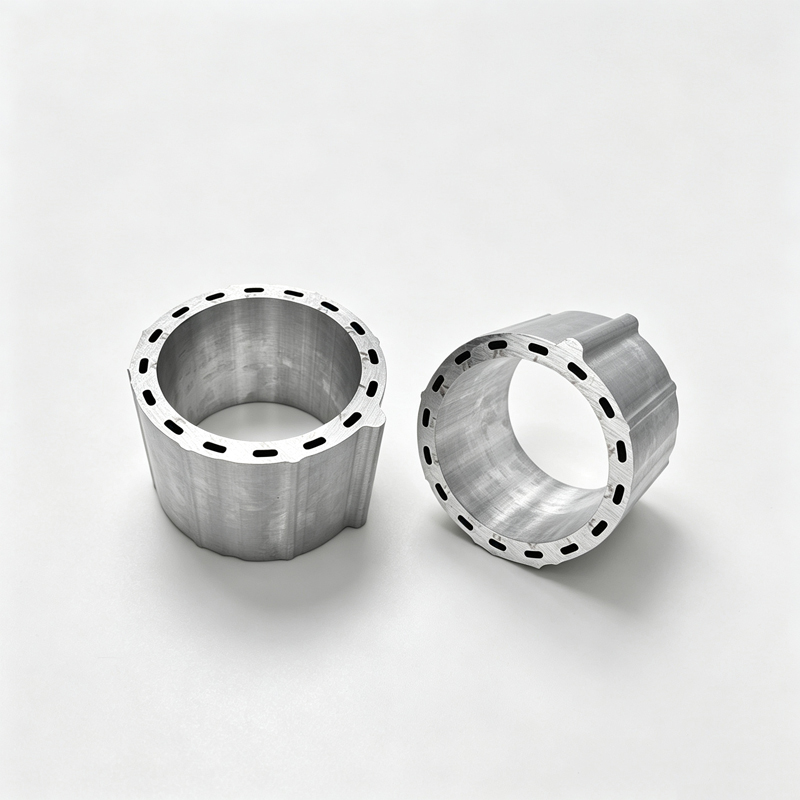
Custom Aluminum Profiles
Custom mold opening for motor housings
Product applications: servo motor housings, stepper motor housings, new energy vehicle drive motor housings, industrial
Product Details
Product applications: servo motor housings, stepper motor housings, new energy vehicle drive motor housings, industrial motor housings, robot joint motor housings, automation equipment motor housings, medical equipment motor housings, communication equipment motor housings, power tool motor housings, elevator traction machine housings, water pump motor housings, fan motor housings
Processes: extrusion, mold opening, CNC finishing, hard oxidation, surface treatment
Extrusion length: 20M
Standards implemented: GB/T 6892-2023, ISO9001
Product Details:
The motor housing is a key structural component protecting the internal components (stator, rotor, bearings), and is responsible for multiple functions such as heat dissipation, dust protection, waterproofing, insulation, and maintaining structural alignment. Aluminum alloy motor housings are gradually replacing traditional cast iron housings, featuring attractive appearances, compact size, light weight, simple structure, easy maintenance, and easy machining and molding.
Compared to traditional cast iron housings, the advantages of aluminum alloy motor housings are: their density is only one-third that of cast iron, significantly reducing the overall weight of the motor; Its thermal conductivity is about five times that of cast iron, significantly improving heat dissipation efficiency; No need for anti-rust coating, neat and attractive appearance; High machining precision and good assembly consistency.
Compared with die-cast aluminum motor housings, extrusion-formed motor housings offer higher dimensional accuracy and more flexible structural design capabilities. They can integrate functional structures such as heat dissipation fins, mounting slots, and routing slots into one piece, reducing subsequent processing steps. Extrusion forming is especially suitable for small to medium batches, multiple varieties, and high-precision customization needs.
This product focuses on the core requirements for motor housings for aluminum profiles to be "high precision, lightweight, excellent heat dissipation, and reliable sealing," providing a full-process one-stop service from cross-sectional structure optimization, mold development, extrusion forming to CNC precision machining and surface treatment.
01 Quality starts from raw materials: produced using A00 primary aluminum ingots, free of scrap aluminum, with pure material and stable mechanical properties. Different grades can be selected based on motor power, heat dissipation requirements, and working environment: 6063-T5 (general industrial motor, good moldability and high cost performance), 6061-T6 (high-power motor, new energy vehicle drive motor, high strength), 6005-T6 (heavy-duty motor, balancing strength and formability).
02 Motor housing dedicated extrusion process: The extrusion production of motor housings differs significantly from ordinary industrial profiles. The motor housing must have precise inner cavity dimensions (suitable for stator core interference fits), uniform wall thickness (to ensure consistent heat dissipation), and flat end faces (suitable for end cover sealing). The extrusion process optimizes process parameters according to the characteristics of the motor housing, ensuring stable internal cavity dimensional tolerances between ±0.02mm and ±0.04mm.
03 High-precision CNC machining Equipped with precision equipment such as five-axis CNC machining centers, it can perform deep machining processes such as precision cutting of motor housings, end face milling, precision boring of inner holes, mounting hole drilling and tapping, and end cover mating surface grinding. The dimensional tolerance of the key bearing housing can be controlled at ±0.03mm, and the flatness of the end cover mating surface ≤ 0.02mm.
04 One-stop delivery service: From extrusion, CNC finishing to surface treatment, the entire process is delivered in one stop, allowing customers to connect with only one supplier. It can be paired with various surface treatment processes such as anodizing (to enhance corrosion resistance and surface hardness), hard oxidation (for high wear resistance scenarios), powder coating (custom color appearance), and sandblasting/brushing (metallic texture).
Machining capability parameters:
| Project | Parameters/Description |
|---|---|
| Applicable scenarios | Servo motors, stepper motors, new energy vehicle drive motors, industrial motors |
| Optional materials | 6063-T5 (general), 6061-T6 (high power/new energy), 6005-T6 (heavy load) |
| Extrusion equipment | 600T-12500T extruders |
| The largest circumscribed circle | 600-700mm |
| Dimensional tolerances of the inner cavity | ± 0.02mm to ±0.04mm |
| Key bearing housing tolerances | ≤±0.03mm |
| Flatness of the mating surface of the end cover | ≤0.02mm |
| CNC machining accuracy | ±0.01-0.005mm |
| Maximum processing length | 6500mm |
| Surface treatment | Anodizing, hard oxidation, powder coating, sandblasting, and wire drawing |
| Implement standards | GB/T 6892-2023, ISO9001 |
| Mold opening cycle | Standard cross-sections are ready in 7-10 days |
| Bulk delivery times | Delivery takes 10-15 days after sample confirmation |
| Minimum order quantity | Supports 50kg scale R&D prototyping |
| Production area | Qingpu, Shanghai |
Reference for selecting aluminum profiles for motor housings:
| Motor type | Recommended materials | Key requirements |
|---|---|---|
| Servo motor housing | 6063-T5 / 6061-T6 | The bearing chamber features high-precision, heat-dissipating fin structure |
| Stepper motor housing | 6063-T5 | Dimensional accuracy and appearance quality |
| New energy vehicle drive motor housing | 6061-T6 | High strength, high thermal conductivity, and lightweight design |
| Industrial motor housing | 6063-T5 / 6005-T6 | Corrosion-resistant and long-term stability |
| Robot joint motor housing | 6061-T6 | Lightweight, high precision, low inertia |
Typical application scenarios:
Servo motor housings (industrial automation, CNC machine tools, robots)
Stepper motor housings (3D printers, automation equipment, medical instruments)
New Energy Vehicle Drive Motor Housing (Pure Electric/Hybrid Vehicles)
Industrial motor housings (pumps, fans, compressors, elevator traction machines)
Robot joint motor housings (collaborative robots, service robots)
Automation Equipment Motor Housings (Conveyor Lines, Packaging Machinery)
Medical device motor housings (surgical instruments, testing equipment)
Communication equipment motor housings (base station antenna drivers, cooling fans)
FAQ: Q1: What are the advantages of aluminum alloy motor housings compared to cast iron housings? A: Compared to traditional cast iron housings, aluminum alloy motor housings have four core advantages: First, lightweight and weight reduction—aluminum alloy density is only one-third that of cast iron, significantly reducing the overall motor weight. In the new energy vehicle field, motor weight reduction directly contributes to improving driving range; Second, high heat dissipation efficiency — aluminum alloy has about five times the thermal conductivity of cast iron, significantly improving heat dissipation efficiency, which can lower motor operating temperature and extend service life; Third, attractive appearance—the aluminum alloy surface can be treated with various treatments such as anodizing and powder coating, resulting in a clean and attractive appearance without the need for anti-rust coating; Fourth, high machining precision—aluminum alloy extrusion forming + CNC precision machining, dimensional consistency surpasses cast iron, and assembly consistency is excellent. Q2: What is the precision of the aluminum profile of the motor housing? A: Precision indicators achievable by the aluminum profile of the motor housing: Key bearing housing dimensional tolerance ≤±0.03mm (suitable for bearing interference fit installation), end cover mating surface flatness ≤0.02mm (ensuring sealing and installation accuracy), inner cavity dimensional tolerance ±0.02mm to ±0.04mm (suitable for stator core installation), CNC machining accuracy ±0.01-0.005mm. Specific accuracy should be evaluated based on motor type and installation requirements. Q3: What is the difference between the extrusion molding motor housing and the die-cast aluminum motor housing? A: There are four main differences between the extrusion molding motor housing and the die-cast aluminum motor housing: First, the difference in precision—the dimensional tolerance for extrusion forming can reach ±0.02mm to ±0.04mm, while the die-cast aluminum tolerance is usually between ±0.1mm and ±0.3mm, offering higher extrusion precision; Second, structural flexibility—extrusion molding can integrate cooling fins, mounting slots, wiring slots, and other functional structures into one piece, while die-cast aluminum is limited by molds and has relatively low structural flexibility; Third, surface quality—extrusion molding has a high surface finish and can be directly anodized. Die-cast aluminum often has defects such as pores and shrinkage porosity; Fourth, suitable for batch sizes—extrusion forming is suitable for small to medium batches and multi-variety customization, while die-cast aluminum is suitable for large-scale standardized production. Q4: What materials can be used for the aluminum profiles of motor housings? A: Three materials can be selected based on motor power, heat dissipation requirements, and working environment: 6063-T5—good moldability and high cost performance, suitable for general-purpose industrial motor housings and stepper motor housings, with a high surface finish and suitable for anodizing; 6061-T6 — After T6 heat treatment, yield strength ≥ 240MPa, excellent overall performance, suitable for high-power motors, new energy vehicle drive motors, and robot joint motors; 6005-T6—Balancing strength and formability, suitable for heavy-duty motor housings. Q5: What is the mold opening cycle and minimum order quantity for the aluminum profile of the motor housing? A: The standard cross-section mold opening cycle takes 7-10 days for sample release, and after batch delivery and sample confirmation, it takes 10-15 days. Supports 50kg-class R&D prototyping, adapting to new product development and small-batch trial production needs; mass production projects can lock in dedicated capacity. The specific mold opening cycle depends on the complexity of the cross-section: simple round tube shells (single cavity, symmetrical structure) can be sampled in 7-8 days; Samples with cooling finned housings (multi-cavity, asymmetrical) emerge in 8-10 days; Complex integrated shells (multi-cavity, thin-walled, large cross-section) can be sampled in 10-12 days. The mold opening fee uses H13 hot work mold steel, with a mold lifespan of ≥50,000 cycles. If the agreed mass production quantity is reached, the full mold opening fee can be refunded.
GET A QUOTE
Once you have submitted your requirements, we will contact you as soon as possible regarding your product inquiry.:Custom mold opening for motor housings