Custom Aluminum Profiles
Mold opening for non-standard profiles
Custom mold opening for non-standard profiles to meet special requirements
Product Details
Product applications: special-shaped frames for non-standard automation equipment, structural components for special equipment, special-shaped skeleton for robot arms, special-shaped guide rails for intelligent logistics equipment, irregular cavities for communication equipment, special-shaped structural components for medical devices, special-shaped components for military equipment, special-shaped profiles for aerospace, special-shaped structural parts for new energy equipment, special-shaped frames for semiconductor equipment, special-shaped brackets for optical instruments, and special-shaped structural components for precision testing equipment
Processes: extrusion, mold opening, CNC finishing, welding assembly, surface treatment
Extrusion length: 20M
Standards implemented: GB/T 6892-2023, ISO9001
Product Details:
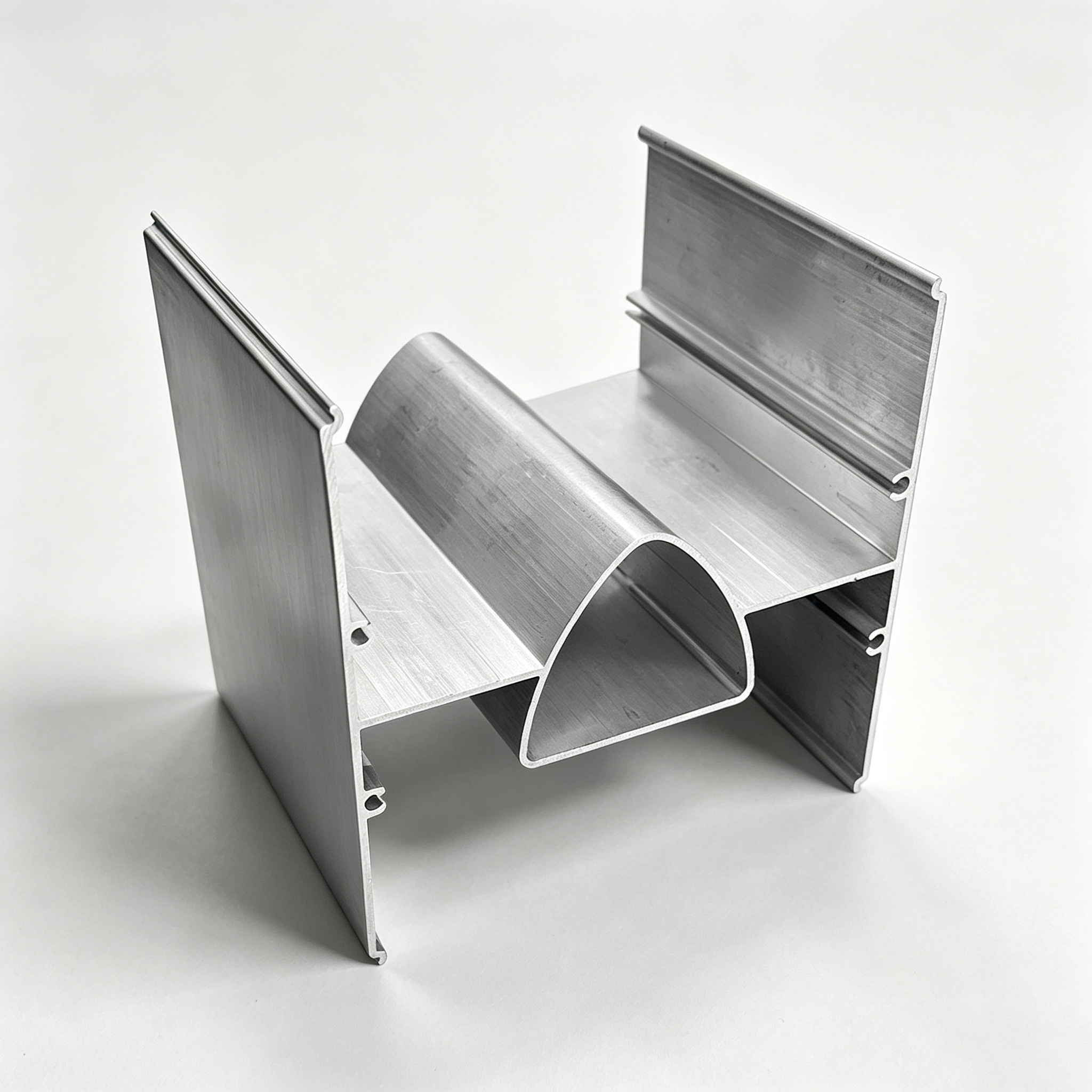
Non-standard special-shaped aluminum profiles refer to custom aluminum profiles whose cross-sectional shapes are not included in standard profile warehouses—such as multiple slots, deep cavities, asymmetrical structures, shaped surfaces, and functional integrated cross-sections. Unlike conventional standard profiles, non-standard profiles require a new mold opening according to equipment structural requirements, and each profile has a unique cross-section.
Unlike conventional standard profiles, the cross-sectional structure of non-standard profiles is often more complex—multiple slots require precise control of groove width and depth; The deep cavity structure requires uniform wall thickness and consistent metal flow velocity; The asymmetrical structure bears uneven force, placing extremely high demands on mold design and extrusion processes; The functional integration cross-section requires the integration of multiple functional structures on a single profile.
This product focuses on the core requirements of "complex cross-sections, high precision, and customization" for non-standard profiles, providing a full-process one-stop service from cross-section design optimization, mold development, extrusion forming to CNC precision machining and surface treatment.
01 Quality starts from raw materials: produced using A00 primary aluminum ingots, free of scrap aluminum, with pure material and stable mechanical properties. The complex cross-sectional structure of profiles is extremely sensitive to the quality of raw materials. The primary aluminum ingots have a dense structure and few impurities, forming the foundation for forming complex cross-sections. High-quality aluminum alloys such as 6063-T5, 6061-T6, 6005-T6, and 7075-T6 can be selected.
02 CAE Simulation and Exclusive Mold Design: Non-standard profiles have asymmetrical shapes and uneven wall thickness distribution; each cross-section requires an independent design of a dedicated mold. Before mold opening, CAE metal flow simulation technology is used to model the flow path and velocity distribution of metal in mold cavities, predict the filling state of multiple slots, the uniformity of deep cavity flow velocity, and the stress distribution of asymmetric sections, ensuring molding quality from the design side.
03 Precision extrusion of complex shaped cross-sections: closed-loop control of temperature and extrusion speed during the extrusion process, optimizing the process for structural characteristics such as multiple grooves, deep cavities, and asymmetry of profiles. In shaping of irregular curved surfaces, the accuracy of the surface contour is ensured by adjusting the extrusion parameters; The multi-slot structure ensures consistent groove width and depth by precisely controlling metal flow rate.
04 High-precision machining equipment equipped with five-axis CNC machining centers and other precision devices, capable of performing deep machining processes such as precision cutting of profiles, end face milling, groove finishing, special-shaped surface machining, and drilling and tapping. Machining accuracy ±0.01-0.005mm, multiple imported machine tools and ultra-long aluminum profile machining centers ensure timely delivery.
05 Full-process quality control The production process is equipped with multiple quality control nodes, providing material and dimensional inspection reports for each batch. Strictly implement the ISO9001 quality management system.
Machining capability parameters:
| Project | Parameters/Description |
|---|---|
| Applicable cross-section types | Multi-slot integrated cross-section, deep cavity structure, asymmetrical irregular shapes, irregular curved surfaces, and integrated functional slot cross-sections |
| The largest circumscribed circle | 600-700mm |
| Wall thickness range | 0.6mm-50mm |
| Dimensional tolerances | ± 0.02mm to ±0.04mm |
| Key assembly position tolerances | ≤±0.05mm |
| CNC machining accuracy | ±0.01-0.005mm |
| Maximum processing length | 6500mm |
| Optional materials | 6063-T5, 6061-T6, 6005-T6, 7075-T6, 6082-T6 |
| Extrusion equipment | 600T-12500T extruders |
| Surface treatment | Anodizing, hard oxidation, powder coating, brushing, polishing |
| Implement standards | GB/T 6892-2023, ISO9001 |
| Mold opening cycle | Conventional irregular cross-sections take 7-10 days to emerge |
| Bulk delivery times | Delivery takes 10-15 days after sample confirmation |
| Minimum order quantity | Supports 50kg scale R&D prototyping |
| Production area | Qingpu, Shanghai |
Typical cross-sectional structures of non-standard profiles:
| Cross-section type | Structural features | Typical applications |
|---|---|---|
| Multi-slot integrated cross-section | Multiple functional slots are integrated into design, integrating navigation, installation, wiring, and other functions | Special-shaped frames and guide rail profiles for automation equipment |
| Deep cavity structure | Large deep cavity, uniform wall thickness, and high metal flow rate control requirements | Communication equipment cavities and structural components of special equipment |
| Asymmetric irregular cross-section | Asymmetry on both sides and uneven force distribution make mold design more challenging | Non-standard equipment structural parts and robotic arms |
| Irregular curved cross-section | The curved surface profile is complex, requiring high molding precision | Optical instrument brackets, medical device structural components |
| Functional integration cross-section | A single profile integrates multiple functional structures | Special equipment components, military profiles |
Typical application scenarios:
Non-standard automated equipment special-shaped frames
Special equipment structural components
Robot arm with a reshaped skeleton
Special-shaped guide rails for intelligent logistics equipment
Communication equipment irregular-shaped cavities
Irregular structural components for medical devices
Special-shaped components for military equipment
Aerospace shaped profiles
Special-shaped structural components for new energy equipment
Irregular frames for semiconductor equipment
Irregular brackets for optical instruments
Precision inspection equipment for irregular structural components
FAQ: Q1: What is the difference between non-standard profiles and standard profiles? A: Standard profiles are profiles that have been molded and mass-produced by the manufacturer. The cross-sectional shape is fixed, and the options are limited; the purchaser can purchase directly. Non-standard profiles require new mold opening according to customer drawings, with cross-sectional shapes fully customized as needed. They can integrate complex structures such as multiple slots, deep cavities, asymmetric and irregular curved surfaces, offering extremely high flexibility. Q2: What is the precision of non-standard profiles? A: The accuracy indicators achievable for non-standard profiles: dimensional tolerances for special-shaped sections are stably controlled between ±0.02mm and ±0.04mm, key assembly position tolerances ≤±0.05mm, CNC machining accuracy ±0.01-0.005mm, maximum circumscribed circle diameter 600-700mm, and wall thickness range from 0.6mm to 50mm. Specific accuracy should be evaluated based on the complexity of the cross-section. Q3: How are the complex cross-sections of non-standard profiles formed? A: The forming of complex cross-sections of non-standard profiles is ensured through three stages: First, CAE metal flow simulation—before mold opening, CAE simulation technology is used to simulate the flow path and velocity distribution of metal in the mold cavity, predicting the filling state of multiple slots, the uniformity of deep cavity flow velocity, and the stress distribution of asymmetric sections, ensuring forming quality from the design side; Second, dedicated mold design—designed for the shape characteristics of non-standard profiles, using H13 hot work mold steel, with a mold service life of ≥50,000 cycles; Third is precision extrusion process—the extrusion process is closed-loop to control temperature and extrusion speed, optimizing the process for structural features such as multiple grooves, deep cavities, and asymmetry of profiles. Q4: What materials can be selected for non-standard profiles? A: Four materials can be selected based on cross-sectional structure and load conditions: 6063-T5—good formability and high surface finish, suitable for conventional profiles such as multi-slot profiles and special-shaped curved profiles; 6061-T6—After T6 heat treatment, yield strength ≥ 240MPa, suitable for heavy-duty structural parts such as robotic arms and special equipment structural parts; 6005-T6—Balancing strength and formability, suitable for medium-load profiles; 7075-T6—Aerospace-grade ultra-high-strength aluminum alloy, yield strength ≥ 500MPa, suitable for extreme conditions in aerospace, military equipment, and other fields. Q5: What is the mold opening cycle and minimum order quantity for non-standard profiles? A: The mold opening cycle for conventional special-shaped cross-sections takes 7-10 days for sample release, and 10-15 days after batch delivery confirmation. Supports 50kg-class R&D prototyping, with mass production projects locking exclusive capacity. The specific mold opening cycle depends on the complexity of the cross-section: multi-slot integrated cross-sections take 7-8 days to produce samples; Deep cavity structures are ready in 8-10 days; Asymmetric irregular cross-sections emerge in 9-11 days; Irregular curved surface cross-sections can be sampled in 10-12 days; Functional integration cross-section: 11-13 days to take delivery. The mold opening fee uses H13 hot work mold steel, with a mold lifespan of ≥50,000 cycles. If the agreed mass production quantity is reached, the full mold opening fee can be refunded.
GET A QUOTE
Once you have submitted your requirements, we will contact you as soon as possible regarding your product inquiry.:Mold opening for non-standard profiles