
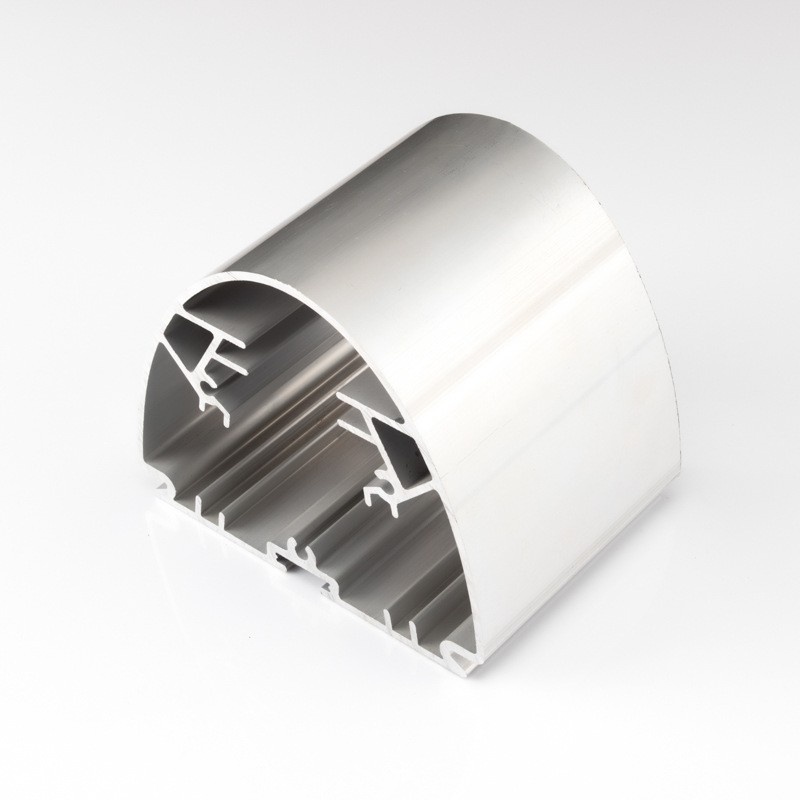
Custom Aluminum Profiles
Multi cavity shaped profile mold opening
Multi-cavity special-shaped aluminum profiles refer to sections containing...Two or more independent cavitiesNon-standar
Product Details
Multi-cavity special-shaped aluminum profiles refer to sections containing...Two or more independent cavitiesNon-standard aluminum profiles are used in industrial aluminum profile customization.One of the most technically challenging categories.
Why is it difficult?The more, the denser, and the smaller the cavity, the thinner and longer the mold head. During extrusion, the impact force of the metal is concentrated on the working head.If you're not careful, the foreman could be swept away.. Unlike conventional single-cavity profiles, multi-cavity profiles have complex metal flow paths and uneven flow velocity distribution during the extrusion process, which greatly increases the requirements for die design, extrusion process and temperature control.
Shanghai Chuansi Aluminum focuses onHigh-difficulty multi-cavity special-shaped profile mold opening customizationFrom CAE metal flow simulation, precision mold design, profile extrusion (cooperative production line) to CNC precision machining, the entire process is independently controllable.
Core Advantages at a Glance:
| advantage dimension | Technical Indicators | Customer Value |
|---|---|---|
| high-difficulty multi-cavity capability | Two or more independent cavities, full coverage of complex cross-sections | Equipment lightweighting and functional integration integrated molding |
| Shuiultra-thin wall thickness | minimum wall thickness0.6mm | Ultra-lightweight, high material utilization rate |
| cavity high precision | cavity coaxiality≤0.03mm | Precise relative positioning of multiple cavities ensures worry-free assembly. |
| high-precision shape | Dimensional tolerance ±0.02mm to ±0.04mm | Precise dimensions, suitable for rigorous assembly |
| CAE simulation | Prediction of flow velocity distribution by simulation before mold opening | Solve uneven metal flow at the source, high success rate of one-time mold trial |
| Fast delivery | Samples for standard cross-sections take 7-10 days, with a minimum order of 50kg. | Rapid R&D iteration and controllable risks |
Applicable scenarios (matching):
| cross-section type | structural features | typical application |
|---|---|---|
| multi-cavity integrated section | A combination of two or more independent cavities, with high functional integration. | Robot skeleton, special-shaped frame of automated equipment |
| ultra-thin-walled multi-cavity profile | Wall thickness 0.6-1.8mm, dense partition structure | Sensor housing, optical instrument structure, micro transmission assembly |
| composite section profile | Multi-structure combination of boss + deep groove + special-shaped cavity | Aerospace precision profiles, analytical instrument accessories |
| asymmetric cavity profile | The cavities are asymmetrical in size/shape, resulting in significant differences in flow rates. | Special testing equipment, non-standard functional components |
Typical application scenarios:
Robot skeleton profiles (multi-cavity structure optimized for bending and torsional rigidity + lightweight)
Automated equipment special-shaped frame (functionally integrated cavity, reducing subsequent processing)
Industrial manipulator guide rail (multi-cavity high-rigidity cross-section, high-precision movement)
Sensor housing and optical instrument structural components (ultra-thin-walled, multi-cavity, precision assembly)
Communication equipment cavity profiles (multi-cavity integrated wiring and heat dissipation functions)
Aerospace precision profiles (composite section high-precision structural parts)
Medical device structural components (thin-walled multi-cavity high-precision profiles)
Multi-cavity structural components for new energy equipment (lightweight, high-rigidity structure)
Military equipment parts (high-strength multi-cavity structure)
High-precision instrument frame (multi-cavity high-rigidity structure)
01 A00 virgin aluminum ingot + high-end material matrix – the quality foundation for complex cavities
The uniformity of metal flow in multi-cavity special-shaped profiles is extremely sensitive to the quality of raw materials—primary aluminum ingots have a dense structure and few impurities, which is the foundation for ensuring the quality of complex cross-section forming.
AdoptGrade A00 virgin aluminum ingotThe production process contains no waste aluminum, with pure materials and stable mechanical properties.
| Material | tensile strength | characteristic | Recommended scenarios |
|---|---|---|---|
| 6063-T5 | ≥205MPa | Good moldability and high surface finish | Conventional multi-cavity structural member, communication equipment cavity, sensor housing |
| 6061-T6 | ≥310MPa | Excellent comprehensive performance | Robot skeleton, special-shaped frame of automation equipment (heavy-duty load-bearing parts) |
| 7075-T6 | ≥524MPa | Aviation grade, strength comparable to steel | Aerospace precision profiles, military equipment parts |
02 CAE Fluid Simulation + Precision Mold Design – Solving the Problem of Multi-Cavity Forming from the Source
For complex cross-sections such as multi-cavity, asymmetrical, and composite sections, this procedure is performed before mold opening.CAE Metal Flow Simulation Analysis:
Prediction of metal flow velocity distribution and filling state in each cavity
Avoid problems such as uneven flow velocity, local material shortages, and deformation during extrusion.
Optimize the layout of the shunt holes and the length of the working belt to ensure consistent flow velocity across all cavities.
Each multi-cavity profile is independently molded.It does not share existing molds, allowing for maximum matching with customer-specific designs.
Mold adoptionH13 hot working die steel vacuum heat treatment formingTo ensure uniform cross-sectional wall thickness and stable dimension. According to the slender structural characteristics of the multi-cavity tool head, the strength design of the mold is optimized.Reduce the risk of foreman fracture.
03 Multi-cavity precision extrusion molding – core technology for tool head breakage prevention
extrusion processClosed-loop control of temperature and extrusion speedOptimize the layout of metal shunt holes and the length of the working belt according to the characteristics of the multi-cavity structure:
Each cavity has a consistent metal flow rate and is fully filled.
Problems such as material breakage, distortion, and cavity deformation are prone to occur during the extrusion process of thin-walled multi-cavity profiles. These problems can be effectively controlled by optimizing the mold flow channel and extrusion process.
To address the challenge of multi-cavity workheads being slender and easily broken, through...Split ratio optimization + flow rate balance controlReduce force on the foreman and ensure extrusion stability.
Scope of production:Maximum circumscribed circle 600-700mm,Minimum wall thickness 0.6mm.
04 High-precision CNC machining – multi-cavity precision machining
equippedFive-axis CNC machining centerPrecision equipment such as these can complete deep processing processes such as precision cutting, end face milling, cavity finishing, and drilling and tapping of multi-cavity profiles.
| accuracy item | Achievable indicators |
|---|---|
| External dimensional tolerance | ±0.02mm to ±0.04mm |
| cavity coaxiality | ≤0.03mm |
| joint surface flatness | ≤0.02mm |
| overall distortion | ≤0.2mm/m |
| CNC machining accuracy | ±0.01-0.005mm |
Multiple imported machine tools and ultra-long machining center travel6.5 meters.
05 Full-process quality control
Multiple quality control nodes are set up in the production process, from raw materials and extrusion to full inspection of finished products, to ensure that every dimension of complex cross-sections meets precision standards. Provided per batchMaterial inspection report and dimensional inspection report. Strictly implement the ISO9001 quality management system.
Complete processing capacity parameters:
| Project | Parameters / Description |
|---|---|
| Applicable cross-section type | Multi-cavity, thin-walled multi-cavity, asymmetric cavity, composite cross-section, special-shaped cavity |
| minimum wall thickness | 0.6mm-1.8mm |
| maximum circumscribed circle | 600-700mm |
| dimensional tolerance | ±0.02mm to ±0.04mm |
| cavity coaxiality | ≤0.03mm |
| joint surface flatness | ≤0.02mm |
| overall distortion | ≤0.2mm/m |
| CNC machining accuracy | ±0.01-0.005mm |
| Optional materials | 6061-T6, 6063-T5, 7075-T6 |
| surface treatment | Natural anodic oxidation, hard oxidation, sandblasting, electrophoresis, fingerprint-free treatment |
| extrusion equipment | 600T-12000T (cooperative production line) |
| Maximum machining length | 6500mm |
| Execution Standards | GB/T 6892-2023, ISO9001 |
| mold opening cycle | Regular cross-section sampling takes 7-10 days |
| Batch delivery time | Delivery 10-15 days after sample confirmation |
| minimum order quantity | 50kg (supports R&D prototyping) |
| Production origin | Shanghai Qingpu |
Typical cross-sectional structure of multi-cavity profile:
| cross-section type | structural features | typical application |
|---|---|---|
| multi-cavity integrated section | A combination of two or more independent cavities, with high functional integration. | Robot skeleton, special-shaped frame of automated equipment |
| ultra-thin-walled multi-cavity profile | Wall thickness 0.6-1.8mm, dense partition structure | Sensor housing, optical instrument structure, micro transmission assembly |
| composite section profile | Multi-structure combination of boss + deep groove + special-shaped cavity | Aerospace precision profiles, analytical instrument accessories |
| asymmetric cavity profile | The cavities are asymmetrical in size/shape, resulting in significant differences in flow rates. | Special testing equipment, non-standard functional components |
FAQ (Frequently Asked Questions)
Q1: What are the difficulties in processing multi-cavity special-shaped profiles?
A: Multi-cavity special-shaped profiles are used in industrial aluminum profile customization.One of the most technically challenging categories. The difficulty mainly comes from four aspects: ① The mold head is easy to break - the more, the denser and the smaller the cavity, the thinner and longer the mold head. During extrusion, the metal impact force is concentrated on the head, and the head will be broken if you are not careful, resulting in a high mold scrap rate. ② Uneven metal flow rate – The different metal flow paths and flow rates in each cavity can easily lead to defects such as uneven wall thickness and insufficient filling; ③ Thin-walled structures are prone to problems such as material breakage, distortion, and cavity deformation during the extrusion process; ④ High dimensional control difficulty – Multi-cavity structures require high accuracy in the relative position between cavities, and the coaxiality of the cavities must be controlled within 0.03mm. Our company uses CAE metal flow simulation technology to solve the problem of uneven metal flow from the mold design stage, reduce the number of mold trials, and ensure the forming quality of complex cross-section profiles.
Q2: How accurate can multi-cavity special-shaped profiles be?
A: Cavity coaxiality ≤0.03mm, external dimension tolerance ±0.02mm to ±0.04mm, joint surface flatness ≤0.02mm, overall distortion ≤0.2mm/m, CNC machining accuracy ±0.01-0.005mm. The accuracy depends on: ① the complexity of the cross-section - the more cavities and the thinner the wall thickness, the more difficult it is to control the accuracy; ② Material selection - 7075-T6 has better dimensional stability than 6063-T5 after heat treatment; ③ Wall thickness design – The control difficulty of ultra-thin-walled multi-cavity profiles with a wall thickness of 0.6-1.8mm is significantly higher than that of conventional multi-cavity profiles with a wall thickness of more than 2mm. Provide drawings or technical requirements, and the engineering department will provide the optimal accuracy solution after evaluation.
Q3: How can multi-cavity special-shaped profiles ensure the uniformity of wall thickness of each cavity?
A: The uniformity of the wall thickness of each cavity is the core index for measuring the quality of multi-cavity special-shaped profiles. Our company guarantees this through three aspects: ① CAE metal flow simulation - simulation analysis of the flow velocity distribution of each cavity before mold opening, targeted optimization of the diversion hole layout and working belt length, and solving uneven wall thickness from the design stage; ② Precision mold design – H13 hot-working mold steel vacuum heat treatment forming, mold cavity accuracy can reach ±0.01mm; ③ Precise control of the extrusion process – closed-loop control of aluminum bar temperature, extrusion cylinder temperature, die temperature and extrusion speed, with wall thickness deviation controlled within ±0.03mm.
Q4: What materials can be used for multi-cavity special-shaped profiles?
A: Three materials are available: 6063-T5 – with good moldability and high surface finish, suitable for conventional multi-cavity structural components, such as communication equipment cavities and sensor housings; 6061-T6 – Yield ≥ 240 MPa, suitable for heavy-duty load-bearing components, such as robot skeletons and special-shaped frames of automated equipment; 7075-T6 – Tensile strength ≥524MPa, aerospace-grade ultra-high strength, suitable for aerospace precision special-shaped parts and military equipment components. Our company recommends the optimal material solution based on the cavity structure and stress conditions.
Q5: What is the mold opening period and minimum order quantity for multi-cavity special-shaped profiles?
A: Sampling takes 7-10 days for standard cross-sections, and 10-15 days for batch delivery. Minimum order 50kg. The mold opening period depends on the complexity of the cross-section: 7-8 days for a double-cavity symmetrical structure; Three-cavity asymmetric structure 8-10 days; Thin-walled multi-cavity structure with more than five cavities 10-12 days. The molds are made of H13 hot-worked mold steel with a lifespan of ≥50,000 cycles. The mold opening fee will be fully refunded upon reaching mass production volume.
Get the solution now
Contact Manager Du:13611846009
Provide drawings or technical requirements, Technical DepartmentWithin 2 hoursThe multi-cavity feasibility evaluation and mold opening scheme are given.
Free technical consultation | High-difficulty multi-chamber assessment | Direct supply from the source factory
GET A QUOTE
Once you have submitted your requirements, we will contact you as soon as possible regarding your product inquiry.:Multi cavity shaped profile mold opening