
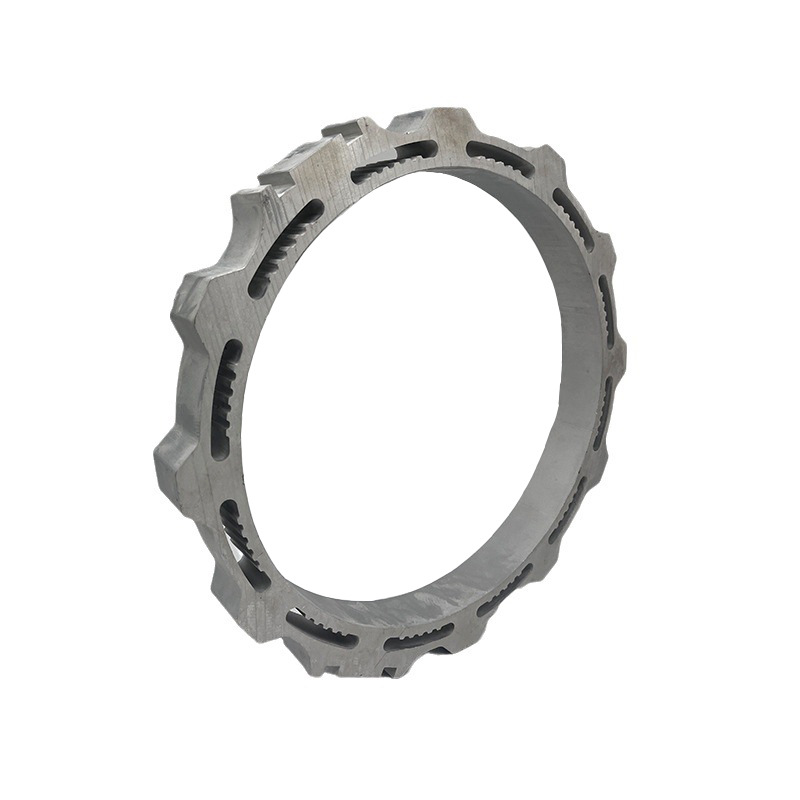
Custom Aluminum Profiles
Thin walled large section aluminum profile mold opening
Thin-walled and large-section aluminum profiles are a technological high ground in the field of industrial aluminum prof
Product Details
Thin-walled and large-section aluminum profiles are a technological high ground in the field of industrial aluminum profile customization. Unlike conventional profiles, thin-walled, large-section profiles need to simultaneously meet two contradictory requirements: "large cross-section width" and "extremely thin wall thickness"—the larger the cross-section, the longer the metal flow path and the more difficult it is to control the flow velocity. The thinner the wall thickness, the more difficult it is to fill the metal and the easier it is to produce defects. Thin-walled structures are prone to problems such as material breakage, distortion, and cavity deformation during extrusion.
The core technical difficulty of thin-walled large-section aluminum profiles is that the wide section leads to a long flow path of metal in the mold cavity and an extremely uneven flow velocity distribution; The thin-walled structure leads to high metal filling resistance, which is prone to defects such as material breakage, distortion, and uneven wall thickness. Cross-sections with significant wall thickness differences (both 0.8mm thin-walled and thick-walled areas on the same profile) require extremely high control of metal flow rate balance. Ordinary manufacturers are often hesitant to accept thin-walled, large-section orders or fail multiple mold trials.
Shanghai Chuansi Aluminum focuses on the core requirements of "ultra-wide section, ultra-thin wall thickness, high precision, and lightweight" for thin-walled and large-section aluminum profiles, providing one-stop services for the entire process, from cross-sectional structure design, CAE metal flow simulation, mold development, profile extrusion (cooperative production line) to CNC precision machining. In view of the technical characteristics of thin walls and large cross-sections, by optimizing the die shunt structure and extrusion process, the uniform wall thickness of the entire profile without warping and deformation can be ensured, reducing the product's self-weight while preserving the structural strength.
01 Quality starts with raw materials
It is produced using A00 virgin aluminum ingots, containing no waste aluminum, with pure materials and dense structure. Thin-walled and large-cross-section metal flow is extremely sensitive to the quality of raw materials, and virgin aluminum ingots are the foundation for ensuring the quality of extrusion forming of ultra-wide thin-walled profiles. Various materials such as 6061-T6 (high-strength lightweight structure), 6063-T5 (good moldability and high surface finish), and 6005-T6 (fatigue resistance and rail transit scenarios) can be selected according to the application scenario.
02 CAE Simulation and Dedicated Mold Design
Thin-walled, large-section profiles have complex shapes and significant differences in wall thickness, requiring an independent design of a special mold for each section. Before mold opening, CAE metal flow simulation technology is used to simulate the flow path and velocity distribution of metal in the mold cavity, predict the metal filling state of various parts of the wide section, the flow velocity uniformity of thin-walled areas, and the flow velocity balance of parts with significant wall thickness differences. This solves problems such as uneven flow velocity, material shortages, and deformation from the design stage, reduces the number of mold trials, and ensures the stability of the finished product shape and dimensions.
03 Thin-walled, large-section precision extrusion molding
The temperature and extrusion speed are controlled in a closed-loop extrusion process, and the process is optimized according to the structural characteristics of thin walls and large cross-sections. By optimizing the mold shunt structure and extrusion process, the uniform wall thickness of the entire profile is ensured without warping deformation, retaining structural strength while reducing product weight. It can produce thin-walled large-section profiles with an ultra-wide section of 750mm and a minimum wall thickness of 0.8mm. The meter weight can be customized from 0.05kg/m to 100kg/m, and the circumscribed circle can be customized from 5mm to 750mm.
04 High-precision CNC machining
Equipped with precision equipment such as a five-axis CNC machining center, it can complete deep machining processes such as precision cutting, end face milling, precision machining of thin-walled parts, and drilling and tapping of thin-walled and large-section profiles. The machining accuracy is ±0.01-0.005mm, and the dimensional tolerance is stably controlled between ±0.02mm and ±0.04mm. Multiple imported machine tools and ultra-long aluminum profile processing centers have a travel distance of up to 6.5 meters.
05 Full-process quality control
Multiple quality control nodes are set up in the production process, from raw material spectroscopy inspection and full process inspection to finished product three-coordinate inspection, to ensure that the dimensional accuracy and wall thickness uniformity of each batch of thin-walled large-section profiles meet the standards. Material inspection report and dimension inspection report are provided for each batch.
Processing capacity parameters:
| Project | Parameters / Description |
|---|---|
| Applicable cross-section type | Ultra-wide section thin-walled profiles, multi-cavity thin-walled profiles, profiles with significant wall thickness differences, and special-shaped thin-walled profiles |
| maximum cross-sectional width | 750mm class |
| maximum circumscribed circle | 5mm-750mm |
| minimum wall thickness | 0.8mm |
| Maximum weight in meters | ≤100kg/m |
| dimensional tolerance | ±0.02mm to ±0.04mm |
| CNC machining accuracy | ±0.01-0.005mm |
| Maximum machining length | 6500mm |
| Optional materials | 6061-T6, 6063-T5, 6005-T6, 6082-T6 |
| extrusion equipment | 600T-12000T (cooperative production line) |
| Execution Standards | GB/T 6892-2023 High-precision |
| surface treatment | Anodizing, hard oxidation, powder spraying |
| mold opening cycle | Sampling for conventional structures takes 10-15 days. |
| Batch delivery time | 12-18 days after sample validation |
| minimum order quantity | Supports 50kg R&D prototyping |
| Production origin | Shanghai Qingpu |
Typical features of thin-walled, large-section aluminum profiles:
| characteristic dimension | Parameters / Description |
|---|---|
| cross-sectional width | Some profiles reach 750mm, far exceeding conventional profiles. |
| Extremely thin wall | Minimum up to 0.8mm |
| Significant difference in wall | There are significant differences between thin-walled and thick-walled parts on the same profile. |
| large extrusion ratio | Flat die extrusion ratio λ>60, split combination die extrusion ratio λ>40 |
| High precision requirements | Dimensional tolerance ±0.02mm to ±0.04mm |
Typical application scenarios:
Lightweight structure for new energy equipment: lightweight battery tray profiles, weight-reducing frame for energy storage equipment
Lightweight framework for automated equipment: lightweight main beams for large conveyor lines and weight-reducing frames for automated equipment.
Unmanned aerial vehicles and aircraft: lightweight unmanned aerial vehicle framework, aircraft structural profiles
Rail transit lightweighting: lightweight vehicle body components and lightweight interior profiles
Lightweight curtain walls for large buildings: large-span lightweight curtain wall structures, lightweight profiles for building decoration
Lightweighting of photovoltaic brackets: lightweight photovoltaic bracket profiles, solar tracking system structural components
FAQ (Frequently Asked Questions)
Q1: What are the difficulties in processing thin-walled, large-section aluminum profiles?
A: Thin-walled, large-section aluminum profiles are one of the most technically challenging categories in the field of industrial aluminum profile customization, requiring the simultaneous satisfaction of two contradictory requirements: "wide section width" and "extremely thin wall thickness". The specific difficulties are reflected in four aspects: First, uneven metal flow velocity - the metal flow paths vary greatly in different parts of the wide section, and the flow velocity distribution is extremely uneven, which can easily lead to uneven wall thickness and local material shortages; Second, thin walls are prone to deformation—thin-walled structures are prone to problems such as material breakage, distortion, and cavity deformation during the extrusion process; Third, the extrusion ratio is large—the extrusion ratio of flat dies λ>60, and the extrusion ratio of shunt combination dies λ>40. Excessive extrusion ratios lead to high metal deformation resistance. Fourth, there is a significant difference in wall thickness—the same profile has both 0.8mm thin walls and thick walls, which places extremely high demands on the balance and control of metal flow velocity. Ordinary manufacturers are often afraid to accept such orders or fail multiple mold trials.
Q2: How accurate can thin-walled, large-section aluminum profiles be?
A: The dimensional tolerance is stably controlled between ±0.02mm and ±0.04mm, the CNC machining accuracy is ±0.01-0.005mm, the minimum wall thickness can reach 0.8mm, and the maximum cross-sectional width can reach 750mm. The specific accuracy depends on factors such as cross-sectional width, wall thickness, and wall thickness difference. Our company uses CAE metal flow simulation technology to predict flow velocity distribution, solve the problem of uneven metal flow from the mold design stage, and ensure the dimensional accuracy of thin-walled large-section profiles.
Q3: How can thin-walled, large-section aluminum profiles ensure uniform wall thickness?
A: Ensure wall thickness uniformity in four aspects: First, CAE metal flow simulation – CAE simulation analysis is performed before mold opening to solve the problem of uneven flow velocity from the design stage; Secondly, a dedicated mold design—optimizing the layout of the shunt holes and the length of the working belt in response to the significant difference in wall thickness; Third, precise control of the extrusion process—closed-loop control of aluminum bar temperature, extrusion cylinder temperature, die temperature, and extrusion speed; Fourth, strict testing is carried out – the wall thickness deviation is controlled within ±0.03mm.
Q4: What is the mold opening cycle and minimum order quantity for thin-walled large-section aluminum profiles?
A: The conventional structural mold opening cycle is 10-15 days for sample production, and 12-18 days after batch delivery sample confirmation. Supports 50kg R&D prototyping. Profiles with a cross-sectional width of less than or equal to 500mm and a wall thickness of more than or equal to 1.5mm are sampled in 10-12 days; Profiles with a cross-sectional width of 500-750mm and a wall thickness of 1.0-1.5mm are sampled in 12-14 days; Ultra-thin-walled large-section profiles with a cross-sectional width of 750mm and a wall thickness of ≤1.0mm will be sampled within 14-16 days. Thin-walled large-section profiles have a longer mold opening cycle than conventional profiles due to their large section width, extremely thin wall thickness, and complex mold design.
GET A QUOTE
Once you have submitted your requirements, we will contact you as soon as possible regarding your product inquiry.:Thin walled large section aluminum profile mold opening