
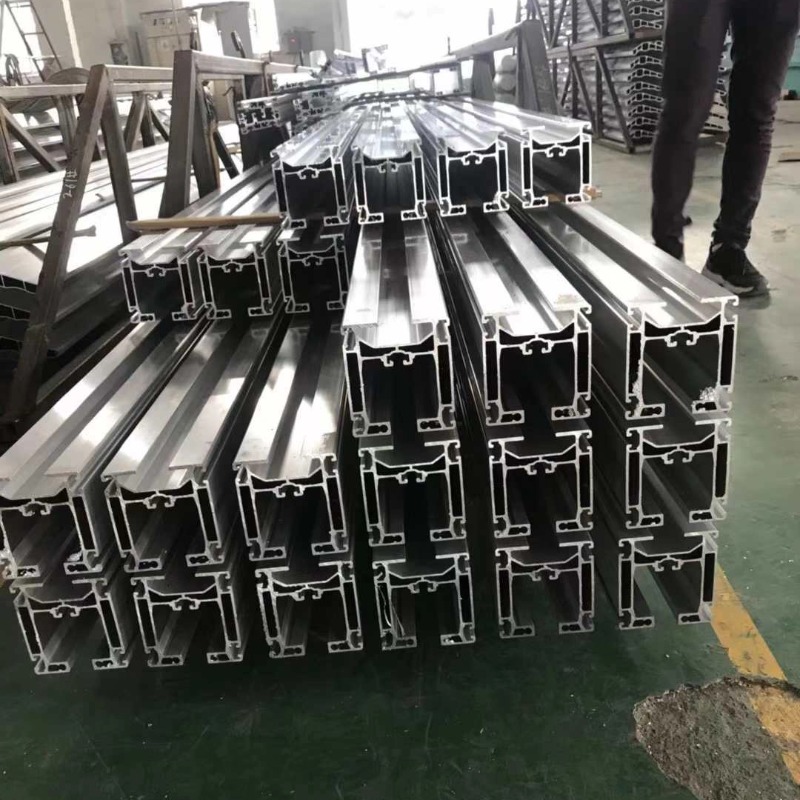
Custom Aluminum Profiles
Aluminum profile mold for rail transit
We offer customized mold-making of aluminum profiles for rail transit, targeting high-speed trains, subways, light rail,
Product Details
We offer customized mold-making of aluminum profiles for rail transit, targeting high-speed trains, subways, light rail, maglev and other rail transit equipment fields. Aluminum profiles are widely used in rail transit. They can be used to make car bodies (roofs, sidewalls, floors, etc.) as well as accessories (luggage racks, doors, pedals, water tanks, etc.). The density of aluminum alloy is only one-third that of steel. Compared with stainless steel bodies, aluminum alloy vehicles can reduce weight by more than 35% and increase transport capacity by 10%. Using aluminum profiles instead of steel can reduce the weight of the train by 50%, save energy, reduce emissions, and make the train easier to control and more stable under conditions such as turns and undulations during high-speed operation. Currently, high-speed trains with speeds exceeding 250 kilometers per hour are largely made of aluminum alloy.
Shanghai Chuansi Aluminum focuses on the core requirements of "large cross-section, lightweight, high precision, and weldability" for rail transit aluminum profiles, providing one-stop services for the entire process, from cross-sectional structure design, mold development, and large-tonnage profile extrusion (cooperative production line) to CNC precision machining, friction stir welding, and surface treatment.
01 Quality starts with raw materials
This high-quality aluminum alloy for rail transit is produced using A00 virgin aluminum ingots. It contains no waste aluminum, resulting in pure materials, dense structures, and stable mechanical properties. Depending on the stress conditions and welding requirements of the rail transit vehicle body, various materials such as 6005A-T6 (high-speed train body side walls/roof/chassis, with excellent fatigue resistance), 6061-T6 (high-strength vehicle body structural parts), and 6063-T5 (interior accessories) can be selected.
02 Large-section hollow thin-walled precision extrusion
Most rail transit car body profiles are long, hollow, thin-walled, and complex cross-sectional structures. During the extrusion process, the metal flow is very uneven, which requires extremely high requirements for die design and extrusion technology. By adopting large-tonnage extrusion equipment, large-section rail car body components can be produced, realizing one-time production of the whole, eliminating the need for secondary splicing, and reducing the number of section splicing of profiles by 50%. It can produce ultra-large materials with a circumscribed circle diameter of 600-700mm, and the dimensional tolerance of key assembly positions is stably controlled within ±0.02mm to ±0.04mm.
03 High-precision CNC machining
Equipped with precision equipment such as a five-axis CNC machining center, it can complete deep machining processes such as precision cutting, end face milling, and precision drilling and tapping of rail transit profiles. With a machining accuracy of ±0.01-0.005mm, multiple imported machine tools and ultra-long aluminum profile machining centers have a stroke of up to 6.5 meters, meeting the precision machining requirements of rail transit vehicle body modules and components.
04 Welding and Assembly Kits
The rail transit vehicle body is assembled by welding multiple profiles. It can be equipped with advanced welding processes such as friction stir welding, and can meet the EN 15085-2 rail vehicle welding certification requirements. One-stop delivery from individual profiles to welded assemblies (vehicle side walls, roofs, floor modules, etc.) reduces the number of customer connections.
05 Full-process quality control
Multiple quality control nodes are set up in the production process, and a three-coordinate full-size inspection report and a material inspection report are provided for each batch. Strictly implement the ISO9001 quality management system.
Processing capacity parameters:
| Project | Parameters/Description |
|---|---|
| Applicable scenarios | Structural components and interior accessories for high-speed trains, subways, light rail, and maglev trains. |
| Optional materials | 6005A-T6 / 6061-T6 / 6063-T5 |
| Execution Standards | GB/T 6892-2023 High precision, compatible with EN 15085-2 |
| maximum circumscribed circle | 600-700mm |
| Maximum machining length | 6500mm |
| Critical assembly position tolerance | ≤±0.02mm to ±0.04mm |
| straightness | ≤0.2mm/m |
| CNC machining accuracy | ±0.01-0.005mm |
| surface treatment | Anodizing, hard oxidation, electrophoresis, powder spraying |
| matching process | CNC finishing, friction stir welding, assembly |
| extrusion equipment | 600T-12000T (cooperative production line) |
| mold opening cycle | Sampling for conventional structures takes 12-18 days |
| Batch delivery time | 15-20 days after sample confirmation |
| minimum order quantity | Supports small batch customization |
| Production origin | Shanghai Qingpu |
Main application components of aluminum profiles for rail transit vehicle bodies:
| component type | Recommended materials | Key Requirements |
|---|---|---|
| car body side wall profile | 6005A-T6 | Large cross-section hollow thin wall, high strength, weldable |
| roof profile | 6005A-T6 | Lightweight, fatigue resistance, long dimensional accuracy |
| floor profile | 6005A-T6 | High load-bearing capacity, good flatness, integrated C-slot |
| underframe side beam | 6061-T6 | High strength, impact resistance |
| Door/pedal profiles | 6063-T5 | High precision and good surface quality |
| Luggage rack/interior profile | 6063-T5 | Appearance, texture, lightweight |
Typical application scenarios:
Side wall, roof, floor and end wall profiles of high-speed train body
Side panels, underframes, and side beam profiles for subway/light rail cars
Maglev train guide rail profiles and vehicle body structural parts
EMU skirt panel and driver's cab frame profile
Rail vehicle luggage racks, doors, pedals, water tank profiles
Conductive rail, power supply rail, contact rail profiles
Vehicle equipment mounting frame and hanging groove structure
FAQ (Frequently Asked Questions)
Q1: What are the advantages of aluminum profiles for rail transit compared to traditional stainless steel car bodies?
A: The density of aluminum alloy is only one-third that of steel. Compared with stainless steel bodies, aluminum alloy vehicles can reduce weight by more than 35% and increase transport capacity by 10%. Using aluminum profiles instead of steel can reduce the weight of the train by 50%, save energy, reduce emissions, and make the train easier to control and more stable under conditions such as turns and undulations during high-speed operation. Currently, high-speed trains with speeds exceeding 250 kilometers per hour are largely made of aluminum alloy.
Q2: How large can the cross-section of aluminum profiles for rail transit vehicles be?
A: It can produce ultra-large materials with a circumscribed circle diameter of 600-700mm, realizing the one-time production of large-cross-section rail car body components without the need for secondary splicing, and reducing the number of profile section splicing by 50%. Rail transit vehicle body profiles are mostly long, hollow, thin-walled, complex cross-sectional structures, which have extremely high requirements for die design and extrusion processes. Our company ensures the forming quality of large-section profiles through large-tonnage extrusion equipment and CAE simulation optimization.
Q3: What is the dimensional accuracy of aluminum profiles for rail transit?
A: The dimensional tolerance of key assembly positions is stably controlled between ±0.02mm and ±0.04mm, and the straightness is ≤0.2mm/m. It is equipped with a five-axis CNC machining center to complete deep machining processes such as precision cutting, end face milling, and precision drilling and tapping, with a machining accuracy of ±0.01-0.005mm.
Q4: What materials can be used for aluminum profiles for rail transit?
A: Depending on the stress conditions and welding requirements of the rail transit vehicle body, 6005A-T6 (high-speed train body side walls/roof/chassis, with excellent fatigue resistance), 6061-T6 (high-strength vehicle body structural parts), and 6063-T5 (interior accessories) can be selected. Our company recommends the most suitable material solution based on the vehicle body's stress conditions and welding requirements.
Q5: What welding certifications can aluminum profiles for rail transit be used with?
A: It can comply with EN 15085-2 rail vehicle welding certification requirements. The rail transit vehicle body is assembled by welding multiple profiles. Our company can provide one-stop delivery from a single profile to the welding assembly (vehicle side walls, roof, floor modules, etc.) using advanced welding technologies such as friction stir welding. A three-coordinate full-size inspection report and a material inspection report are provided for each batch.
Q6: What is the minimum order quantity and delivery time for aluminum profiles for rail transit?
A: Minimum order quantity supports small batch customization (starting from 50kg). The conventional structural mold opening cycle is 12-18 days for sampling, and the batch delivery date is 15-20 days after the sample is confirmed. Aluminum profiles for rail transit are mostly large-section, hollow, thin-walled, and complex structures, resulting in high difficulty in die design and extrusion. Their delivery time is longer than that of ordinary industrial profiles. It is recommended to communicate with the section drawings and technical requirements in advance.
Q7: What are the difficulties in extruding large-section hollow thin-walled aluminum profiles?
A: Most rail transit vehicle body profiles are long, hollow, thin-walled, and complex cross-sectional structures. The metal flow during the extrusion process is very uneven—the metal flow velocity varies greatly in different parts, which can easily lead to defects such as wall thickness deviation, bending, and twisting. Our company solves this problem through three aspects: using large-tonnage extrusion equipment to ensure sufficient extrusion force; Optimizing the shunt hole layout and working belt length through CAE metal flow simulation; Strictly control the temperature of the aluminum bar, the temperature of the extrusion cylinder, and the extrusion speed.
GET A QUOTE
Once you have submitted your requirements, we will contact you as soon as possible regarding your product inquiry.:Aluminum profile mold for rail transit