
Custom Aluminum Profiles
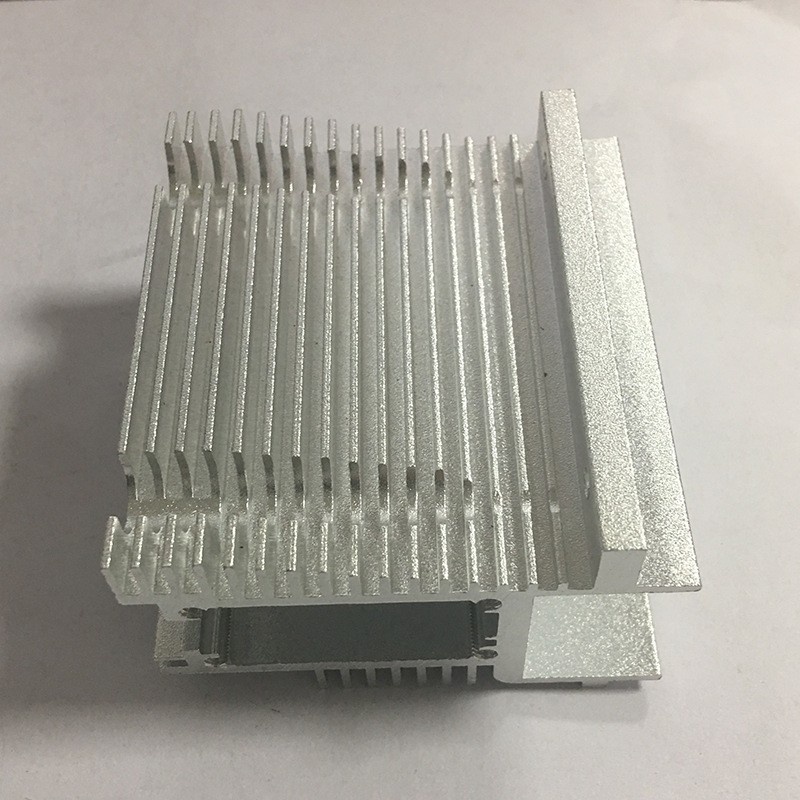
High density tooth radiator aluminum profile mold opening
High-density tooth radiator aluminum profile, specially developed for AI inference servers, edge computing workstations,
Product Details
High-density tooth radiator aluminum profile, specially developed for AI inference servers, edge computing workstations, GPU servers and other scenarios. High-density tooth radiator profiles have complex cross-sectional shapes, large tongue ratio (cantilever: tooth spacing), difficult mold design, and low mold test success rate. The denser the teeth, the longer and thinner the cantilever of the mold. When squeezing, the metal impact force is concentrated at the root of the cantilever, and a little care is taken that the teeth collapse, crooked teeth, and tooth tip fill are not full. The key to die design is to reduce the impact of metal extrusion on the cantilever through reasonable metal distribution supply and flow rate adjustment.
This product focuses on the core requirements of air-cooled heat dissipation for profiles with "high heat dissipation density, low wind resistance and high forming accuracy". It provides one-stop mold opening customization services from tooth topology optimization, CAE metal flow simulation, mold development, isothermal extrusion to precision deep processing.
01 Quality starts with raw materials
It is produced with A00 primary aluminum ingot, does not contain scrap aluminum, has stable thermal conductivity, and has strong heat dissipation performance with batches of products. Conventional air-cooled scenarios use 6063-T5 aluminum alloy, which has good formability and high cost performance. High-power scenarios can use 1070 pure aluminum, which has better thermal conductivity and improved heat dissipation performance by more than 10%. Heavy-duty installation scenarios use 6061-T6 high-strength aluminum alloy, which has strong rigidity and is not easy to deform.
02 CAE simulation and exclusive mold design for high-density teeth
In view of the complex cross-sectional shape and large tongue ratio of high-density tooth radiator profiles, CAE metal flow simulation technology is used to optimize the tooth topology and mold runner, rationally distribute the metal flow rate, and reduce the impact on the cantilever during extrusion. Each high-density tooth section is independently designed with its own die. The mold is formed by vacuum heat treatment of H13 hot working mold steel to ensure tooth profile accuracy and mold life.
03 Isothermal extrusion and precision molding
The isothermal extrusion process is adopted to achieve a complex tooth profile structure with ultra-thin teeth and large aspect ratio. The minimum tooth thickness can reach 0.5mm, the maximum tooth height is 60mm, and the tooth height ratio can reach up to 15: 1. The tooth profile is uniform, and there are no tooth chipping and crooked tooth defects, which ensures that the air duct is uniform and smooth. The tooth thickness deviation is controlled within ± 0.03 mm, and the forming does not have the problem of missing collapsed teeth. Tooth straightness ≤ 0.3mm/m, substrate flatness ≤ 0.05 mm/100mm.
04 Low Stress Stabilization Process
Strictly implement the two-stage constant temperature aging process to fully release the internal residual stress of the profile, and the amount of warpage and deformation of the substrate after machining is extremely small. The flatness of the substrate is ≤ 0.05 mm/100mm, which ensures the close fit of the heat sink and the chip, and effectively reduces the contact thermal resistance.
05 High-precision CNC machining
Equipped with precision equipment such as a five-axis CNC machining center, it can complete deep processing processes such as tooth top finishing of high-density tooth radiators, substrate plane finishing, installation hole drilling and tapping, and heat pipe groove machining. The machining accuracy is ± 0.01-0.005mm, and the stroke of multiple imported machine tools and ultra-long aluminum profile machining centers is up to 6.5 meters.
Processing capacity parameters:
| Item | Parameters/Description |
|---|---|
| Applicable Scenario | AI inference server, edge computing station, GPU server, 5G base station AAU, high power led |
| Optional Materials | 6063-T5 high thermal conductivity aluminum alloy, 1070 pure aluminum, 6061-T6 high strength aluminum alloy |
| Execution standards | GB/T 6892-2023 High Precision |
| Cross-sectional Range | Width 30mm-400mm |
| Tooth Profile Structure | Comb teeth, staggered teeth, needle fins, oblique teeth, etc. |
| Minimum tooth thickness | 0.5mm |
| Maximum tooth height | 60mm |
| Tooth height ratio | Up to 15: 1 |
| Tooth Thickness Tolerance | ± 0.03 mm |
| Tooth Spacing Tolerance | ± 0.05 mm |
| Installation datum tolerance | ± 0.05 mm |
| Substrate Flatness | ≤ 0.05 mm/100mm |
| Tooth Straightness | ≤ 0.3mm/m |
| Surface Finishing | Natural anodic oxidation, black anodic oxidation, high radiation heat dissipation coating, conductive oxidation |
| Deep processing support | CNC cutting, drilling and tapping, substrate grinding, deburring, heat pipe grooving |
| Mold Opening Cycle | Conventional structure 7-10 days sampling |
| Batch delivery date | 10-15 days after sample confirmation |
| MOQ | Support 50kg R&D proofing |
| Origin of production | Shanghai Qingpu |
High-density tooth radiator selection reference:
| Application Scenarios | Recommended Materials | Recommended tooth profile |
|---|---|---|
| AI inference server air cooling | 6063-T5 | High-density comb teeth |
| GPU Server Air Cooling Module | 6063-T5/1070 Pure Aluminum | Staggered teeth |
| Edge Computing Station | 6063-T5 | Needle Fin Teeth |
| 5G base station AAU cooling | 6061-T6 | Helical tooth |
| High Power led Heatsink | 6063-T5 | High-density comb teeth |
Typical scenarios:
AI inference server air-cooled radiator
Edge Computing Station Heatsink
GPU Server Air Cooling Module
Heat dissipation profiles for small and medium-sized computing stations
Heat dissipation of AI industrial vision equipment
5G base station AAU radiator
High Power led Heatsink
Cooling profiles for communication equipment
Radiator for industrial control equipment
FAQ (Frequently Asked Questions)
Q1: What is the difference between high-density tooth radiator aluminum profiles and ordinary radiator aluminum profiles?
A: The teeth of high-density tooth radiator profiles are thinner, the tooth spacing is smaller, and the tooth height ratio is larger - the minimum tooth thickness can reach 0.5mm, and the tooth height ratio can reach up to 15: 1. More heat dissipation teeth are arranged on the limited substrate area, and the heat dissipation area is increased by more than 40% compared with ordinary profiles. However, the design of high-density tooth molds is difficult. The denser the teeth, the longer and thinner the cantilever of the mold. During extrusion, the metal impact force is concentrated at the root of the cantilever, which is prone to defects such as tooth collapse, crooked teeth, and incomplete tooth tip filling. Our company adopts CAE metal flow simulation and isothermal extrusion process to effectively solve the problem of high-density tooth forming, and the tooth thickness deviation is controlled within ± 0.03 mm.
Q2: What is the tooth height ratio of the high-density tooth radiator aluminum profile?
A: Tooth height ratio up to 15: 1 (tooth height 60mm/tooth thickness 0.5mm). A high gear ratio means that a larger heat dissipation area is obtained on a limited substrate area, and the heat dissipation efficiency is higher. However, the larger the tooth height ratio, the longer and thinner the die cantilever, and the more difficult it is to squeeze. By optimizing the tooth topology and mold runner design, our company reasonably distributes the metal flow rate, reduces the impact on the cantilever during extrusion, and ensures the forming quality of high gear ratio profiles.
Q3: What materials can be used for high-density tooth radiator aluminum profiles?
A: Conventional air-cooled scenarios use 6063-T5 aluminum alloy, which has good formability and high cost performance. High-power scenarios can use 1070 pure aluminum, which has better thermal conductivity and improved heat dissipation performance by more than 10%. Heavy-duty installation scenarios use 6061-T6 high-strength aluminum alloy, which has strong rigidity and is not easy to deform. It is produced with A00 primary aluminum ingot, does not contain scrap aluminum, has stable thermal conductivity, and has strong heat dissipation performance with batches of products.
Q4: What is the minimum tooth thickness of a high-density tooth radiator aluminum profile?
A: The minimum tooth thickness can reach 0.5mm, and the tooth thickness deviation is controlled within ± 0.03 mm. The thinner the teeth, the more the number of cooling teeth and the larger the cooling area, but the longer and thinner the die cantilever, the more difficult it is to extrude. Through the isothermal extrusion process and precision mold design, our company ensures the forming accuracy of ultra-thin teeth, without tooth chipping, crooked teeth, and collapsed teeth defects, and ensures a uniform and smooth air duct.
Q5: What is the mold opening cycle and delivery time of high-density tooth radiator aluminum profiles?
A: The conventional structural mold opening cycle is 7-10 days, and the samples are delivered 10-15 days after the batch delivery date is confirmed. Due to the complex cross-sectional shape and difficult mold design of high-density tooth radiator profiles, it is recommended to communicate the tooth shape structure (comb teeth, staggered teeth, needle fins, oblique teeth, etc.) and heat dissipation requirements in advance.
GET A QUOTE
Once you have submitted your requirements, we will contact you as soon as possible regarding your product inquiry.:High density tooth radiator aluminum profile mold opening