
Automated logistics
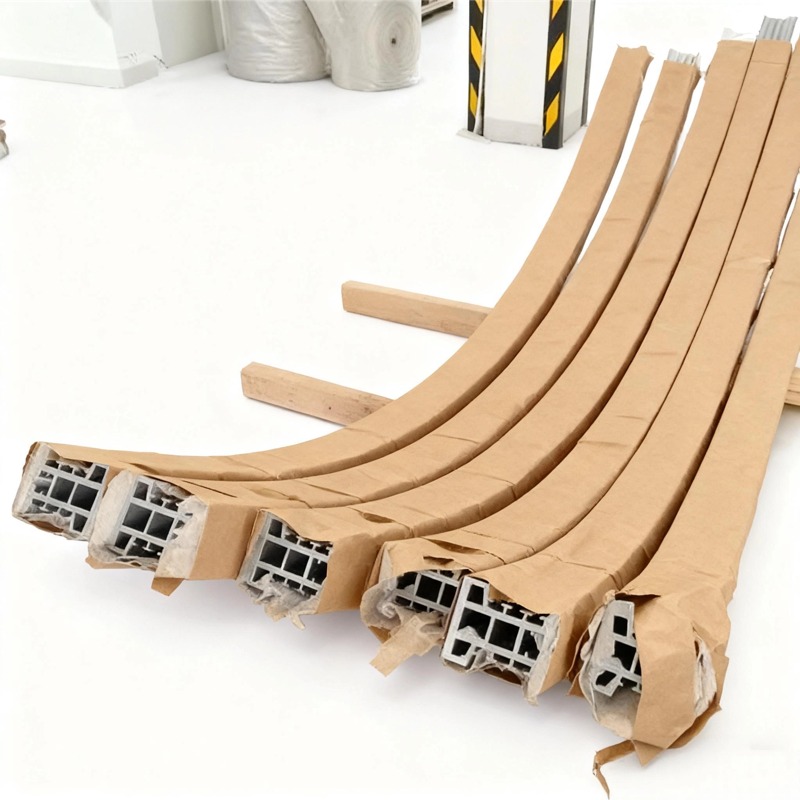
RGV Curved Rail
Does the RGV vehicle stutter when cornering as it runs continuously around a circular path? Does the curved rail arc deviation increase lateral forces on the vehicle and accelerate wheel wear? Do ordinary bent rail joints sit unevenly, causing obvious imp
Product Details
Does the RGV vehicle stutter when cornering as it runs continuously around a circular path? Does the curved rail arc deviation increase lateral forces on the vehicle and accelerate wheel wear? Do ordinary bent rail joints sit unevenly, causing obvious impact as the vehicle passes?
If curved rail accuracy is insufficient, the RGV will not run smoothly, will not stop accurately and will fail quickly.
In intelligent warehousing, automated logistics, robotics and other fields, RGV rail-guided vehicles need to run continuously around circular paths. Traditional straight rails cannot meet curved path needs, so aluminum profiles must be processed into specific arcs through rolling, roll bending and other processes.
Using 6063-T5 or 6061-T6 high-strength aluminum alloy, CNC precision roll bending forming,arc accuracy ≤0.5°, bend error ≤±0.4mm,minimum turning radius can reach 1000mm. Straight and curved sections splice seamlessly with uniform arc and small joint gaps, so the vehicle corners smoothly without stutter, avoiding problems of large arc deviation, vehicle stutter and derailment common to ordinary bent rails. The rail cross-section can integrate guide slots, mounting positions and other functional structures in one-piece extrusion. We supportS-shape, circular, U-shape, L-shapeand other trajectory customizations. The rail working surface can receive hard anodizing wear treatment, suited to high-frequency reciprocating handling conditions.
Core Advantages at a Glance:
| Advantage Dimension | Technical Indicator | Customer Value |
|---|---|---|
| 🎯 High-Precision Arc | Arc accuracy≤0.5°, bend error≤±0.4mm | Smooth cornering without stutter |
| 🔄 Small Turning Radius | Minimum1000mm | Suited to compact space layouts |
| 🔧 Seamless Splicing | Straight and curved sectionsseamlessly spliced | No impact as the vehicle passes |
| 📐 Multi-Trajectory Customization | S-shape / circular / U-shape / L-shape | Suited to various production line layouts |
| 🛡️ Wear Resistance Enhancement | Hard anodizing | Low wear under high-frequency cycling |
| ⚡ Fast Delivery | Samples in 7-10 days for standard arcs, MOQ 50kg | Controllable project schedule |
RGV Curved Rail vs. Straight Rail:
| Comparison Dimension | RGV Curved Rail | Straight Rail |
|---|---|---|
| Travel Path | Curved / circular / cornering | Straight |
| Core Accuracy | Arc accuracy ≤0.5°, bend error ≤±0.4mm | Straightness ≤1.0mm/10m |
| Process Difficulty | High(extrusion + roll bending + splicing) | General (extrusion + precision cut) |
| Key Requirement | Smooth cornering, no stutter or impact | Smooth long-distance straight running |
| Applicable Scenarios | Circular conveying / corner reversal | Straight conveying |
Aluminum Alloy RGV Curved Rail vs. Steel Curved Rail:
| Comparison Dimension | Aluminum Alloy Curved Rail | Steel Curved Rail |
|---|---|---|
| Density | 2.7g/cm³ | 7.8g/cm³ |
| Weight | Light | Heavy |
| Arc Accuracy | ≤0.5° | 1-2° |
| Bend Error | ±0.4mm | ±1-2mm |
| Splicing Method | Seamless splicing | Welded or bolted splicing |
| Corrosion Resistance | Excellent(anodized) | Poor (requires oil coating for rust prevention) |
| Installation Convenience | High | Low |
| Operating Noise | Low | High |
Curved Rail Trajectory Type Comparison:
| Trajectory Type | Structural Features | Typical Application |
|---|---|---|
| S-shape | Two curved rail segments in opposite directions | Production line reversal, bypass conveying |
| Circular | Closed loop formed by alternating curved and straight segments | Circular intelligent warehousing, continuous cyclic conveying |
| U-shape | U-shape formed by two curved segments and one straight segment | Production line end turn-around, compact space rotation |
| L-shape | One 90-degree curved segment + two straight segments | Right-angle turning conveying |
Selection Reference:
| Application | Recommended Material | Recommended Load | Key Requirements |
|---|---|---|---|
| Circular intelligent warehousing | 6061-T6 | 300-500kg | Arc accuracy ≤0.5°, circular closed loop |
| Electronic cyclic production lines | 6063-T5 | ≤300kg | Smooth arc, stable running |
| Parcel sorting centers | 6061-T6 | 300-500kg | High-frequency operation, good wear resistance |
| Closed-loop flexible conveyor lines | 6061-T6 | ≤500kg | Multi-trajectory combination, high splicing accuracy |
| Automated conveyor line curved rails | 6063-T5 | ≤300kg | Small turning radius, smooth splicing |
Typical Applications:
-
Circular intelligent warehousing rail systems
-
Curved rails for electronic cyclic production lines
-
Curved guide rails for automated conveyor lines
-
Circular rails for parcel sorting centers
-
RGV circular rail-guided vehicle systems
-
Closed-loop flexible conveyor lines
-
S-shaped curved rails for production line reversal
-
U-shaped turn-around rails for compact spaces
FAQ (Frequently Asked Questions)
Q1: What is the difference between RGV curved rails and straight rails?
A: Straight rails are for RGV vehicles traveling along straight paths, with a relatively simple process mainly controlling straightness. Curved rails are for RGV vehicles traveling on circular and curved paths, requiring straight profiles to be formed into specific arcs through CNC precision roll bending. The arc accuracy, bend error, and splicing quality of straight and curved sections on a curved rail directly determine whether the vehicle corners smoothly without stutter.
Q2: What arc accuracy and bend error can curved rails achieve?
A: Formed by CNC precision roll bending, arc accuracy is ≤0.5° and bend error is ≤±0.4mm. Curved rails are specially made in various radius and length combinations, with straight and curved sections spliced seamlessly, so the vehicle runs smoothly without stutter or noise.
Q3: What is the minimum turning radius?
A: The minimum turning radius can reach1000mm.When the RGV system lays out circular tracks within limited workshop space, a smaller turning radius effectively reduces footprint and improves space utilization. The smaller the turning radius, the higher the requirements on rail machining accuracy and the RGV steering system; if space allows, we recommend a larger turning radius to ensure smooth vehicle running.
Q4: What is the difference between S-shape, circular and U-shape trajectories?
A: The S-shape trajectory consists of two curved rail segments in opposite directions, used for RGV reversal or bypass between different production line positions; the circular trajectory is a closed loop of alternating curved and straight segments for continuous RGV cyclic running; the U-shape trajectory is a U-shaped path of two curved segments and one straight segment, used for RGV turn-around at both ends of a production line. We can customize various trajectory combinations based on your production line layout.
Q5: Should curved rails use 6063-T5 or 6061-T6?
A: 6063-T5 has good formability and high surface finish, suitable for standard loads (≤300kg) and standard arcs; 6061-T6 has higher strength with a yield strength ≥240MPa, suited to heavy loads (300kg-500kg) or curved conditions requiring higher load-bearing and impact resistance. Under curved conditions, cornering generates centrifugal forces on the vehicle, imposing higher rail strength requirements than straight rails; for heavy-load or high-speed scenarios, we recommend 6061-T6.
Q6: What is the MOQ and lead time for curved rails?
A: MOQ50kg. Standard arcssamples in 7-10 days, bulk lead time after sample confirmation7-10 days. Curved rails involve CNC roll bending, so we recommend providing production line layout drawings and turning radius requirements in advance.
Get Your Solution Now
Contact Manager Du:13611846009
Provide production line layout drawings or turning radius requirements, and our engineering departmentwithin 2 hourswill deliver the curved rail solution assessment.
Free Technical Consultation | RGV Curved Rail Solution Design | Direct from Source Factory

GET A QUOTE
Once you have submitted your requirements, we will contact you as soon as possible regarding your product inquiry.:RGV Curved Rail