
Automated logistics
Overhead Suspended Rail
Is your workshop floor crowded with conveyor lines and equipment, with no space left? Is overhead material handling still manual — inefficient and unsafe? Want robots to run overhead for operations, but cannot find suitable rails? Overhead rails move wor
Product Details
Is your workshop floor crowded with conveyor lines and equipment, with no space left? Is overhead material handling still manual — inefficient and unsafe? Want robots to run overhead for operations, but cannot find suitable rails?
Overhead rails move workshop material conveying from the floor to the air.
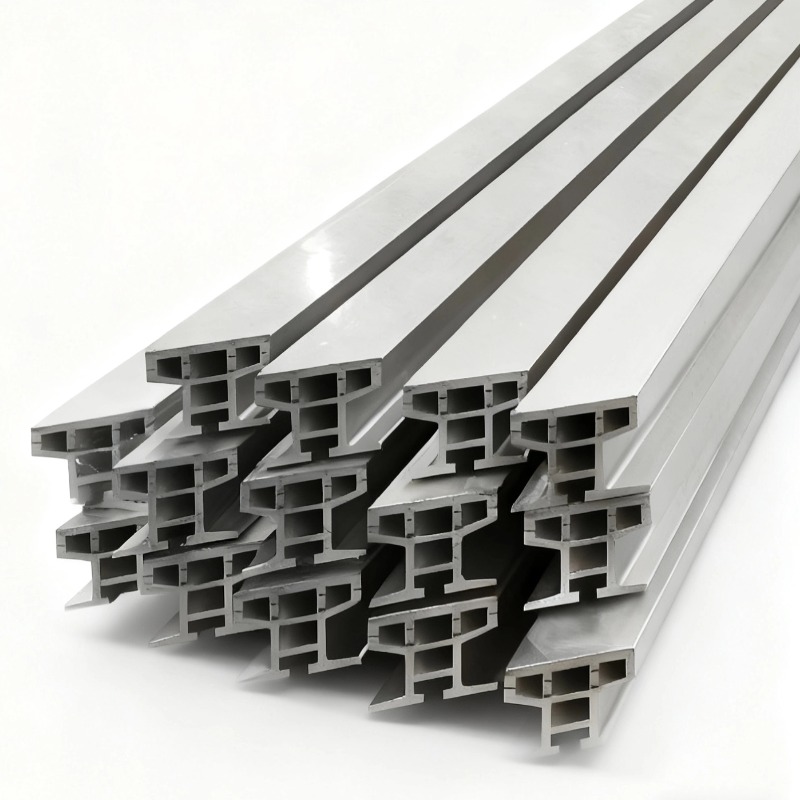
Overhead rails (suspended overhead tracks) are core infrastructure for automated material conveying and lifting in modern factories. Suspended from the workshop ceiling, they provide running tracks for traveling trolleys, trolleys, robots, and lifting devices, enabling automated overhead material conveying and inter-workstation transfer, greatly reducing floor space occupancy and improving workshop space utilization.
Material is 6063-T5 or 6061-T6 high-strength aluminum alloy, die-extruded, with advantages including light weight, high strength, good straightness, and corrosion resistance. Rail cross-sections can be designed as I-shaped, Wang-shapedand other structures, integrating mounting slots, guide grooves, and other functions. CNC precision machining,straightness ≤1.0mm/10m, dimensional tolerance±0.02mm to ±0.04mm. Surface anodizing provides corrosion resistance, wear resistance, and extended service life. Suitable for workshop overhead material conveying, automated production line lifting, robot overhead rail travel, overhead conveyor lines, inter-workstation overhead handling, and light-duty lifting equipment guide rails.
Core advantages at a glance:
| Advantage dimension | Technical specification | Customer value |
|---|---|---|
| 🏗️ Overhead suspension | Suspended above the workshop | Utilizes upper-level space, reduces floor occupancy |
| 🔧 Multiple cross-sections | I-shaped / Wang-shaped / custom cross-section | Adapted to different load-bearing and installation needs |
| 🎯 High precision | Straightness≤1.0mm/10m, tolerance ±0.02mm to ±0.04mm | Trolley runs smoothly |
| 🛡️ Anodizing | Corrosion and wear resistant | Extended service life, maintenance-free |
| 📐 Wide range | Weight per meter0.05-100kg/m, circumscribed circle5-700mm | Full coverage from light to heavy duty |
| ⚡ Fast delivery | 7-10 days for conventional specification samples, 50kg minimum order | Controllable project timeline |
Overhead rail vs. floor rail:
| Comparison dimension | Overhead rail | Floor rail |
|---|---|---|
| Space utilization | Overhead (uses upper-level space) | Floor (occupies floor area) |
| Floor occupancy | None | Yes |
| Applicable scenarios | Overhead material conveying / robot travel | Floor travel / floor rail conveying |
| Installation method | Ceiling suspension / steel structure fixation | Floor fixation / embedded |
| Space utilization rate | High | Standard |
I-shaped vs. Wang-shaped cross-section:
| Comparison dimension | I-shaped cross-section | Wang-shaped cross-section |
|---|---|---|
| Structural features | Top/bottom flanges + single web | Top/bottom flanges + double webs |
| Structural rigidity | Good | Higher |
| Applicable scenarios | Most overhead rail scenarios | Long span / heavy duty / robot overhead rails |
| Load-bearing capacity | Standard | Stronger |
| Recommended scenarios | Conventional overhead conveying | Robot travel / heavy-duty lifting |
Applicable scenarios (choose accordingly):
| Application field | Typical use | Recommended cross-section | Key requirements |
|---|---|---|---|
| Workshop overhead material conveying | Overhead conveyor systems | I-shaped | Lightweight, good straightness |
| Automated production line lifting | Production line overhead lifting rails | I-shaped / Wang-shaped | Stable load-bearing, smooth running |
| Robot overhead rail travel | Robot overhead travel rails | Wang-shaped | High rigidity, high precision |
| Overhead conveyor lines | Continuous overhead conveying | I-shaped | Long distance, low noise |
| Inter-workstation overhead handling | Overhead handling rails | I-shaped | Flexible layout, easy installation |
| Light-duty lifting equipment guide rails | Tool rails / lifting device tracks | I-shaped | Lightweight, low cost |
01 A00 Primary Aluminum Ingot — the Quality Source of Overhead Rails
Produced usingA00-grade primary aluminum ingot, containing no scrap aluminum, with uniform material properties and stable mechanical performance, ensuring fatigue resistance and dimensional stability of overhead rails under long-term suspended operation.
02 High-Strength Aluminum Alloy Extrusion — Multiple Cross-Section Options
Die-extruded from high-strength aluminum alloy, rail cross-sections can be designed as I-shaped, Wang-shapedand other structures, integrating mounting slots, guide grooves, and other functions.
-
Weight per meter from0.05kg/mto100kg/m
-
Circumscribed circle from5mmto700mmall customizable
-
Full coverage from light to heavy duty
03 High-Precision Machining and Straightness Control — Smooth Trolley Operation
ThroughCNC precision machining, the rail surface is flat and burr-free, with low deformation.
-
Straightness precision≤1.0mm/10m
-
Dimensional tolerance±0.02mm to ±0.04mm
-
Ensures overhead rail trolley runs smoothly
04 Anodizing — Corrosion and Wear Resistant
Surface treated withanodizing, dust and corrosion resistant, with strong corrosion resistance and low friction coefficient, extending service life and adapted to normal workshop conditions.
05 Full-Process One-Stop Delivery — Single Point of Contact
From mold development and extrusion to CNC precision machining and surface treatmentone-stop delivery, customers deal with only one supplier. Custom rail cross-section dimensions, rail lengths, and installation methods per drawings, reducing on-site machining.
Complete machining capability parameters:
| Item | Parameter / Description |
|---|---|
| Applicable scenarios | Workshop overhead material conveying, automated production line lifting, robot overhead rail travel |
| Alloy material | 6063-T5 / 6061-T6 |
| Rail type | Straight overhead rails, curved overhead rails, circular overhead rails |
| Cross-section structure | I-shaped, Wang-shaped, custom cross-section |
| Straightness | ≤1.0mm/10m |
| Dimensional tolerance | ±0.02mm to ±0.04mm |
| Weight per meter range | 0.05-100kg/m |
| Circumscribed circle range | 5-700mm |
| Surface treatment | Anodizing |
| Installation method | Ceiling suspension, steel structure fixation |
| Customization range | Rail length, cross-section dimensions, and mounting holes all customizable |
| Extrusion length | Maximum20M |
| Extrusion equipment | 600T-12000T (partner production lines) |
| Machining equipment | CNC machining centers |
| Execution standard | GB/T 6892-2023, ISO9001 |
| Minimum order quantity | 50kg |
| Production location | Qingpu, Shanghai |
Typical application scenarios:
-
Workshop overhead material conveying systems
-
Automated production line lifting rails
-
Robot overhead rail travel systems
-
Overhead conveyor lines
-
Inter-workstation overhead handling rails
-
Light-duty lifting equipment guide rails
-
Tool rails / lifting device tracks
FAQ (Frequently Asked Questions)
Q1: What is the difference between overhead rails and EMS rails?
A: Overhead rail is a general category referring to various lifting rails suspended above the workshop, used to carry trolleys, lifting devices, robots, and other equipment for overhead operation. EMS rail is a specific application form of overhead rail, specifically referring to the load-bearing rail of an electric monorail system, equipped with conductor bar power pickup, car sets, switches, and a complete system. In simple terms: EMS rail is a subclass of overhead rail — all EMS rails are overhead rails, but not all overhead rails are EMS rails. Both are customizable, and selection is based on the customer's automation solution.
Q2: What material is used for overhead rails? How to choose between 6063-T5 and 6061-T6?
A: Our overhead rails support both 6063-T5 and 6061-T6 materials. 6063-T5 has good formability and high surface finish, suitable for conventional loads (≤500kg) and scenarios with appearance requirements. 6061-T6 has yield strength ≥240MPa after T6 heat treatment, suitable for heavy loads (500kg-1000kg) or scenarios with higher load-bearing and impact resistance requirements. Robot overhead rail travel systems are recommended to use 6061-T6; light-duty lifting guide rails can use 6063-T5.
Q3: What is the difference between I-shaped and Wang-shaped cross-sections? How to choose?
A: The I-shaped cross-section is the most common overhead rail form, with a simple structure, good load-bearing, and easy installation, suitable for most overhead rail scenarios. The Wang-shaped cross-section adds a middle web on the basis of the I-shape, providing stronger structural rigidity, suitable for larger spans or higher load-bearing requirements. For general scenarios, I-shaped is sufficient; for long-span heavy-duty scenarios, Wang-shaped is recommended.
Q4: What should be noted during overhead rail installation?
A: Overhead rails are suspended overhead and have high installation precision and structural safety requirements. Before installation, confirm that the workshop ceiling load-bearing structure meets overhead rail load requirements; use a laser alignment instrument to calibrate straightness and levelness during installation; control rail joint gaps to ≤0.5mm; tightening torque of lifting bolts must meet design requirements. Professional installation teams are recommended; we can provide installation technical guidance.
Q5: What is the load range of overhead rails?
A: Overhead rail load range is determined by cross-section dimensions, material, and wall thickness. Generally, light-duty overhead rails have a load capacity ≤500kg, medium-duty 500kg-1000kg, and heavy-duty over 1000kg. Specific selection requires comprehensive calculation based on trolley weight, lifted material weight, and running speed. We can provide selection recommendations and load-bearing capacity calculations.
Q6: What is the maintenance cycle for overhead rails?
A: We recommend a routine inspection every quarter: check whether rail straightness and levelness have changed, check rail joints for loosening or gap widening, check lifting bolts for loosening, and check the running surface for abnormal wear. Promptly adjust or replace when abnormalities are found to effectively ensure long-term safe operation and service life of the overhead rail system.
Q7: Can overhead rails be customized as curved or circular tracks?
A: Yes. We support customization of straight overhead rails, curved overhead rails, and circular overhead rails. Curved overhead rails are formed by CNC precision roll bending, with curving error ≤±0.4mm, arc accuracy ≤0.5°, and curved-to-straight joint gaps ≤0.5mm, for smooth trolley operation. The minimum turning radius is determined by overhead rail cross-section dimensions; customers can provide drawings for our engineering department to evaluate.
Get a solution now
📞 Contact Manager Du:13611846009
Provide workshop layout drawings or overhead rail load requirements; the engineering departmentwithin 2 hourswill provide overhead rail solution assessment.
Free technical consultation | Overhead rail solution design | Direct from source factory

GET A QUOTE
Once you have submitted your requirements, we will contact you as soon as possible regarding your product inquiry.:Overhead Suspended Rail