
Automated logistics
Climbing Robot Rail
Are rack heights in parcel sorting centers limited by manual operation, with warehouse floor space always insufficient? Do climbing robots shake and wobble during vertical ascent, affecting pick-and-place accuracy? The advent of climbing robot rails has
Product Details
Are rack heights in parcel sorting centers limited by manual operation, with warehouse floor space always insufficient? Do climbing robots shake and wobble during vertical ascent, affecting pick-and-place accuracy?
The advent of climbing robot rails has moved warehousing logistics from 2D to 3D.
Parcel automated sorting and intelligent warehousing are undergoing an upward-growth revolution. Traditional warehousing is limited by floor space, with rack heights constrained by manual operation. The emergence of climbing robot systems breaks this limit: robots can not only move horizontally on the ground but also climb vertically along stereoscopic racks, achieving efficient material handling between any two points in 3D space.
Cainiao's self-developed ZeeBot climbing robot reaches a horizontal speed of 4 meters per second and can climb to a 5-story rack height in 10 seconds, boosting storage space utilization by 40% to reach 48 boxes per square meter. The ZSTORE 3D tote climbing robot solution can provide up to 12 meters of stereoscopic storage space, improving storage density by about 20% over traditional solutions.
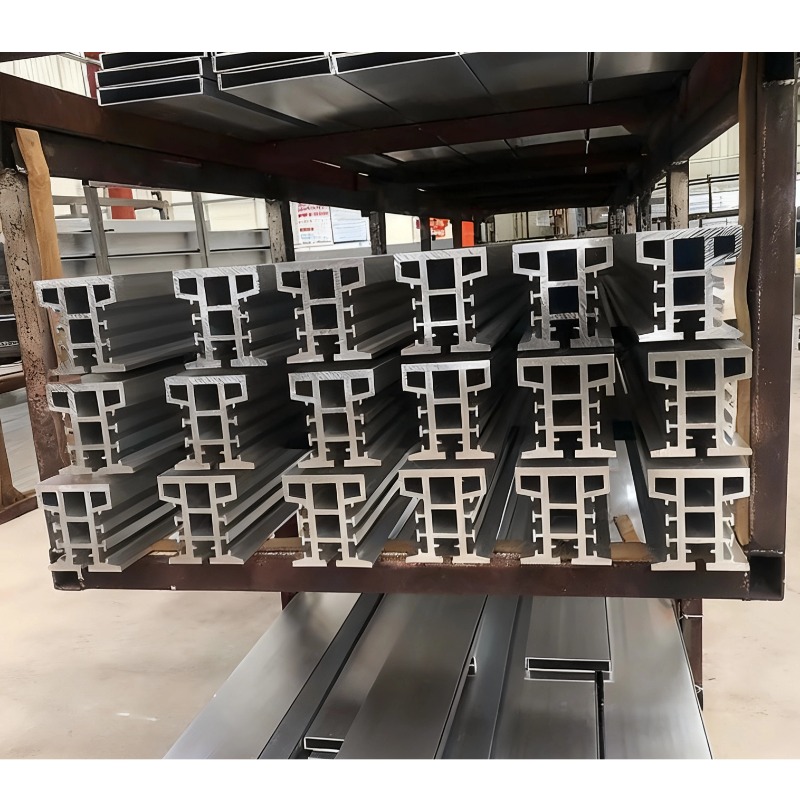
The climbing rail is the core load-bearing component of this system. This product is developed for parcel automated sorting centers and intelligent warehousing stereoscopic rack systems, purpose-built with custom travel and climbing rail profiles for climbing robots.
The material is 6063-T5 or 6061-T6 high-strength aluminum alloy, combining lightweight, high precision and wear resistance. CNC one-piece finishing, straightness≤1.0mm/10m, dimensional tolerance±0.02mm to ±0.04mm. Custom cross-sections such as straight rails, curved rails and climbing rails are available, integrating functional structures such as guide slots, mounting positions and sensor mounting grooves in one-piece extrusion. The rail working surface receives hard anodizing wear treatment, suited to the high-frequency reciprocating climbing and handling conditions of climbing robots.
Core Advantages at a Glance:
| Advantage Dimension | Technical Indicator | Customer Value |
|---|---|---|
| 🏗️ Stereoscopic Warehousing | Suitable for up to12 metersstereoscopic racks | Storage space utilization improved40% |
| 🎯 High Precision | Straightness≤1.0mm/10m, tolerance ±0.02mm to ±0.04mm | Smooth climbing, accurate pick-and-place |
| 🛡️ Wear Resistance Enhancement | Hard anodizing wear treatment | Low wear under high-frequency climbing, long life |
| 🔧 Functional Integration | Guide slots / mounting positions / sensor card slots, one-piece extruded | Reduced post-processing, easy installation |
| ⚡ Fast Delivery | Samples in 7-10 days for standard specifications, MOQ 50kg | Controllable project schedule |
Climbing Robot Rail vs. Ordinary AGV Rail:
| Comparison Dimension | Climbing Robot Rail | Ordinary AGV Rail |
|---|---|---|
| Movement Dimension | 3D (horizontal + vertical) | 2D (horizontal only) |
| Maximum Height | Up to 12 meters | Ground level |
| Precision Requirement | Very high(climbing conditions) | General |
| Wear Requirement | Very high(high-frequency climbing) | General |
| Fatigue Strength | Very high(vertical load + impact) | General |
| Applicable Scenarios | Stereoscopic racks / parcel sorting | Ground flat conveying |
Climbing Robot System vs. Traditional Warehousing:
| Comparison Dimension | Climbing Robot System | Traditional Warehousing |
|---|---|---|
| Space Utilization | 3D stereoscopic | 2D flat |
| Storage Density | Improved by 40%(up to 48 boxes/sqm) | Baseline |
| Rack Height | Up to 12 meters | Limited by manual operation |
| Handling Efficiency | High speed(ZeeBot horizontal 4m/s, 10 seconds to 5 floors) | General |
| Applicable Scenarios | Parcel sorting / e-commerce warehousing | General warehousing |
Applicable Scenarios (Matching):
| Application Field | Typical Use | Adaptable Height | Key Requirements |
|---|---|---|---|
| Parcel automated sorting centers | Climbing robot travel and climbing rails | 5-12 meters | High precision, wear resistance, fatigue resistance |
| Intelligent warehousing stereoscopic racks | Stereoscopic rack climbing guide rails | 5-12 meters | Straightness, perpendicularity |
| E-commerce warehousing stereoscopic storage systems | 3D tote climbing robot rails | 5-12 meters | High-frequency operation, precise positioning |
| Cross-belt sorting robots | Rail curved arc sections | 3-8 meters | Arc accuracy, smooth splicing |
| Logistics sorting centers | Circular/climbing composite rails | 5-10 meters | Composite paths, multi-directional travel |
01 A00 Primary Aluminum Ingot: the Quality Source of Climbing Rails
Produced fromA00-grade primary aluminum ingotwith no scrap aluminum, the material is uniform with stable mechanical properties, ensuring the fatigue strength and dimensional stability of climbing rails under long-term high-frequency climbing conditions. Climbing conditions impose extremely high fatigue strength requirements on the rail, and the dense structure of primary aluminum ingot is key to ensuring the rail bears long-term loads without deformation.
02 High-Precision CNC Machining: Smooth and Accurate Climbing
ThroughCNC one-piece finishing, the rail surface is flat and burr-free, with low deformation.
-
Straightness accuracy≤1.0mm/10m
-
dimensional tolerance±0.02mm to ±0.04mm
-
ensures running smoothness and positioning accuracy of the climbing robot during vertical climbing and horizontal movement
03 Wear Resistance Treatment: Low Wear Under High-Frequency Climbing
The rail working surface can receivehard anodizing wear treatment, with high surface hardness and good wear resistance.
-
Suited to high-frequency reciprocating climbing and handling conditions of climbing robots
-
Low long-term operating wear, low maintenance cost
-
Hard anodized layer HV ≥300, wear resistance more than 3 times that of ordinary anodizing
04 Functional Structure Integration Design: Easy Installation
The rail cross-section can integrateguide slots, mounting positions, sensor mounting groovesand other functional structures, one-piece extruded, reducing post-processing steps for easy installation.
05 Full-Process One-Stop Delivery: Only One Contact Point
From mold development, extrusion and CNC finishing to surface treatmentone-stop delivery, so customers only deal with one supplier. We support custom rail cross-section dimensions, rail length and curved rail arc from drawings.
Full Machining Capability Parameters:
| Item | Parameter / Description |
|---|---|
| Applicable Scenarios | Parcel sorting center climbing rails, intelligent warehousing stereoscopic rack guide rails, climbing robot accessories |
| Alloy Material | 6063-T5 / 6061-T6 |
| Rail Form | Straight rails, curved rails, climbing rails |
| Straightness | ≤1.0mm/10m |
| Dimensional Tolerance | ±0.02mm to ±0.04mm |
| Surface Treatment | Anodizing, hard anodizing (working surface wear treatment) |
| Functional Integration | Guide slots, mounting positions, sensor mounting grooves |
| Customization Range | Rail length, cross-section dimensions and curved rail arc are all customizable |
| Extrusion Length | Maximum20M |
| Extrusion Equipment | 600T-12000T (partner production lines) |
| Machining Equipment | CNC machining center |
| Executive Standard | GB/T 6892-2023, ISO9001 |
| MOQ | 50kg |
| Production Location | Qingpu, Shanghai |
Typical Applications:
-
Climbing rails for parcel automated sorting centers
-
Rail curved arcs for cross-belt sorting robots
-
Climbing guide rails for intelligent warehousing stereoscopic racks
-
Accessory rails for Cainiao ZeeBot-type climbing robots
-
E-commerce warehousing stereoscopic storage systems
-
Circular/climbing composite rails for logistics sorting centers
FAQ (Frequently Asked Questions)
Q1: What is the difference between climbing robot rails and ordinary AGV rails?
A: Climbing robot rails are dedicated to stereoscopic warehousing; the robot can not only move horizontally on the ground but also climb vertically along stereoscopic racks (up to 12 meters), achieving material handling in 3D space. Ordinary AGV rails are ground-level flat travel rails supporting horizontal movement only. Climbing rails have extremely high requirements for straightness (≤1.0mm/10m), wear resistance and structural strength, because the robot bears vertical loads and dynamic impact while climbing. We can customize both types of rails.
Q2: What advantages does the climbing robot system have over traditional warehousing?
A: The climbing robot system breaks the limitation of traditional warehousing by floor space, achieving upward growth. Cainiao's self-developed ZeeBot climbing robot reaches a horizontal speed of 4m/s and can climb to a 5-story rack in 10 seconds, boosting storage space utilization by 40% to reach 48 boxes per square meter. The ZSTORE 3D tote climbing robot provides up to 12 meters of stereoscopic storage space, improving storage density by about 20% over traditional solutions.
Q3: What material is used for climbing robot rails?
A: Our climbing rails support both 6063-T5 and 6061-T6. 6063-T5 has good formability and high surface finish, suitable for standard loads and typical applications; 6061-T6, after T6 heat treatment, has a yield strength ≥240MPa and stronger impact resistance, suited to heavy-load or high-frequency climbing conditions. Climbing conditions impose extremely high fatigue strength requirements, so we recommend 6061-T6 for high-frequency applications.
Q4: What are the accuracy requirements for climbing rails?
A: Straightness ≤1.0mm/10m, dimensional tolerance ±0.02mm to ±0.04mm. During vertical climbing and horizontal movement, rail accuracy directly determines climbing stability, pick-and-place accuracy and system operating efficiency. Insufficient accuracy causes robot shaking and increased positioning deviation during climbing.
Q5: Why do climbing rails need hard anodizing?
A: Climbing robots reciprocate at high frequency on the rails, with wheels rubbing the rail working surface long-term. Untreated aluminum alloy has low surface hardness and easily develops wear grooves over long-term operation. Hard anodizing forms a high-hardness oxide layer (HV ≥300) on the rail working surface, with wear resistance more than 3 times that of ordinary anodizing, effectively extending rail service life.
Q6: Which climbing robot brands are compatible with the climbing rail?
A: It is compatible with Cainiao ZeeBot-type climbing robots, ZSTORE 3D tote climbing robots and other mainstream brands, as well as various customized climbing robot systems. Customers provide robot technical parameters or guide wheel drawings, and we customize the matching rail cross-section dimensions and mounting interface based on brand specifications.
Q7: What is the lead time for climbing rails?
A: Standard cross-sections take 7-10 days for samples, and bulk delivery is 10-15 days after sample confirmation. Climbing rails involve hard anodizing, so lead time is slightly longer than ordinary anodized rails. The exact lead time depends on order quantity and cross-section complexity; we support small-batch trials (MOQ 50kg).
Get Your Solution Now
Contact Manager Du:13611846009
Provide climbing robot specifications or stereoscopic rack layout drawings, and our engineering departmentwithin 2 hourswill deliver the rail solution assessment.
Free Technical Consultation | Climbing Rail Solution Design | Direct from Source Factory


GET A QUOTE
Once you have submitted your requirements, we will contact you as soon as possible regarding your product inquiry.:Climbing Robot Rail