Automated logistics
Robot Overhead Rail Aluminum Profile
Robot overhead rail aluminum profiles - workshop floor space is full of conveyor lines and equipment, with no extra room? Overhead material handling still relies on manual operation, inefficient and unsafe? Robots want to walk and work in the air, but can
Product Details
Robot overhead rail aluminum profiles - workshop floor space is full of conveyor lines and equipment, with no extra room? Overhead material handling still relies on manual operation, inefficient and unsafe? Robots want to walk and work in the air, but cannot find a suitable track?
Robot overhead rails take workshop material conveying from the floor to the air.
The overhead rail (suspended aerial track) is core infrastructure for automated material conveying and lifting operations in modern factories. Suspended from the workshop ceiling, the overhead rail provides travel tracks for traveling cars, trolleys, robots, and lifting fixtures, realizing automated overhead material conveying and inter-station transfer, greatly reducing floor space occupation and improving workshop space utilization.
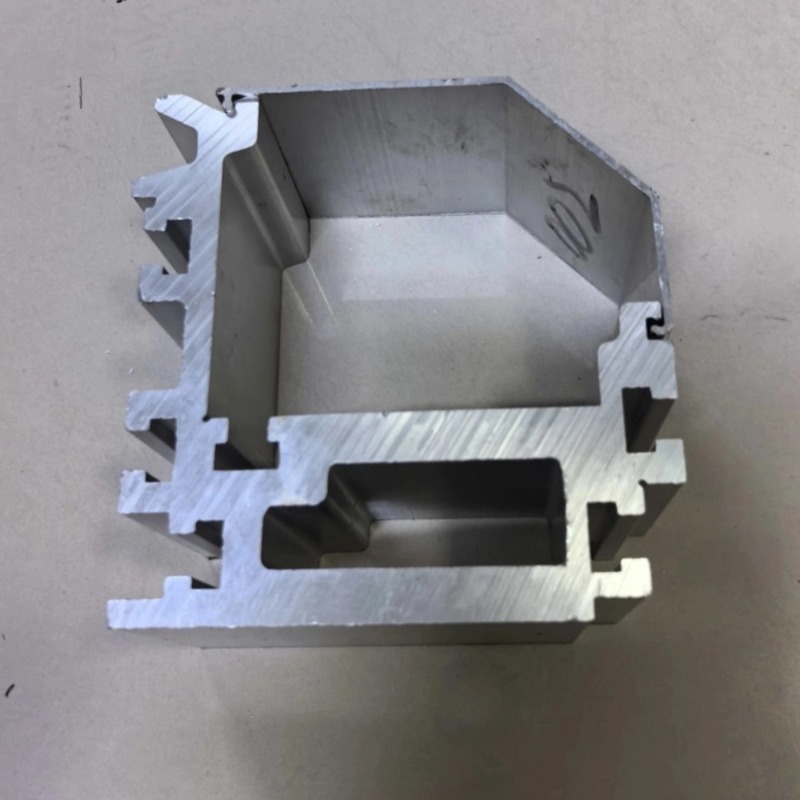
Made of 6063-T5 or 6061-T6 high-strength aluminum alloy, extruded into shape through molds, with advantages of light weight, high strength, good straightness, and corrosion resistance. The track cross-section is produced according to customer drawings, with various structures available such as I-shaped and H-shaped sections. CNC precision machining, straightness ≤1.0mm/10m, dimensional tolerance ±0.02mm to ±0.04mm. Surface anodizing treatment, corrosion-resistant, wear-resistant, extending service life. Weight per meter from 0.05kg/m to 100kg/m, circumscribed circle from 5mm to 700mm. Customers provide cross-section drawings, and we develop molds and produce accordingly.
Core advantages at a glance:
| Advantage dimension | Technical indicator | Customer value |
|---|---|---|
| 🏗️ Overhead suspension | Suspended above the workshop | Uses upper-level space, reducing floor occupation |
| 🔧 Multiple cross-sections | I-shaped / H-shaped / produced per drawings | Adapted to different load-bearing and installation needs |
| 🎯 High precision | Straightness ≤1.0mm/10m, tolerance ±0.02mm to ±0.04mm | Cars run smoothly |
| 🛡️ Anodizing | Corrosion-resistant, wear-resistant | Extended service life, maintenance-free |
| 📐 Wide range | Weight per meter 0.05-100kg/m, circumscribed circle 5-700mm | Full-scenario coverage from light to heavy load |
| ⚡ Fast delivery | Samples of standard specifications in 7-10 days, MOQ from 50kg | Controllable project cycle |
I-shaped vs. H-shaped cross-sections (produced per customer drawing requirements):
| Comparison dimension | I-shaped cross-section | H-shaped cross-section |
|---|---|---|
| Structural features | Upper and lower flanges + middle web | Upper and lower flanges + double webs |
| Structural rigidity | Good | Higher |
| Applicable scenarios | Most overhead rail scenarios | Large-span / heavy-load / robot overhead rails |
| Load-bearing capacity | Standard | Stronger |
Applicable scenarios (find your match):
| Application field | Typical uses | Key requirements |
|---|---|---|
| Workshop overhead material conveying | Suspended conveyor systems | Lightweight, good straightness |
| Automated production line lifting | Aerial lifting rails for production lines | Stable load-bearing, smooth running |
| Robot overhead rail travel | Robot aerial travel tracks | High rigidity, high precision |
| Suspended conveyor lines | Aerial continuous conveying | Long distance, low noise |
| Overhead handling between stations | Overhead handling rails | Flexible layout, convenient installation |
| Light-load lifting equipment guide rails | Tool slide rails / lifting fixture tracks | Lightweight, low cost |
01 A00 Primary Aluminum Ingot - the Source of Overhead Rail Quality
Produced from A00-grade primary aluminum ingot, containing no scrap aluminum, with uniform material and stable mechanical properties, ensuring the fatigue resistance and dimensional stability of overhead rails under long-term suspended operating conditions.
02 High-Strength Aluminum Alloy Extrusion - Produced per Drawings
Extruded from high-strength aluminum alloy; the track cross-section is produced according to customer drawings, with various structures available such as I-shaped and H-shaped sections.
Weight per meter from 0.05kg/m to 100kg/m
Circumscribed circle from 5mm to 700mm
Customers provide cross-section drawings; molds are developed and production carried out per drawings
03 High-Precision Machining and Straightness Control - Cars Run Smoothly
Through CNC precision machining, the track surface is flat and burr-free, with low deformation tendency.
Straightness accuracy ≤1.0mm/10m
Dimensional tolerance ±0.02mm to ±0.04mm
Ensures overhead rail traveling cars run smoothly
04 Anodizing Surface Treatment - Corrosion-Resistant, Wear-Resistant
The surface is anodized for dust protection and corrosion resistance, with strong corrosion resistance and a low friction coefficient, extending service life and adapting to normal workshop operating conditions.
05 Full-Process One-Stop Delivery - Single Window Interface
One-stop delivery from mold development and extrusion to CNC precision machining and surface treatment, so customers only need to interface with one supplier. Customers provide drawings; molds are developed and production carried out per drawings, reducing on-site machining steps.
Complete processing capability parameters:
| Item | Parameter/Description |
|---|---|
| Applicable scenarios | Workshop overhead material conveying, automated production line lifting, robot overhead rail travel |
| Alloy material | 6063-T5 / 6061-T6 |
| Track form | Straight overhead rails, arc overhead rails, ring overhead rails |
| Cross-section structure | I-shaped, H-shaped (produced per customer drawing requirements) |
| Straightness | ≤1.0mm/10m |
| Dimensional tolerance | ±0.02mm to ±0.04mm |
| Weight per meter range | 0.05-100kg/m |
| Circumscribed circle range | 5-700mm |
| Surface treatment | Anodizing |
| Installation method | Ceiling suspension, steel structure fixation |
| Maximum extrusion length | Up to 20M |
| Extrusion equipment | 600T-12000T (partner production lines) |
| Processing equipment | CNC machining centers |
| Execution standards | GB/T 6892-2023, ISO9001 |
| MOQ | 50kg |
| Production location | Qingpu, Shanghai |
Typical application scenarios:
Workshop overhead material conveying systems
Automated production line lifting rails
Robot overhead rail travel systems
Suspended conveyor lines
Overhead handling rails between stations
Light-load lifting equipment guide rails
Tool slide rails / lifting fixture tracks
FAQ (Frequently Asked Questions)
Q1: What is the difference between overhead rails and EMS lifting rails?
A: The overhead rail is a general category term referring to various lifting tracks suspended above the workshop, used to carry trolleys, lifting fixtures, robots, and other equipment for aerial walking operations. The EMS lifting rail is a specific application form of the overhead rail, specifically referring to the load-bearing track of an electric monorail system, equipped with a complete system including sliding contact line power pickup devices, car trains, and turnouts. All EMS lifting rails are overhead rails, but not all overhead rails are EMS lifting rails. We can produce both per drawings, selected according to the customer's automation solution.
Q2: What material is used for overhead rails? How to choose between 6063-T5 and 6061-T6?
A: 6063-T5 has good formability and high surface finish, suitable for conventional loads (≤500kg) and scenarios with surface appearance requirements; 6061-T6, after T6 heat treatment, has a yield strength ≥240MPa, suitable for heavy loads (500kg-1000kg) or scenarios with higher load-bearing and impact resistance requirements. For robot overhead rail travel systems, 6061-T6 is recommended; for light-load lifting guide rails, 6063-T5 is available. We recommend a suitable material based on the load and operating condition parameters provided by the customer.
Q3: What is the difference between I-shaped and H-shaped cross-sections?
A: The I-shaped cross-section is the most commonly used overhead rail cross-section form, with a simple structure, good load-bearing, and convenient installation, suitable for most overhead rail scenarios. The H-shaped cross-section adds a middle crossbeam on top of the I-shaped form, with stronger structural rigidity, suitable for scenarios with larger spans or higher load-bearing requirements. Customers provide drawings, and we produce accordingly.
Q4: What should be noted when installing overhead rails?
A: Overhead rails are installed with aerial suspension, with high requirements for installation accuracy and structural safety. Before installation, confirm that the workshop roof load-bearing structure meets the overhead rail load requirements; during installation, use a laser alignment instrument to calibrate straightness and levelness; control track splicing gaps within ≤0.5mm; fastening torque of lifting bolts must meet design requirements. We recommend construction by a professional installation team, and we can provide installation technical guidance.
Q5: Can overhead rails be customized as bent rails or ring tracks?
A: Yes. We support production of straight overhead rails, arc overhead rails, and ring overhead rails per drawings. Arc overhead rails are formed by CNC precision roll bending, with circle bending error ≤ ±0.4mm, curvature accuracy ≤0.5 degrees, and splicing gap between bent and straight rails ≤0.5mm, so cars run smoothly. Customers provide bent rail radius and angle drawings, and we produce accordingly.
Q6: What does the customer need to provide for overhead rail production?
A: Customers need to provide overhead rail cross-section drawings (CAD format preferred), marked with key dimensions, tolerance requirements, material requirements, and parameters such as load capacity and installation method. We perform mold design and develop mold production based on customer drawings. If the customer does not yet have cross-section drawings, they can provide equipment parameters and installation requirements, and we can assist in providing a cross-section solution for customer confirmation before production.
Q7: What are the MOQ and lead time for overhead rails?
A: The MOQ is 50kg. Samples of conventional cross-sections are available in 7-10 days, and batch delivery is 7-10 days after sample confirmation. Because overhead rails involve lifting safety, we recommend discussing load and span requirements in advance.
Get the solution now
📞 Contact Manager Du: 13611846009
Provide overhead rail cross-section drawings or installation requirements, and our technical department will deliver a production evaluation and solution within 2 hours.
Free technical consultation | Overhead rails produced per drawings | Direct supply from source factory
GET A QUOTE
Once you have submitted your requirements, we will contact you as soon as possible regarding your product inquiry.:Robot Overhead Rail Aluminum Profile