
Automated logistics
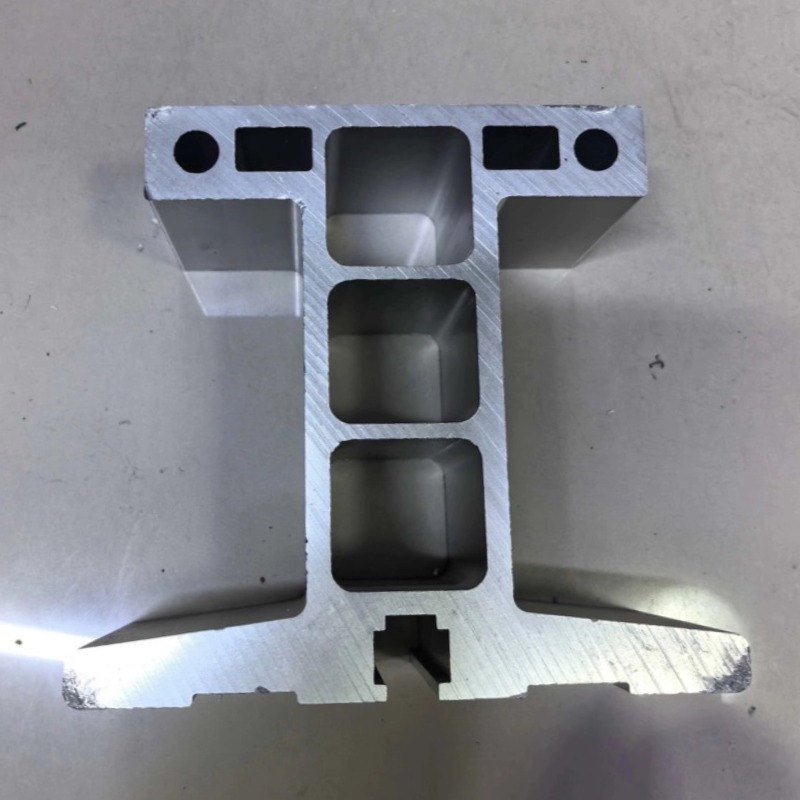
Automotive Final-Assembly EMS Hanging-Rail Aluminum Profiles
Automotive final-assembly EMS hanging-rail aluminum profiles - overhead conveying on the automotive final assembly line always jamming? Abnormal noise from trolleys at the curves of ring-shaped overhead rails in intelligent warehousing? EMS trolleys runni
Product Details
Automotive final-assembly EMS hanging-rail aluminum profiles - overhead conveying on the automotive final assembly line always jamming? Abnormal noise from trolleys at the curves of ring-shaped overhead rails in intelligent warehousing? EMS trolleys running unsteadily on curved sections?
Aluminum-alloy EMS hanging rails solve all these problems at once.
EMS (Electrical Monorail System) is an overhead suspended conveying system in which multiple independent load carriers run on a specific horizontal monorail. The EMS overhead self-powered trolley conveying system makes full use of the upper space of the workshop, reducing floor-space occupation by over 40% and achieving safe, efficient separation of people and vehicles; it is widely used in automotive welding, painting, final-assembly automated production lines as well as warehousing logistics and other industries.
The EMS hanging rail is the core load-bearing component of the EMS system, serving both as the running track for electric traveling trolleys and as the main load-bearing member. Made of high-strength 6063-T5 or 6061-T6 aluminum alloy, extrusion-formed and produced to customer drawings, it offers light weight, high strength, good straightness and corrosion resistance. CNC precision roll-bent with ring-bending error ≤±0.4mm and arc accuracy ≤0.5°. The rail cross-section integrates conductor-rail mounting slots, guide slots, mounting/fixing positions and other functional structures as required, formed as one extrusion. Load capacity 500kg-2000kg, running speed 10-100m/min. Suitable for EMS overhead suspended conveying, intelligent warehousing overhead rails, automotive final-assembly-line hanging rails and robot inspection hanging rails. The customer provides drawings and we produce to drawing.
Core Advantages at a Glance:
| Advantage Dimension | Technical Indicator | Customer Value |
|---|---|---|
| 🏗️ Space Saving | Reduces floor-space occupation by over 40% | Makes full use of upper workshop space |
| 💪 Wide Load Range | 500kg-2000kg | Suits light-load to heavy-load scenarios |
| 🚀 High-Speed Running | 10-100m/min | Meets production-line cycle-time requirements |
| 🎯 High Curved-Rail Precision | Ring-bending error ≤±0.4mm, arc accuracy ≤0.5° | Trolley turns smoothly without jamming |
| 🔌 Functional Integration | Conductor-rail mounting slots formed as one extrusion | Convenient power pickup, no extra brackets needed |
| 🛤️ Multiple Line Types | Straight/curved/ring-shaped rails | Suits different line layouts |
| 🔧 One-Stop Delivery | Mold development/extrusion/ring bending/CNC/surface treatment | Interface with only one window |
EMS Hanging Rail vs. Ordinary Overhead Rail:
| Comparison Dimension | EMS Hanging Rail | Ordinary Overhead Rail |
|---|---|---|
| System Definition | Electric monorail system (including conductor-rail pickup, trolley trains, switches) | General suspended rail |
| Load Capacity | 500kg-2000kg | 100kg-500kg |
| Running Speed | 10-100m/min | 10-30m/min |
| Functional Integration | Conductor-rail slots + guide slots + mounting positions | Relatively simple |
| Degree of Automation | High (self-powered trolley + automatic control) | General (manual/semi-automatic) |
| Typical Applications | Automotive final assembly/welding/painting, intelligent warehousing | General overhead handling |
Aluminum-Alloy EMS Hanging Rail vs. Steel Hanging Rail:
| Comparison Dimension | Aluminum-Alloy EMS Hanging Rail | Steel Hanging Rail |
|---|---|---|
| Density | 2.7g/cm³ | 7.8g/cm³ |
| Weight | Light | Heavy |
| Top-Structure Load | Low | High |
| Corrosion Resistance | Excellent (anodized) | Poor (requires regular oiling to prevent rust) |
| Installation Convenience | High | Low (requires lifting equipment) |
| Running Noise | Low | High |
| Maintenance Cost | Low (maintenance-free) | High (regular rust prevention) |
Application Scenarios (match your case):
| Application Field | Typical Use | Recommended Load Capacity | Key Requirements |
|---|---|---|---|
| Automotive final assembly line | Overhead conveying of bodies/components | 1000-2000kg | Heavy load, high-frequency operation |
| Automotive welding line | Overhead conveying in welding workshops | 500-1000kg | Heat resistant, weld-slag resistant |
| Automotive painting line | Overhead conveying in painting workshops | 500-1000kg | Dust resistant, anti-static |
| Intelligent warehousing | Ring-shaped overhead rail systems | 500-1000kg | Curved-rail precision, ring operation |
| Robot inspection | Inspection robot hanging rails | 500kg | High precision, stable running |
| Workshop overhead material handling | Material conveying between workstations | 500-1000kg | Flexible layout, space saving |
01 A00 Primary Aluminum Ingot - the Strength Guarantee of the EMS Hanging Rail
Produced from A00-grade primary aluminum ingot, containing no scrap aluminum, with uniform material and stable mechanical properties, ensuring the fatigue strength and dimensional stability of the EMS hanging rail under long-term suspended running conditions.
02 High-Strength Aluminum-Alloy Extrusion - Lightweight and High Strength Combined
Extruded from high-strength aluminum alloy and produced to customer drawings. Weight per meter from 0.05kg/m to 100kg/m, circumscribed circle from 5mm to 700mm. The rail cross-section integrates conductor-rail mounting slots, guide slots, mounting/fixing positions and other functional structures as required, formed as one extrusion to reduce post-processing operations.
03 CNC Precision Roll Bending - Curved-Rail Accuracy ≤0.5°
Formed by a CNC precision roll-bending process, with ring-bending error ≤±0.4mm and arc accuracy ≤0.5°.
Curved rails are custom-made in various radius and length combinations
Straight and curved sections seamlessly joined, trolley runs smoothly
Customer provides curved-rail radius and angle drawings; we produce to drawing
04 High-Precision CNC Machining - Precision Assembly in One Step
Equipped with five-axis CNC machining centers and other precision equipment, with high-precision drilling, tapping and CNC machining.
CNC machining accuracy: ±0.01-0.005mm
Multiple imported machines and extra-long machining centers with 6.5-meter travel
The rail working surface can be hard-anodized for wear resistance, suited to high-frequency reciprocating handling
05 Full-Process One-Stop Delivery - Interface with Only One Window
One-stop delivery from mold development and extrusion to ring bending, CNC finishing and surface treatment; the customer interfaces with only one supplier. The customer provides drawings and we produce to drawing, reducing on-site machining operations.
Complete Processing Capability Parameters:
| Item | Parameter / Description |
|---|---|
| Application Scenarios | EMS overhead suspended conveying, intelligent warehousing overhead rails, automotive final-assembly-line hanging rails |
| Alloy Material | 6063-T5 / 6061-T6 |
| Rail Type | Straight rails, curved rails, ring-shaped rails (produced to customer drawings) |
| Load Capacity | 500kg-2000kg |
| Running Speed | 10-100m/min |
| Ring-Bending Error | ≤±0.4mm |
| Arc Accuracy | ≤0.5° |
| Dimensional Tolerance | ±0.02mm to ±0.04mm |
| CNC Machining Accuracy | ±0.01-0.005mm |
| Surface Treatment | Anodizing, hard anodizing |
| Functional Integration | Conductor-rail mounting slots, guide slots, mounting/fixing positions (as required) |
| Customization Scope | Rail length, curved-rail radius, cross-section dimensions (customer provides drawings) |
| Extrusion Length | Up to 20M |
| Extrusion Equipment | 600T-12000T (partner production lines) |
| Processing Equipment | CNC roll-bending machines, ring-bending machines, stretch-bending machines, five-axis CNC machining centers |
| Executive Standard | GB/T 6892-2023, ISO9001 |
| MOQ | 50kg |
| Production Location | Qingpu, Shanghai |
Typical Application Scenarios:
EMS overhead suspended conveying systems
Ring-shaped overhead rails for intelligent warehousing
Overhead rails for automotive final assembly lines
Welding/painting automated conveying lines
Robot inspection hanging rails
Workshop overhead material handling systems
FAQ (Frequently Asked Questions)
Q1: What is the difference between EMS hanging rails and RGV/AGV tracks?
A: EMS (Electrical Monorail System) is an overhead suspended conveying system in which the rail is mounted above the workshop and trolleys run suspended below the rail, making full use of upper space and reducing floor-space occupation by over 40%. RGV/AGV tracks are laid on the floor, with trolleys traveling on the ground. EMS suits scenarios requiring overhead conveying such as automotive final-assembly, welding and painting lines; RGV/AGV suits ground handling and warehousing logistics. The two are complementary, and we can produce both to drawing.
Q2: What curved-rail precision can the EMS hanging rail achieve?
A: Formed by a CNC precision roll-bending process, with ring-bending error ≤±0.4mm and arc accuracy ≤0.5°. Curved rails are custom-made in various radius and length combinations, with straight and curved sections seamlessly joined, so the trolley runs smoothly without jamming or abnormal noise. The customer provides curved-rail radius and angle drawings; we produce to drawing.
Q3: What is the load-capacity range of the EMS hanging rail?
A: Load capacity is 500kg-2000kg and running speed is 10-100m/min. The specific load and speed depend on the chosen alloy material (6063-T5 or 6061-T6), cross-section dimensions and wall thickness. The customer provides the material weight and production-line cycle-time requirements, and we recommend a matching material and cross-section solution accordingly.
Q4: How to choose between 6063-T5 and 6061-T6?
A: 6063-T5 has good formability and high surface finish, suited to standard load capacities (500kg-1000kg) and scenarios with surface-appearance requirements; 6061-T6 has higher strength, yield strength ≥240MPa, suited to heavy loads (1000kg-2000kg) or scenarios demanding higher load-bearing and impact resistance. For heavy-load scenarios such as automotive final assembly lines, 6061-T6 is recommended.
Q5: How is the conductor rail installed on the EMS hanging rail?
A: The rail cross-section integrates conductor-rail mounting slots as required, formed as one extrusion. The conductor rail can be embedded directly into the mounting slot without extra brackets, for convenient installation. The conductor rail supplies power during EMS trolley running; the customer provides the conductor-rail specification and we customize the corresponding mounting-slot dimensions.
Q6: What does the customer need to provide for EMS hanging-rail production?
A: The customer needs to provide the hanging-rail cross-section drawings (CAD format preferred), marked with key dimensions, load requirements, material requirements, and parameters such as curved-rail radius and angle. We design the mold and produce according to the customer drawings. If the customer does not yet have cross-section drawings, they can provide the equipment parameters and installation requirements, and we can assist by proposing a cross-section solution for customer confirmation before production.
Q7: What is the MOQ and lead time for the EMS hanging rail?
A: The MOQ is 50kg. Standard cross-sections are sampled in 7-10 days, and mass production delivery is 10-15 days after sample approval. Curved rails and ring-shaped tracks involve roll bending, so the lead time may be slightly longer, determined by product complexity.
Get Your Solution Now
📞 Contact Manager Du: 13611846009
Provide the EMS hanging-rail cross-section drawings or installation requirements, and our technical department will deliver a production assessment and solution within 2 hours.
Free technical consultation | EMS hanging rails produced to drawing | direct supply from the source factory
GET A QUOTE
Once you have submitted your requirements, we will contact you as soon as possible regarding your product inquiry.:Automotive Final-Assembly EMS Hanging-Rail Aluminum Profiles