
Automated logistics
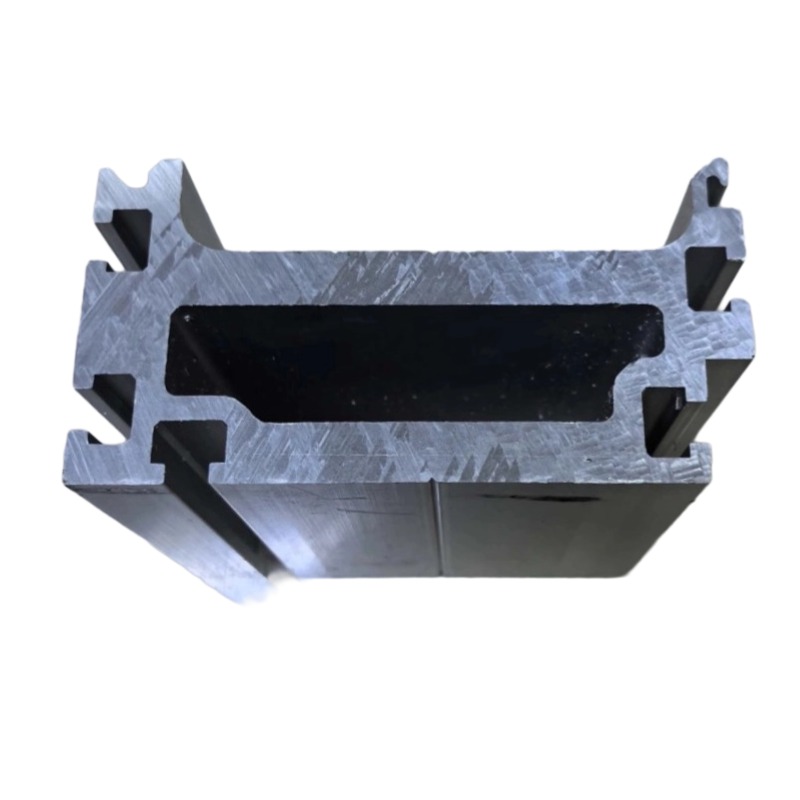
Parent-Child Shuttle Car Guide Rail Aluminum Profiles
Shuttle car guide rail aluminum profiles for parent-child shuttle systems — do shuttle cars drift and jam in the aisles of high-density warehouses? Do guide rails rust and wear in the low-temperature, high-humidity cold chain environment? Are rail joints
Product Details
Shuttle car guide rail aluminum profiles for parent-child shuttle systems — do shuttle cars drift and jam in the aisles of high-density warehouses? Do guide rails rust and wear in the low-temperature, high-humidity cold chain environment? Are rail joints uneven when child cars change levels, causing trolley jolts?
The precision and durability of shuttle car guide rails directly determine the operating efficiency and maintenance cost of high-density warehouses.
The parent-child shuttle system is the core technical solution for intelligent high-density warehousing. Child shuttle cars run along guide rails within rack aisles, responsible for pallet storage and retrieval; parent shuttle cars transfer horizontally between aisles, responsible for deploying child cars to different aisles. This system eliminates forklift aisles and greatly improves warehousing space utilization, especially suitable for high-density storage scenarios such as cold chain warehousing, e-commerce distribution centers, and food and pharmaceutical industry dense storage.
Shuttle car guide rails are the foundational load-bearing components of the parent-child shuttle system; rail precision directly determines shuttle running stability, positioning accuracy, and long-term system reliability.
Material options include 6063-T5 or 6061-T6 high-strength aluminum alloy, combining lightweight construction, high precision, and wear resistance. Integrated CNC finishing, straightness ≤1.0mm/10m, dimensional tolerance ±0.02mm to ±0.04mm. Custom cross-sections available for in-aisle shuttle guide rails, parent-child car level-change tracks, and switching tracks, integrating guide grooves, mounting positions, and sensor card slots in one-piece extrusion. The running surface can be hard-anodized (HV≥300), suitable for high-frequency reciprocating handling and heavy-duty shuttle conditions. Compatible with shuttle cars from 10kg to 2000kg. Especially suitable for the harsh low-temperature, high-humidity cold chain environment, with excellent corrosion resistance and stable long-term operation in -25°C environments.
Core advantages at a glance:
| Advantage dimension | Technical specification | Customer value |
|---|---|---|
| 📦 Wide load range | 10kg-2000kg | Covers all storage needs from totes to pallets |
| 🎯 High precision | Straightness ≤1.0mm/10m, tolerance ±0.02mm to ±0.04mm | Shuttle runs smoothly, positions accurately |
| 🛡️ Wear-resistant reinforcement | Hard anodizing (running surface wear treatment, HV≥300) | Low wear under high-frequency reciprocation, long service life |
| ❄️ Cold chain adaptation | Corrosion-resistant, low-temperature resistant (-25°C) | Stable operation in cold chain low-temperature, high-humidity environments |
| 🔧 Integrated functionality | Guide groove / mounting position / sensor card slot integrated in one-piece extrusion | Reduces secondary machining, easy installation |
| 📐 Multiple rail types | Aisle guide rails / level-change tracks / switching tracks | Adapted to all parent-child shuttle scenarios |
| ⚡ Fast delivery | 7-10 days for conventional specification samples, 50kg minimum order | Controllable project timeline |
Shuttle car guide rail vs. stacker floor rail:
| Comparison dimension | Shuttle car guide rail | Stacker floor rail |
|---|---|---|
| Installation position | Inside racks / rack bottom | Ground |
| Load-bearing object | Shuttle cars (child / parent) | Stacker crane |
| Cross-section design | Narrow, compact, adapted to shuttle guide wheels | Wide, heavy, adapted to stacker running wheels |
| Functional integration | Guide groove / sensor card slot / mounting position | Relatively simple |
| Environmental requirements | Cold chain / ambient / cleanroom all acceptable | General industrial environment |
| Corrosion resistance requirements | High (cold chain high-humidity environment) | General |
Aluminum alloy shuttle car guide rail vs. steel guide rail:
| Comparison dimension | Aluminum alloy shuttle car guide rail | Steel guide rail |
|---|---|---|
| Density | 2.7g/cm³ | 7.8g/cm³ |
| Weight | Light (easy installation) | Heavy (requires lifting equipment) |
| Corrosion resistance | Excellent (hard anodized) | Poor (requires regular oiling for rust prevention) |
| Low-temperature adaptability | Excellent (stable at -25°C) | General (low-temperature brittleness) |
| Maintenance cost | Low (maintenance-free) | High (regular rust prevention) |
| Cleanliness | Low particle generation | Prone to rust and flaking |
Child car guide rail vs. parent car guide rail:
| Comparison dimension | Child car guide rail | Parent car guide rail |
|---|---|---|
| Installation position | Inside rack aisle | Horizontal corridor between aisles |
| Load-bearing object | Child shuttle car | Parent shuttle car (including child car + goods) |
| Cross-section design | Narrow, adapted to child car guide wheels | Larger, stronger load capacity |
| Key requirements | High straightness | High load-bearing strength |
| Application scenarios | Storage and retrieval within aisles | Horizontal transfer between aisles |
Selection guide:
| Application scenario | Recommended material | Recommended load capacity | Key requirements |
|---|---|---|---|
| Parent-child shuttle system | 6061-T6 | 100-2000kg | High precision, wear-resistant |
| High-density warehouse racks | 6061-T6 | 100-1500kg | High space utilization |
| Cold chain warehousing | 6061-T6 | 100-1000kg | Low-temperature resistant -25°C, corrosion-resistant |
| E-commerce distribution center | 6063-T5 | 10-500kg | High-frequency operation, precise positioning |
| Food and pharmaceutical industry | 6063-T5 | 100-1000kg | Clean surface, corrosion-resistant |
| Parent-child car level change | 6061-T6 | 100-2000kg | Verticality, joint precision |
Typical application scenarios:
Intelligent warehousing parent-child shuttle systems
High-density warehouse rack rails
Automated stereoscopic warehouses
Cold chain warehousing logistics
E-commerce distribution centers
Intelligent factory material handling
Food and pharmaceutical industry dense storage
Parent-child car level-change tracks / switching tracks
FAQ (Frequently Asked Questions)
Q1: What is the difference between a parent-child shuttle system and a stacker crane stereoscopic warehouse?
A: The parent-child shuttle system is a high-density storage solution that eliminates forklift aisles; child cars run within rack aisles to store and retrieve goods, while parent cars transfer horizontally between aisles, greatly improving space utilization. It is suitable for scenarios with relatively few SKUs and large-volume single-product storage. A stacker crane stereoscopic warehouse is an automated storage and retrieval solution where the stacker crane runs along floor rails and uses a forks to store and retrieve goods between racks, suitable for multi-variety, high-frequency in/out scenarios. We can provide the core rails for both solutions, and selection is based on the customer's warehousing model.
Q2: What is the difference between shuttle car guide rails and stacker floor rails?
A: Shuttle car guide rails are installed inside racks or at rack bottoms; shuttle cars run on them to store and retrieve goods. The rails are typically narrow with compact cross-sections adapted to shuttle guide wheel dimensions. Stacker floor rails are installed on the ground; the stacker crane runs along them in aisles, with larger cross-sections and stronger load capacity. Material and machining precision requirements are similar (6061-T6/6063-T5, straightness ≤1.0mm/10m), but cross-section design and installation methods differ.
Q3: The shuttle car guide rail load range spans 10kg-2000kg — how to choose?
A: The load capacity of shuttle car guide rails depends on material, cross-section dimensions, wall thickness, and structural design. Light-duty shuttles (≤300kg) can use 6063-T5 material with smaller cross-sections; heavy-duty shuttles (500kg-2000kg) require 6061-T6 material with larger cross-sections and thicker walls. We comprehensively calculate based on the customer's shuttle self-weight + cargo weight + running speed to recommend the appropriate rail specification.
Q4: Why do shuttle car guide rails require hard anodizing?
A: Shuttle cars run on guide rails at high frequency, with wheels in constant friction against the running surface. Hard anodizing forms a high-hardness oxide layer (HV≥300) on the running surface, with wear resistance over 3 times that of ordinary anodizing, effectively extending rail service life and reducing maintenance costs. Hard anodizing is recommended as standard for cold chain warehousing and food/pharmaceutical industries.
Q5: What is the difference between child car and parent car guide rails?
A: Child car guide rails are installed within rack aisles; child cars run along them to store and retrieve goods. The cross-section is typically narrow with high straightness requirements. Parent car guide rails are installed in horizontal corridors between aisles; parent cars move horizontally along them to deploy child cars to different aisles. The cross-section is typically larger with stronger load capacity. Both types are customizable, supporting special cross-section designs for level-change tracks and switching tracks.
Q6: What special requirements does the cold chain environment impose on shuttle car guide rails?
A: The cold chain environment (-25°C to 0°C, high humidity) imposes higher requirements on shuttle car guide rail material and surface treatment: material is recommended to be 6061-T6 (stable mechanical properties at low temperature, yield strength retention >95%), avoiding the increased brittleness of 6063-T5 at low temperatures; surface treatment must be hard anodizing (film thickness ≥25μm) for condensation water corrosion resistance; rail-to-rack connectors are recommended in stainless steel to avoid electrochemical corrosion. We can provide dedicated material and surface treatment solutions for cold chain environments.
Q7: What is the minimum order quantity and lead time for shuttle car guide rails?
A: The minimum order quantity is 50kg. Conventional cross-sections take 7-10 days for samples, and batch delivery is 7-10 days after sample confirmation. Shuttle car guide rail projects typically have tight lead times; expedited scheduling is supported, determined based on order volume and cross-section complexity.
Get a solution now
📞 Contact Manager Du: 13611846009
Provide shuttle specifications or high-density warehouse layout drawings; the engineering department will provide rail model recommendations and solution assessment within 2 hours.
Free technical consultation | Shuttle car guide rail solution design | Direct from source factory
GET A QUOTE
Once you have submitted your requirements, we will contact you as soon as possible regarding your product inquiry.:Parent-Child Shuttle Car Guide Rail Aluminum Profiles