
Automated logistics
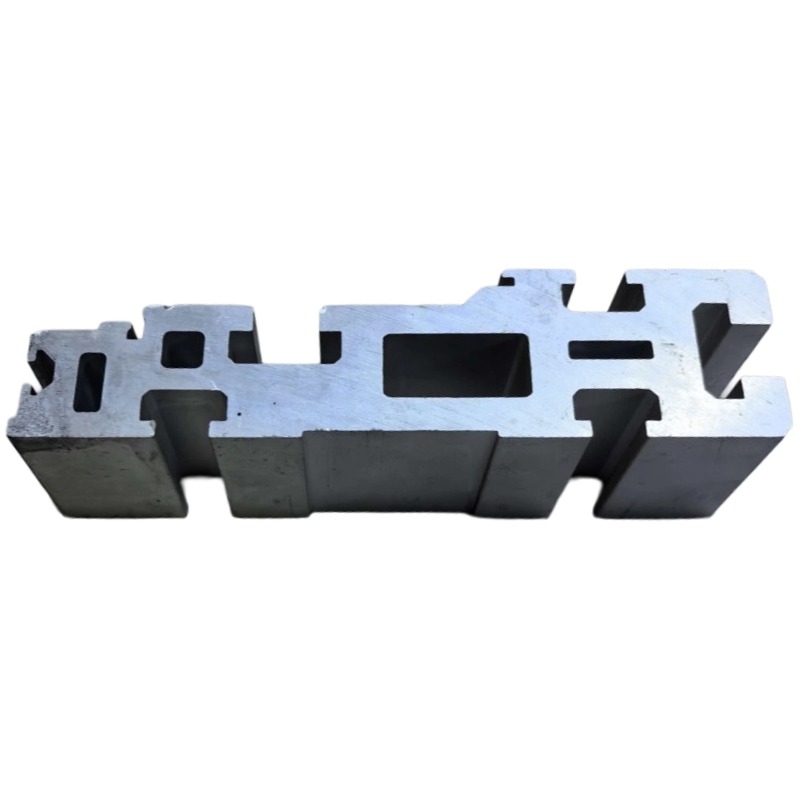
Crane Conductor-Rail Aluminum Profiles
Crane conductor-rail aluminum profiles - power cuts off while the crane is running? Unstable power pickup for moving equipment on automated production lines? Poor conductor-rail contact at curves for EMS overhead trolleys? The precision of the conductor r
Product Details
Crane conductor-rail aluminum profiles - power cuts off while the crane is running? Unstable power pickup for moving equipment on automated production lines? Poor conductor-rail contact at curves for EMS overhead trolleys?
The precision of the conductor rail directly determines the reliability of the mobile power-supply system.
Conductor-rail power supply is one of the mainstream power-supply methods for moving equipment; through conductor rails (copper bars or conductive bars) installed inside the track, paired with current collectors, mobile power supply is achieved. This conductor rail is extruded from high-strength aluminum alloy and is the load-bearing body of the conductor-rail power system, serving both as a guide rail and a power-supply conductor.
The material is conductive 6063-T5 aluminum alloy, combining good conductivity and mechanical properties. The surface is anodized for corrosion and wear resistance, ensuring power-supply safety. The rail cross-section can integrate multi-pole conductor-rail mounting slots, supporting single-pole and multi-pole conductor rail installation to suit various power requirements. CNC precision machining, dimensional tolerance ±0.02mm to ±0.04mm. Rail joints are flat, the current collector runs smoothly without jamming, and the smooth working surface reduces carbon-brush wear and extends maintenance intervals. Straight and curved rails can be customized. Suitable for crane conductor-rail power systems, automated production-line mobile power-supply tracks, traveling-crane power-supply conductor rails, EMS overhead trolley power supply, AGV charging-rail power systems, and mobile power supply for automated warehouses.
Core Advantages at a Glance:
| Advantage Dimension | Technical Indicator | Customer Value |
|---|---|---|
| ⚡ Excellent Conductivity | 6063-T5 conductive aluminum alloy, conductivity ≥45% IACS | Reduces power transmission loss |
| 🔌 Multi-Pole Integration | Multi-pole conductor-rail mounting slots (single-pole/multi-pole installation) | Suit various power requirements, one rail for multiple uses |
| 🛡️ Safe Insulation | Anodized, surface-insulated | Ensures power-supply system safety and reliability |
| 🎯 High Precision | Dimensional tolerance ±0.02mm to ±0.04mm | Current collector runs smoothly without jamming |
| 🔧 Low Wear | Smooth working surface, low carbon-brush wear | Extends maintenance intervals, lowers O&M cost |
| ⚡ Fast Delivery | Standard specifications sampled in 7-10 days, MOQ from 50kg | Project timeline under control |
Conductor Rail vs. Ordinary Load-Bearing Track:
| Comparison Dimension | Conductor Rail | Ordinary Load-Bearing Track |
|---|---|---|
| Core Function | Power supply + guidance (dual function) | Load bearing + guidance (single function) |
| Cross-Section Features | Integrated conductor-rail mounting slots | No power-supply structure |
| Material Requirement | Conductive aluminum alloy (conductivity ≥45% IACS) | Ordinary aluminum alloy |
| Surface Treatment | Anodized (insulating + wear-resistant) | Anodized (wear-resistant) |
| Application Scenarios | Mobile power-supply systems | Traveling conveyor systems |
Aluminum-Alloy Conductor Rail vs. Steel Conductor Rail:
| Comparison Dimension | Aluminum-Alloy Conductor Rail | Steel Conductor Rail |
|---|---|---|
| Density | 2.7g/cm³ | 7.8g/cm³ |
| Weight | Light | Heavy |
| Conductivity | ≥45% IACS | About 8-12% IACS |
| Corrosion Resistance | Excellent (anodized) | Poor (requires oiling to prevent rust) |
| Insulation Performance | Excellent (anodized insulating layer) | Poor (requires additional insulation) |
| Installation Convenience | High | Low |
| Maintenance Cost | Low (maintenance-free) | High (regular rust prevention) |
Selection Guide:
| Application Scenario | Recommended Conductor-Rail Poles | Key Requirements |
|---|---|---|
| Crane power-supply system | Single-pole/multi-pole | Rail straightness, conductor-rail slot precision |
| Automated production-line mobile power supply | Multi-pole | Rail straightness, multi-pole slot precision |
| Traveling-crane power-supply conductor rail | Single-pole | Rail straightness, smooth current-collector sliding |
| EMS overhead trolley power supply | Multi-pole | Smooth transition of curved rail + conductor rail |
| AGV charging-rail power system | Single-pole | Charging-section precision, wear resistance |
| Automated warehouse mobile power supply | Multi-pole | Long-distance straightness, low wear |
Typical Application Scenarios:
Crane conductor-rail power systems
Automated production-line mobile power-supply tracks
Traveling-crane power-supply conductor rails
EMS overhead trolley power-supply tracks
AGV charging-rail power systems
Automated warehouse mobile power supply
FAQ (Frequently Asked Questions)
Q1: What is the difference between a conductor rail and an ordinary load-bearing track?
A: A conductor rail is a power-supply track whose core function is to transmit power to moving equipment, while also acting as a guide. Its cross-section integrates conductor-rail mounting slots, with copper or conductive bars installed inside, and the current collector slides along the rail to pick up power. An ordinary load-bearing track (such as shuttle-car guide rails or overhead rails) is a traveling track whose core function is to carry and guide equipment movement, with no power-supply function. We can customize both types of track; conductor rails are often used together with load-bearing tracks in automated production lines and crane systems.
Q2: What is the difference between conductive 6063-T5 and ordinary 6063-T5?
A: The alloy grades are the same, but conductive aluminum alloy has stricter control of trace elements during production, giving higher conductivity and lower resistance. Ordinary 6063-T5 focuses more on mechanical properties and formability, with conductivity of about 35-40% IACS; conductive aluminum alloy, through optimized processing, reaches conductivity of 45-50% IACS, effectively reducing power transmission loss. Our conductor rails use conductive aluminum alloy to ensure the energy efficiency and economy of the power system over long-term operation.
Q3: Can multiple poles of conductor rail be installed on one track?
A: Yes. The rail cross-section can integrate multi-pole conductor-rail mounting slots, supporting single-pole, multi-pole and multi-pole integrated conductor rail installation to suit different equipment power requirements. Multi-pole conductor rails can simultaneously transmit multiple power circuits (such as three-phase power + control signals) within one track, suitable for automated production-line equipment requiring simultaneous power supply and signal transmission. The mounting-slot dimensions can be customized according to the conductor-rail brand and specification chosen by the customer.
Q4: Why is the conductor rail surface anodized?
A: Anodizing forms a dense oxide film on the rail surface with three functions: first, improving corrosion resistance to adapt to routine workshop conditions; second, increasing surface hardness for wear resistance, reducing wear on the current-collector carbon brushes; third, forming an insulating layer to prevent accidental conduction of the rail and improve power-supply system safety. Untreated aluminum alloy surfaces easily oxidize and corrode, producing conductive dust that affects the stability and service life of the power system.
Q5: How is the current-carrying capacity of the conductor rail determined?
A: The current-carrying capacity of the conductor rail is determined by three factors: the conductor-rail material (copper or aluminum bar, cross-sectional area), the number of poles (single-pole or multi-pole), and the rail cross-section dimensions (mounting-slot accommodation space). The customer provides equipment power and conductor-rail specifications, and we design a matching rail cross-section based on mounting-slot dimensions and structural-strength requirements, ensuring both current-carrying capacity and mechanical strength are met.
Q6: Can the conductor rail work with conductor rails of different brands?
A: Yes. Our rail mounting slots can be customized according to the conductor-rail brand and specification chosen by the customer. Major domestic and international conductor-rail brands such as VAHLE, Conductix-Wampfler, Annenbao and domestic conductor-rail brands can all be accommodated. The customer provides the conductor-rail product specification, and we design matching mounting-slot dimensions accordingly, ensuring convenient on-site installation and reliable conductor-rail fixation.
Q7: What is the MOQ and lead time for the conductor rail?
A: The MOQ is 50kg. Standard cross-sections are sampled in 7-10 days, and mass production delivery is 7-10 days after sample approval. The conductor-rail mounting-slot specifications must be confirmed before mold development; we recommend providing the conductor-rail brand and specification parameters in advance.
Get Your Solution Now
📞 Contact Manager Du: 13611846009
Provide the conductor-rail brand specification or power-supply system drawings, and our technical department will deliver a conductor-rail solution assessment within 2 hours.
Free technical consultation | conductor-rail solution design | direct supply from the source factory
GET A QUOTE
Once you have submitted your requirements, we will contact you as soon as possible regarding your product inquiry.:Crane Conductor-Rail Aluminum Profiles