
Automated logistics
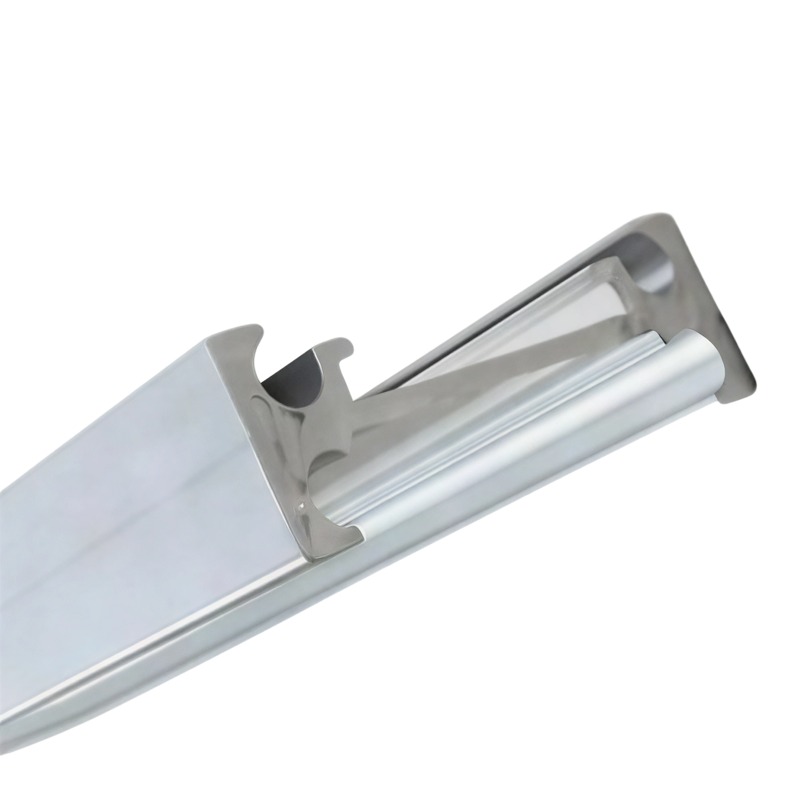
KBK I-Beam Aluminum Rail
KBK I-beam aluminum profiles — Is material handling in your workshop still done by forklifts shuttling back and forth? Are lifting operations between workstations still using bulky steel rails? Is rust and flaking from steel rails in cleanrooms affecting
Product Details
Is material handling in your workshop still done by forklifts shuttling back and forth? Are lifting operations between workstations still using bulky steel rails? Is rust and flaking from steel rails in cleanrooms affecting product quality?
These problems can all be solved at once by the KBK aluminum-alloy I-beam rail.
KBK (Komponenten Baukasten Kran, modular crane kit) light crane systems are core equipment for modern factory production conveyor lines. The I-beam aluminum rail is the core load-bearing component of the KBK system — hanging trolleys and electric hoists travel on it to perform material handling and lifting tasks between workstations.
Extruded from high-strength 6063-T5 or 6061-T6 aluminum alloy with an I-shaped cross-section, the rail load covers 125kg-2000kg, minimum self-weight only 2.7kg/m, far lighter than traditional steel rails (about 1/3 of steel rails). Surface anodizing provides corrosion resistance, wear resistance and low noise. The modular design makes the rail system easy to install and smooth to run. It supports straight rails, curved rails, switches and other line layouts, with a curved-rail turning radius of up to 1.5m. The rail cross-section can integrate conductor-bar mounting slots to power moving trolleys. It is suitable for KBK modular cranes, workstation cranes, suspended conveying systems, automotive production-line overhead rails, light lifting rails in cleanrooms and other scenarios.
Core advantages at a glance:
| Advantage Dimension | Technical Indicator | Customer Value |
|---|---|---|
| 🪶 Lightweight design | Minimum self-weight 2.7kg/m (1/3 of steel rails) | Easy installation, reduced overhead structural load |
| 💪 Wide load coverage | 125kg-2000kg | Fits the full KBK-I/II/III series |
| 🔧 Modular system | Flexible combination of straight / curved / switch rails | Flexible system layout, easy installation |
| 🛤️ Small turning radius | Curved rail up to 1.5m | Fits compact workshop spaces |
| 🔌 Functional integration | Conductor-bar mounting slot (conductor bar can be built in) | Power for moving trolleys, no trailing cable needed |
| 🛡️ Anodized surface | Corrosion-resistant, wear-resistant | Suitable for cleanrooms, long life |
| ⚡ Rapid delivery | Sampling in 7-10 days for standard specifications, MOQ 50kg | Project timeline controllable |
Aluminum-alloy KBK I-beam rail vs. steel KBK rail:
| Comparison Dimension | Aluminum-Alloy I-Beam Rail | Steel KBK Rail |
|---|---|---|
| Density | 2.7g/cm³ | 7.8g/cm³ |
| Rail Self-Weight | Minimum 2.7kg/m | About 8-12kg/m |
| Overhead Structural Load | Low | High |
| Corrosion Resistance | Excellent (anodized) | Poor (requires regular oiling for rust prevention) |
| Running Noise | Low (with nylon wheels) | High (steel wheels + steel rails) |
| Suitable for Cleanrooms | Suitable (low particle generation) | Not suitable (rust and flaking) |
| Maintenance Cost | Low (maintenance-free) | High (regular rust prevention) |
| Appearance | High finish | Average |
KBK rail selection guide:
| Model | Suitable Load | Typical Application |
|---|---|---|
| KBK-I type | 125kg-500kg | Tool slide rails, light-load material handling between workstations |
| KBK-II type | 500kg-1000kg | Workstation cranes, suspended conveying systems (most commonly used) |
| KBK-III type | 1000kg-2000kg | Automotive production lines, heavy-load suspension systems |
Application scenarios (pick the right one):
| Application Field | Typical Use | Recommended Model | Key Requirement |
|---|---|---|---|
| KBK modular cranes | Material handling between workstations | KBK-I/II type | Lightweight, low noise |
| Workstation cranes | Lifting operations at a single station | KBK-II type | Smooth running, precise positioning |
| Suspended conveying systems | Overhead material conveying on production lines | KBK-II/III type | Long distance, curved rails and switches |
| Automotive production lines | Overhead conveying of bodies/components | KBK-III type | Heavy load, high-frequency running |
| Cleanrooms | Electronics / pharmaceutical / food workshops | KBK-I/II type | Low particles, corrosion-resistant |
| Tool slide rails | Tool suspension / workstation assistance | KBK-I type | Light load, flexible |
01 A00 Primary Aluminum Ingot — the Source of KBK Rail Quality
Produced from A00-grade primary aluminum ingot with no scrap aluminum; the material is uniform and its mechanical properties are stable, ensuring the fatigue strength and dimensional stability of the I-beam rail under long-term suspended running. The compact microstructure of primary aluminum ingot is the key to ensuring the rail carries load long-term without deformation.
02 High-Strength Aluminum-Alloy Extrusion — I-Shaped Cross-Section Load-Bearing Design
Extruded from high-strength aluminum alloy with an I-shaped cross-section, it is the core load-bearing rail of the KBK light crane system.
Rail load covers 125kg-2000kg, fitting single-girder, double-girder, suspended and other crane forms
Minimum product rail self-weight is only 2.7kg/m, far lighter than traditional steel rails (about 1/3 of steel rails)
The I-shaped cross-section design optimizes the bending section modulus, minimizing self-weight while ensuring load capacity
03 Precision Machining and Straightness Control — Smooth, Stable Trolley Running
CNC precision machining makes the rail surface flat and burr-free, with little deformation.
Dimensional tolerance ±0.02mm to ±0.04mm
Rail joints are flat, and trolley running is low-noise
An advanced nylon-wheel design effectively reduces rail wear
04 Anodized Surface Treatment — Corrosion-Resistant, Wear-Resistant
The surface is anodized (film thickness ≥15μm), corrosion-resistant and wear-resistant, and can be used long-term in cleanrooms, humid environments and other conditions.
No oiling for rust prevention needed, maintenance-free
High surface finish, suitable for scenarios with requirements on the workshop environment
Used with nylon wheels, running noise is significantly lower than the steel-rail + steel-wheel combination
05 Modular System Design — Flexible Layout, Fast Installation
All components of the KBK system are standardized modules that can be produced in large batches with high quality.
Supports straight rails, curved rails, switches and other line layouts
Curved-rail turning radius up to 1.5m, fitting compact workshop spaces
Conductor bars can be built in to power moving trolleys without trailing cables
The system is easy to install and runs smoothly
06 Full-Process One-Stop Delivery — Only One Point of Contact
One-stop delivery from mold development and extrusion to CNC finishing and surface treatment, so the customer only deals with one supplier.
Supports custom rail cross-section dimensions, rail length and curved-rail radius from drawings
Reduces on-site machining steps and shortens the project timeline
Complete machining capability parameters:
| Item | Parameter / Description |
|---|---|
| Application Scenarios | KBK modular cranes, workstation cranes, suspended conveying systems |
| Alloy Material | 6063-T5 / 6061-T6 |
| Rail Form | Straight rail, curved rail, switch |
| Rail Load | 125kg-2000kg |
| Rail Self-Weight | Minimum 2.7kg/m |
| Dimensional Tolerance | ±0.02mm to ±0.04mm |
| Surface Treatment | Anodizing (film thickness ≥15μm) |
| Curved-Rail Turning Radius | Up to 1.5m |
| Functional Integration | Conductor-bar mounting slot (conductor bar can be built in) |
| Compatible Systems | KBK-I, KBK-II, KBK-III type rails |
| Compatible Cranes | Single-girder, double-girder, suspended |
| Extrusion Length | Up to 20M |
| Extrusion Equipment | 600T-12000T (partner lines) |
| Processing Equipment | CNC machining centers |
| Executive Standard | GB/T 6892-2023, ISO9001 |
| MOQ | 50kg |
| Production Location | Qingpu, Shanghai |
Typical Application Scenarios:
KBK modular crane rails
Workstation crane rails
Suspended conveying systems
Material-handling rails between workstations
Automotive production-line overhead rails
Light lifting rails in cleanrooms
Tool slide rails
FAQ (Frequently Asked Questions)
Q1: What is the difference between I-beam rails and ordinary aluminum-profile rails?
A: I-beam rails have an I-shaped cross-section and are load-bearing rails specifically designed for KBK light crane systems; the cross-section is optimized to achieve lightweighting while ensuring load capacity. Ordinary aluminum-profile rails have varied cross-sections (such as rectangular or C-shaped) for different scenarios. The top of the I-beam rail is used for suspended mounting, the bottom flange for trolley wheels, and the middle web carries the load — a scientifically designed structure. Our I-beam rails are compatible with standard KBK trolley wheels, ensuring smooth trolley running.
Q2: What advantages do aluminum-alloy I-beam rails have over traditional steel KBK rails?
A: Four major advantages: first, light weight — minimum self-weight only 2.7kg/m, about 1/3 of steel rails, easy to install and reducing the overhead structural load; second, corrosion resistance — after anodizing no oiling for rust prevention is needed, and they can be used long-term in cleanrooms and humid environments; third, low noise — used with nylon wheels, running noise is significantly lower than the steel-rail + steel-wheel combination; fourth, good appearance — high surface finish, suitable for scenarios with requirements on the workshop environment.
Q3: The rail load range 125kg-2000kg spans so widely — how do I choose?
A: Small I-beam rails (KBK-I type) suit 125kg-500kg light lifting needs, for tool slide rails and material handling between workstations; medium I-beam rails (KBK-II type) suit 500kg-1000kg, for workstation cranes and suspended conveying systems; large I-beam rails (KBK-III type) suit 1000kg-2000kg, for automotive production lines and heavy-load suspension systems. Once the customer provides the lifting weight and span requirements, our company recommends the matching I-beam model and material accordingly.
Q4: What curved-rail turning radius can I-beam rails achieve?
A: The curved-rail turning radius can reach 1.5m. KBK systems need to lay out rail lines in different directions within limited workshop space; the 1.5m turning radius fits most workshop KBK system layout needs, and smaller radii can be custom-made if required.
Q5: Can conductor bars be built into I-beam rails?
A: Yes. The rail cross-section can integrate a conductor-bar mounting slot, and a conductor bar can be built in to power moving trolleys. Conductor-bar power supply is the standard method for KBK crane systems; by installing a conductor bar (copper bar or conductive rail) inside the rail and pairing it with a current collector, it powers moving electric hoists without trailing cables.
Q6: Can I-beam rails be adapted to KBK systems of different brands?
A: Yes. Our I-beam rails are compatible with standard KBK-I, KBK-II and KBK-III rail interfaces. Domestic KBK system brands (such as Demag, Konecranes, Kito, etc.) and international brands (such as Demag, Konecranes, ABUS, etc.) differ in wheel and suspension dimensions; once the customer provides the system brand or wheel specifications, our company custom-matches the rail cross-section to the brand standard.
Q7: What should be noted for the installation and maintenance of I-beam rails?
A: The I-beam rail is the core load-bearing component of the KBK system, and installation quality directly affects system running safety. Before installation, confirm that the workshop overhead structure meets the rail load-bearing requirements; during installation, use a laser alignment instrument to calibrate straightness and levelness; rail joints must be flat without steps (gap ≤0.5mm); suspension devices must be tightened per design requirements. It is recommended to check rail straightness, suspension-bolt tightness and joint condition every six months.
Get a solution now
📞 Contact Manager Du: 13611846009
Provide KBK system layout drawings or load requirements, and the technical department will deliver a rail model recommendation and solution assessment within 2 hours.
Free technical consultation | KBK rail solution design | Direct supply from the source factory
GET A QUOTE
Once you have submitted your requirements, we will contact you as soon as possible regarding your product inquiry.:KBK I-Beam Aluminum Rail