
Aluminum Product Processing
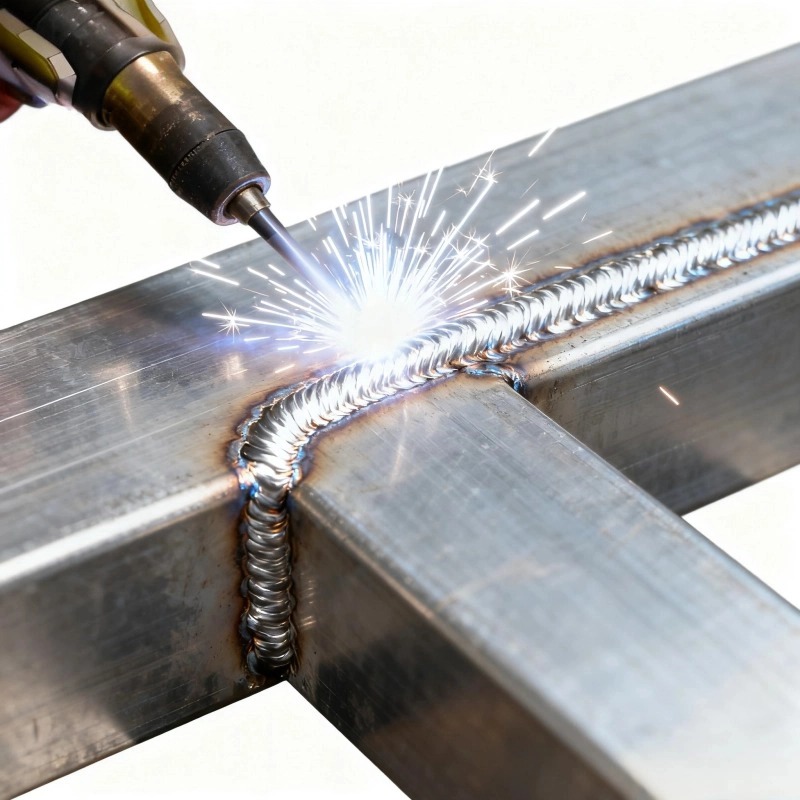
Custom Welding of Aluminum Structural Parts
Custom welding of aluminum structural parts is a custom service that joins aluminum profiles or sheets by welding into non-standard brackets, connectors, frames, and other structural parts. Unlike assembling standard profiles with connectors, welded struc
Product Details
Custom welding of aluminum structural parts is a custom service that joins aluminum profiles or sheets by welding into non-standard brackets, connectors, frames, and other structural parts. Unlike assembling standard profiles with connectors, welded structural parts offer higher structural strength, better rigidity, and superior long-term running stability, suited to heavy-duty equipment, high-precision machinery, and long-running automated production lines. Welded aluminum structural parts feature an attractive appearance, light weight, easy profile cross-section forming, and high corrosion resistance and recyclability.
Shanghai Chuangsi Aluminum provides a full-process one-stop service from extrusion and CNC finishing to welded assembly and surface treatment. Suitable alloys include 6061-T6, 6063-T5, 5052, and 5083, covering structural parts from 0.5mm to 40mm thick. We support custom work per drawings or samples and small-batch prototyping, with a welding quality inspection report for each batch.
01 Quality Starts from Raw Materials
Produced from A00 primary aluminum ingot with no scrap aluminum, giving pure material and stable welding performance. We select high-quality 6061-T6, 6063-T5, 5052, and 5083 aluminum profiles and sheets to safeguard weld quality from the source.
02 Professional Weld Process Control
The core difficulty of welding aluminum structural parts is controlling welding deformation and ensuring weld strength. Aluminum has high thermal conductivity (about 201W/(m·K), roughly 4x that of steel) and a large thermal expansion coefficient (about 2x that of steel); concentrated heat during welding easily deforms profiles. We control weld quality through the following measures:
Optimized welding sequence: using segmented skip welding and symmetric welding to avoid heat concentration
Controlled heat input: adjusting welding voltage, current, and travel speed to precisely control heat input
Rigid fixturing: using dedicated fixtures to hold workpieces and limit displacement during welding
Welding anti-deformation: presetting reverse deformation before welding to compensate for post-weld shrinkage
Weld quality inspection: key welds are verified by non-destructive testing to ensure weld strength meets design requirements
03 Multi-Process Welding Capability
Equipped with argon arc welders, gas-shielded welders, spot welders, and robotic automatic welding equipment. We can perform MIG/TIG argon-arc welding, gas-shielded welding, spot welding, and robotic automatic welding on aluminum structural parts, covering welding needs from 0.5mm to 40mm across different profile cross-sections.
MIG welding (metal inert-gas welding) : high welding efficiency, suited to structural parts from 3mm to 10mm thick
TIG welding (tungsten inert-gas welding) : high weld quality and a clean bead, suited to thin sheets (0.5mm to 3mm) and appearance-critical structural parts
Spot welding: suited to point-fixed welding of thin-sheet structural parts
Robotic automatic welding: good consistency and high efficiency, suited to batch structural-part welding
04 One-Stop Delivery Service
From extrusion and CNC finishing to welded assembly and surface treatment, the full process is delivered one-stop. The customer deals with only one supplier, effectively reducing quality risks from multi-stage handoffs. Each batch comes with a welding quality inspection report, and key welds are traceable. We can weld all kinds of aluminum structural parts with short lead times and assured quality.
Machining capability parameters:
| Item | Parameter/Description |
|---|---|
| Application | Non-standard brackets, connectors, frames, bases, fixtures, and other structural parts |
| Applicable alloys | 6061-T6, 6063-T5, 5052, 5083, etc. |
| Welding process | MIG/TIG argon-arc welding, gas-shielded welding, spot welding, robotic automatic welding |
| Applicable thickness | 0.5mm-40mm |
| Weld strength | ≥85% of base material |
| Welding standard | ISO9001 quality management system |
| Supporting processing | Extrusion, mold development, CNC finishing, surface treatment |
| Surface treatment | Anodizing, powder coating, sandblasting, brushing |
| Production location | Qingpu, Shanghai |
| MOQ | Small-batch customization supported, custom work per drawings or samples |
Typical applications of aluminum structural-part welding:
| Application | Welding requirements | Typical products |
|---|---|---|
| Non-standard industrial equipment brackets | High load capacity, stable structure | Equipment mounting brackets, base brackets |
| Automated equipment connectors | High dimensional precision, consistent assembly | Robot connectors, equipment adapters |
| Inspection equipment frames | Stable structure, good precision retention | Inspection platform frames, measuring instrument supports |
| Tooling and fixtures | Precise positioning, sufficient rigidity | Welding jigs, assembly fixtures |
| Conveyor line supports | High mounting precision, long-term stability | Conveyor belt supports, roller supports |
| Aerospace components | High strength, lightweight | Aviation structural brackets, satellite connectors |
FAQ (Frequently Asked Questions)
Q1: What is the difference between custom welded aluminum structural parts and assembling standard profiles with connectors?
A: Assembling standard profiles with connectors (angle brackets, bolts, nuts, etc.) is a mechanical connection that is quick and detachable, but has limited rigidity and torsional strength. Welded structural parts permanently join profiles or sheets into a whole by MIG/TIG argon-arc welding, offering higher structural strength, better rigidity, and superior long-term running stability, suited to heavy-duty equipment, high-precision machinery, and long-running automated lines. Welded aluminum structural parts feature an attractive appearance, light weight, easy profile cross-section forming, and high corrosion resistance and recyclability.
Q2: What types of structural parts can be welded?
A: We can weld non-standard industrial equipment brackets (equipment mounting brackets, base brackets), automated equipment connectors (robot connectors, equipment adapters), equipment base brackets (heavy load-bearing bases for large equipment), inspection equipment frames (inspection platform frames, measuring instrument supports), tooling and fixtures (welding jigs, assembly fixtures), conveyor line supports (belt supports, roller supports), robot workstation connectors, electrical equipment mounting brackets, instrument supports, aerospace components (aviation structural brackets, satellite connectors), medical device structural parts, and new-energy equipment brackets.
Q3: Which alloys and thicknesses can be welded?
A: We can weld 6061-T6 (high-strength structural parts, excellent overall performance), 6063-T5 (general structural parts, good formability and weldability), 5052 (good corrosion resistance, for humid or chemical environments), and 5083 (marine-grade alloy, excellent corrosion resistance). Thickness range is 0.5mm-40mm: thin sheets (0.5mm-3mm) use TIG argon-arc welding or robotic welding; medium plates (3mm-10mm) use MIG welding for efficiency; thick plates (10mm-40mm) use multi-pass welding to ensure penetration and strength.
Q4: How do you ensure weld strength and structural stability?
A: We ensure this through five steps: first, base material selection - high-quality aluminum profiles and sheets; second, filler wire matching - dedicated wire for each alloy; third, process control - optimized welding sequence, controlled heat input, skip welding, and rigid fixturing; fourth, deformation control - using welding anti-deformation to preset reverse deformation and compensate post-weld shrinkage; fifth, quality inspection - key welds verified by non-destructive testing, with a welding quality report each batch. Weld strength typically reaches 85% or more of the base material.
Q5: What is your non-standard customization capability for welded aluminum structural parts?
A: We take on custom welding of all kinds of non-standard brackets, connectors, and frames. The customer provides drawings or samples, and we deliver the full process one-stop from extrusion and CNC finishing to welded assembly and surface treatment, supporting custom work per drawings/samples and small-batch prototyping. We weld all kinds of aluminum structural parts with short lead times and assured quality.
Q6: How is aluminum structural-part welding priced?
A: Priced by structural-part complexity, weld length, and material thickness. Simple brackets are priced per set; complex parts are priced by weld meter or labor hours. Free evaluation and quotation on samples. Contact Manager Du at 13611846009.
Q7: What are the MOQ and lead time for welded aluminum structural parts?
A: MOQ is 50kg, supporting small-batch prototyping and batch production. Standard structural-part welding samples take 5-7 days, and batch delivery is 10-15 days after sample confirmation. Because welding involves extrusion, CNC finishing, and welded assembly, we recommend discussing structural requirements and load parameters in advance.
Q8: Which fields mainly use welded aluminum structural parts?
A: Mainly used for welding non-standard industrial equipment brackets, automated equipment connectors, equipment base brackets, inspection equipment frames, tooling and fixtures, conveyor line supports, robot workstation connectors, electrical equipment mounting brackets, instrument supports, aerospace components, medical device structural parts, and new-energy equipment brackets.

GET A QUOTE
Once you have submitted your requirements, we will contact you as soon as possible regarding your product inquiry.:Custom Welding of Aluminum Structural Parts