
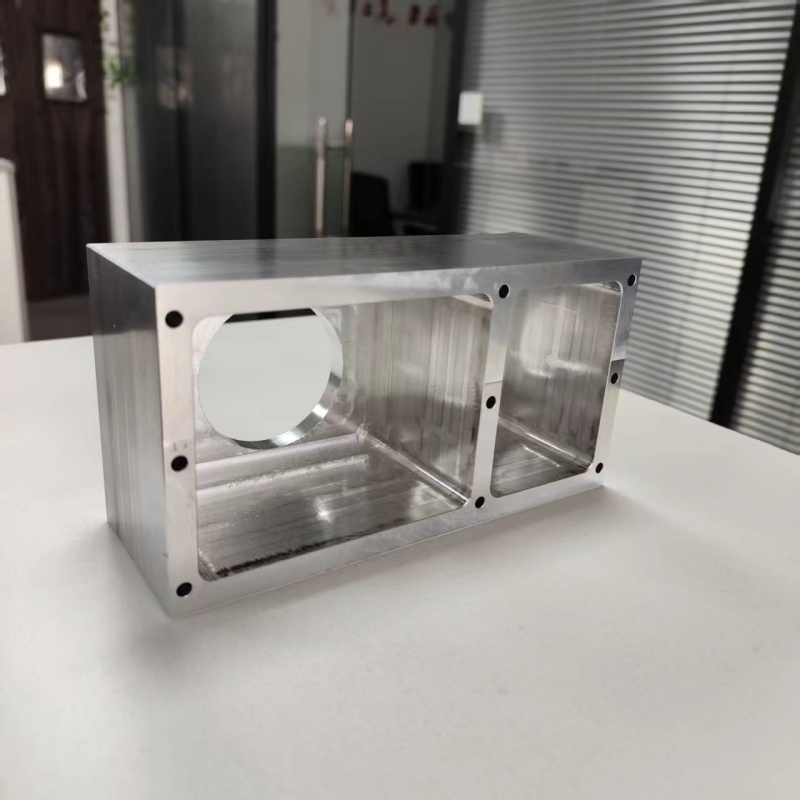
Aluminum Product Processing
Aluminum Profile CNC Milling
Aluminum profile CNC milling is one of the core processes in aluminum profile precision machining, and the most important means of transforming extruded aluminum profiles into high-precision structural parts. Milling removes material from the profile surf
Product Details
Aluminum profile CNC milling is one of the core processes in aluminum profile precision machining, and the most important means of transforming extruded aluminum profiles into high-precision structural parts. Milling removes material from the profile surface with a rotating tool and can complete precision machining of complex features such as face milling, curved-surface milling, groove milling, profile milling, cavity milling and circular interpolation.
Milling accuracy directly determines part assembly precision and equipment performance: whether it is the high-precision plane needed for AI server heat sink substrates, the complex internal structure required for semiconductor equipment cavities, or the precision contour needed for robot connectors, milling is the key process to realize these designs.
Shanghai Chuangsi Aluminum Co., Ltd. is located in Qingpu, Shanghai, with its own factory equipped with five-axis/three-axis CNC machining centers and gantry milling machines, adopting high-rigidity spindles and precision servo drive systems. Spindle speed reaches up to 24000rpm, milling positioning accuracy is ±0.02mm, repeat positioning accuracy is ±0.005mm, and surface roughness can reach Ra1.6μm (high precision Ra ≤0.8μm). We can machine all grades of aluminum alloy including 6061-T6, 6063-T5, 6005-T6, 6082-T6 and 7075-T5. Maximum machining length is 6.5m, width 550mm and height 500mm, meeting milling needs from extra-long profiles to large structural parts.
Core Machining Capabilities:
1. Face milling: Large-area material removal on the profile surface to obtain high-flatness mounting or reference surfaces. Flatness ≤0.02mm, surface roughness Ra ≤1.6μm, suitable for equipment mounting surfaces and heat sink substrate planes.
2. Curved-surface milling: Multi-axis linkage controls the tool along curved paths to machine complex 3D surfaces, suitable for robot arm surfaces, irregular part surfaces and aerodynamic contours.
3. Groove milling: Milling T-slots, V-slots, U-slots and dovetail slots on the profile surface. Slot width accuracy ±0.02mm, slot depth accuracy ±0.02mm, suitable for guide rail mounting slots and positioning slots.
4. Profile milling: Milling along the outer or inner contour of the workpiece to obtain precise outer dimensions. Contour accuracy ±0.02mm, suitable for connectors, flanges and structural parts.
5. Cavity milling: Milling internal cavity structures inside the profile while retaining the outer wall, suitable for RF and microwave cavities, semiconductor cavities and sensor housings.
6. Circular interpolation and multi-axis linkage machining: Five-axis linkage completes precision machining of complex arcs and spatial surfaces in a single setup, performing multi-face machining without repeated clamping.
Machining capability parameters:
| Item | Parameter / Description |
|---|---|
| Equipment Type | Five-axis / three-axis CNC machining center, gantry milling machine |
| Milling Positioning Accuracy | ±0.02mm |
| Repeat Positioning Accuracy | ±0.005mm |
| Flatness | ≤0.02mm |
| Contour Accuracy | ±0.02mm |
| Groove Accuracy | ±0.02mm |
| Surface Roughness | Ra ≤1.6μm (high precision Ra ≤0.8μm) |
| Spindle Speed | Up to 24000rpm |
| Maximum Machining Length | 6500mm |
| Maximum Machining Width | 550mm |
| Maximum Machining Height | 500mm |
| Milling Methods | Face milling, curved-surface milling, groove milling, profile milling, cavity milling, circular interpolation |
| Available Materials | 6061-T6, 6063-T5, 6005-T6, 6082-T6, 7075-T5 |
| Machining Method | Custom from drawings, custom from samples |
| Executive Standard | GB/T 6892-2023 high-precision grade |
| MOQ | 50kg |
| Sample Lead Time | 3-7 days (depending on complexity) |
| Bulk Lead Time | 7-15 days after sample confirmation |
| Production Location | Qingpu, Shanghai |
Selection Reference:
| Application | Recommended Milling Method | Key Requirement |
|---|---|---|
| AI server heat sink substrate | Face milling | Flatness ≤0.02mm, Ra ≤1.6μm |
| Semiconductor equipment cavity | Cavity milling + profile milling | Cavity accuracy ±0.02mm, high internal finish |
| Robot connector | Profile milling + curved-surface milling | Contour accuracy ±0.02mm, multi-face machining |
| Equipment mounting surface | Face milling + groove milling | Flat mounting surface, precise groove positioning |
| 5G communication equipment housing | Cavity milling + profile milling | Thin-wall milling without deformation, high cavity accuracy |
| New energy battery tray | Face milling + groove milling | Large-plane flatness, batch consistency |
Typical Applications:
-
Face milling of AI server heat sink substrates
-
Internal milling of semiconductor equipment cavities
-
Profile milling of robot connectors
-
Milling flatting of automation equipment mounting surfaces
-
Cavity machining of 5G communication equipment housings
-
Precision structural part milling for medical equipment
-
Plane and groove milling for new energy battery trays
-
Complex contour machining for non-standard equipment
FAQ (Frequently Asked Questions)
Q1: What is the difference between aluminum profile milling and ordinary CNC machining?
A: CNC machining is a general term covering milling, turning, drilling, tapping and other processes. Milling specifically refers to removing material from the workpiece surface with a rotating tool, and is the core component of CNC machining. We publish milling as a separate category so customers can precisely find the matching service for their milling needs.
Q2: What accuracy can milling achieve?
A: Milling positioning accuracy ±0.02mm, repeat positioning accuracy ±0.005mm. Flatness ≤0.02mm, contour accuracy ±0.02mm, groove accuracy ±0.02mm. The exact accuracy must be comprehensively evaluated based on workpiece size, structure and material.
Q3: What is the maximum aluminum profile size that can be milled?
A: Maximum machining length 6500mm, width 550mm, height 500mm. Milling of extra-long profiles is one of our core strengths, especially suited to the machining needs of large equipment structural parts.
Q4: Is aluminum alloy milling prone to deformation, and how is it solved?
A: Aluminum alloy has a relatively high thermal expansion coefficient and relatively low rigidity, so deformation indeed occurs easily during milling. We control deformation through the following measures: (1) optimize clamping with dedicated tooling and fixtures; (2) select suitable tools and cutting parameters; (3) separate roughing and finishing in multiple passes when necessary; (4) use support fixtures for thin-wall parts to reduce vibration.
Q5: What is the difference between five-axis and three-axis milling?
A: Three-axis milling moves the tool along X, Y and Z directions, suitable for features such as planes, grooves and simple contours. Five-axis milling adds two rotary axes, completing complex curved surfaces and multi-face machining in one setup, with higher accuracy and efficiency, suited to curved irregular parts and complex cavities. We have both types of equipment and select the optimal solution based on part features.
Q6: Is milling the same as end face milling flatting?
A: Not exactly. End face milling flatting is a specific application of milling, referring specifically to milling the profile end face to obtain a flat end face and precise length. Milling covers a broader range including face milling, curved-surface milling, groove milling, profile milling and cavity milling. End face milling flatting can be understood as one member of the milling family.

GET A QUOTE
Once you have submitted your requirements, we will contact you as soon as possible regarding your product inquiry.:Aluminum Profile CNC Milling