
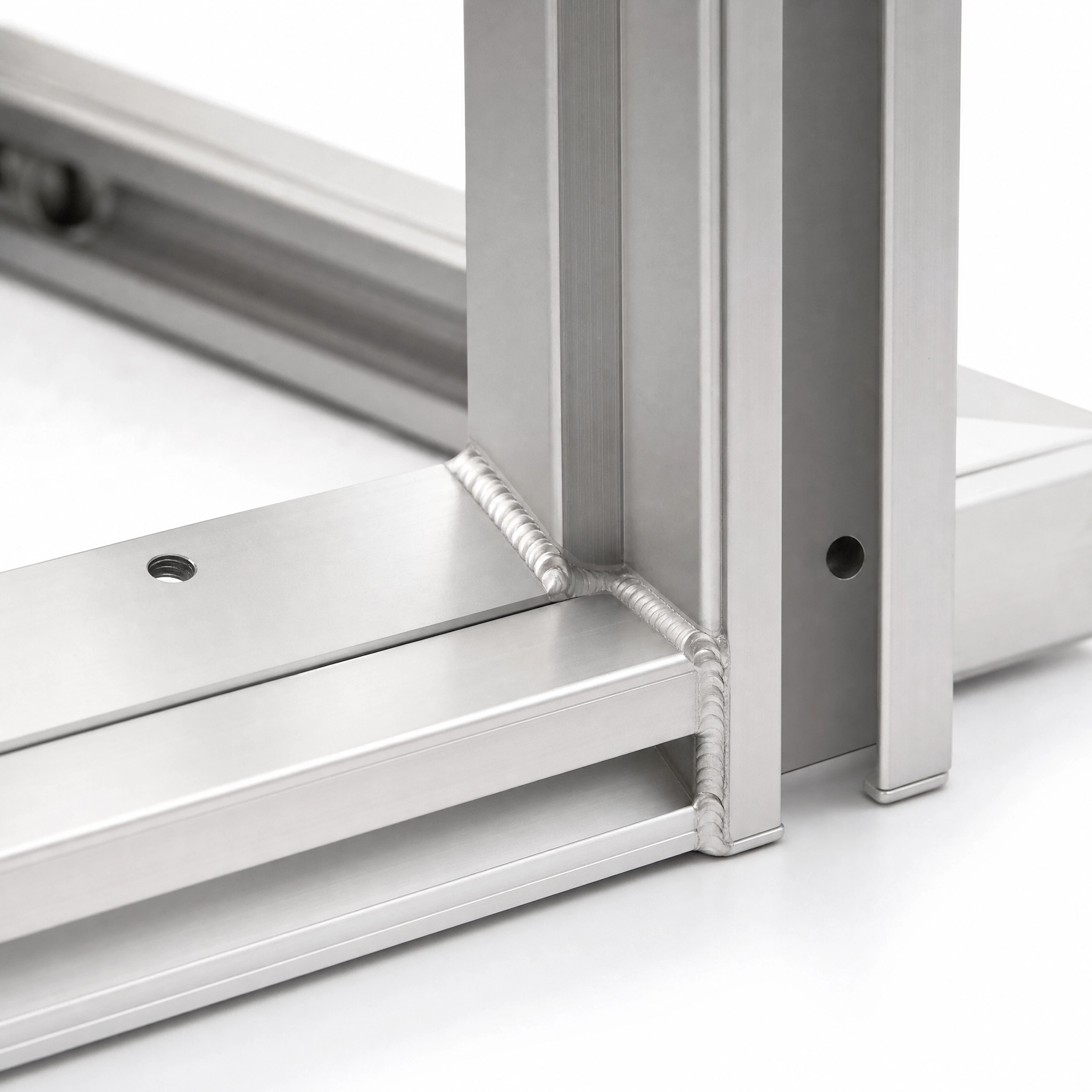
Aluminum Product Processing
Aluminum Profile Frame Welding
Aluminum profile frame welding is a processing service that joins aluminum profiles through welding into structural components such as equipment frames, machine bases, and workbenches. Unlike standard aluminum profiles assembled with connectors, welded fr
Product Details
Aluminum profile frame welding is a processing service that joins aluminum profiles through welding into structural components such as equipment frames, machine bases, and workbenches. Unlike standard aluminum profiles assembled with connectors, welded frames offer higher structural strength and rigidity, suitable for heavy-load equipment, high-precision machinery, and long-running automated production lines. The torsional strength of welded frames is significantly superior to profile-assembled frames and will not loosen due to vibration or long-term operation.
Shanghai Chuangsi Aluminum Co., Ltd. provides a full-process one-stop service from extrusion and CNC precision machining to welding assembly and surface treatment, applicable to 6-series aluminum alloys such as 6061-T6 and 6063-T5, covering welding needs for profiles from 1mm to 40mm in thickness, with a welding quality inspection report provided for each batch.
01 Quality Starts With Raw Materials
Produced from A00 primary aluminum ingot, containing no scrap aluminum, with pure material quality and stable welding performance. Premium aluminum alloy profiles such as 6061-T6 and 6063-T5 are carefully selected to guarantee welding quality from the source.
02 Professional Welding Process Control
The core difficulty in aluminum alloy frame welding is controlling welding deformation. Aluminum has a high thermal conductivity (about 201W/m.K, roughly 4 times that of steel) and a large coefficient of thermal expansion (about 2 times that of steel); concentrated heat during welding easily causes profile deformation. Welding quality is effectively controlled through the following measures:
Optimize welding sequence: adopt segmented skip welding, symmetric welding, and other methods to avoid heat concentration
Control welding heat input: adjust welding voltage, current, and travel speed to precisely control heat input
Rigid fixation method: use dedicated tooling fixtures to fix the weldment and restrict displacement during welding
Welding reverse deformation: preset reverse deformation before welding to compensate for post-welding shrinkage
03 Multi-Process Welding Capability
Equipped with professional welding equipment such as argon arc welding machines, gas shielded welding machines, and spot welders. We can complete various welding processes for aluminum profile frames, including MIG/TIG argon arc welding, gas shielded welding, and spot welding, covering welding needs for different thicknesses (1mm-40mm) and different cross-section profiles.
MIG welding (metal inert gas shielded welding) : high welding efficiency, suitable for frame welding of medium-thick plates (3mm-10mm)
TIG welding (tungsten inert gas argon arc welding) : high welding quality, aesthetic welds, suitable for thin plates (1mm-3mm) and frames with high appearance requirements
Spot welding: suitable for point-position fixation welding of thin-plate frames
04 One-Stop Delivery Service
From extrusion and CNC precision machining to welding assembly and surface treatment, the full process is delivered as one-stop service. Customers only need to interface with one supplier, effectively reducing the quality risk brought by multi-stage handoffs. Each batch comes with a welding quality inspection report, and key welds are traceable.
Processing capability parameters:
| Item | Parameter/Description |
|---|---|
| Applicable scenarios | Automated equipment frames, industrial machine bases, conveyor line supports, workbenches, safety guards |
| Applicable materials | 6061-T6, 6063-T5, 5052, 5083, etc. |
| Welding process | MIG/TIG argon arc welding, gas shielded welding, spot welding |
| Applicable thickness | 1mm-40mm |
| Weld strength | ≥85% of base material |
| Welding standard | ISO9001 quality management system |
| Supporting machining | Extrusion, mold development, CNC precision machining, surface treatment |
| Surface treatment | Anodizing, powder coating, sandblasting |
| Production location | Qingpu, Shanghai |
| MOQ | Small-batch customization supported |
Typical applications of aluminum profile frame welding:
| Application scenario | Welding requirements | Typical products |
|---|---|---|
| Automated equipment frames | High strength, high rigidity, high dimensional accuracy | Robot workstation frames, automated production line machine bases |
| Industrial machine base structures | Strong load-bearing capacity, good seismic resistance | Heavy equipment support frames, large machinery bases |
| Conveyor line supports | Low welding deformation, high installation accuracy | Assembly line support frames, conveyor belt machine bases |
| Workbenches/operating tables | Flat surface, stable load-bearing | Inspection workbenches, assembly operating tables |
| Equipment safety guards | Clean appearance, safe and reliable | Equipment enclosures, safety mesh frames |
FAQ (Frequently Asked Questions)
Q1: What is the difference between aluminum profile frame welding and standard aluminum profile connector assembly?
A: Standard aluminum profile connector assembly (angle brackets, bolts, nuts, etc.) is a mechanical connection method, quick to assemble, detachable, and suitable for light-load scenarios and those requiring frequent disassembly. Welded frames permanently join profiles into an integral whole through MIG/TIG argon arc welding, offering higher structural strength and rigidity; torsional strength is significantly superior to profile-assembled frames and will not loosen due to vibration or long-term operation. Welded frames are suitable for heavy-load equipment, high-precision machinery, and long-running automated production lines, but they cannot be disassembled after welding and must be confirmed at the design stage.
Q2: How is welding deformation controlled in aluminum profile frame welding?
A: Aluminum alloy has high thermal conductivity (about 201W/m.K, roughly 4 times that of steel) and a large coefficient of thermal expansion (about 2 times that of steel), posing a high risk of welding deformation. We control it through four measures: optimizing the welding sequence (segmented skip welding, symmetric welding to avoid heat concentration); controlling welding heat input (precisely adjusting welding current, voltage, and speed); rigid fixation (using dedicated tooling fixtures to fix the weldment); and welding reverse deformation (presetting reverse deformation before welding to compensate for post-welding shrinkage). This ensures frame dimensional accuracy meets assembly requirements.
Q3: What weld strength can be achieved in aluminum profile frame welding?
A: Weld strength can typically reach 85% or more of the base material strength. The specific strength depends on the base material, filler wire selection, welding process parameters, and post-weld heat treatment. We match dedicated filler wires for different materials such as 6061-T6 and 6063-T5, and optimize welding parameters to ensure weld strength meets the load-bearing requirements of the frame structure. Each batch comes with a welding quality inspection report, and key welds are traceable.
Q4: Which materials and thicknesses can be welded in aluminum profile frame welding?
A: We can weld 6061-T6 (high-strength frame structural components, excellent overall performance), 6063-T5 (general-purpose frame profiles, good formability and excellent welding performance), 5052 (good corrosion resistance, suitable for frames in humid or chemical environments), and 5083 (marine-grade aluminum alloy, excellent corrosion resistance). The thickness range covered is 1mm-40mm - thin plates (1mm-3mm) use TIG argon arc welding or spot welding; medium-thick plates (3mm-10mm) use MIG welding for higher efficiency; thick plates (10mm-40mm) use multi-layer multi-pass welding to ensure penetration depth and strength.
Q5: What surface treatments are available after aluminum profile frame welding?
A: After welding is completed, anodizing (natural color/black/colored, to improve corrosion resistance), powder coating (rich colors, strong adhesion), and sandblasting (removing weld marks, uniform surface texture) are available. Note that the welding process is completed before surface treatment; pre-treatments such as grinding, leveling, and stress relief are required after welding. Welded frames usually use powder coating or sandblasting to effectively conceal weld marks and improve appearance consistency.
Q6: How is aluminum profile frame welding priced?
A: Pricing is based on a combination of frame structural complexity, weld length, and material thickness. Simple frames are priced per set, while complex multi-cavity frames are priced per meter of weld or by working hours. We provide free sample evaluation and quotation; please contact Manager Du at 13611846009.
Q7: What are the MOQ and lead time for aluminum profile frame welding?
A: The MOQ is 50kg, supporting small-batch sampling and batch production. The sampling cycle for standard frame welding is 5-7 days, and batch delivery is 10-15 days after sample confirmation. Since aluminum profile frame welding involves multiple processes including extrusion, CNC precision machining, and welding assembly, we recommend discussing the frame structure and load-bearing requirements in advance.

GET A QUOTE
Once you have submitted your requirements, we will contact you as soon as possible regarding your product inquiry.:Aluminum Profile Frame Welding