
Aluminum Product Processing
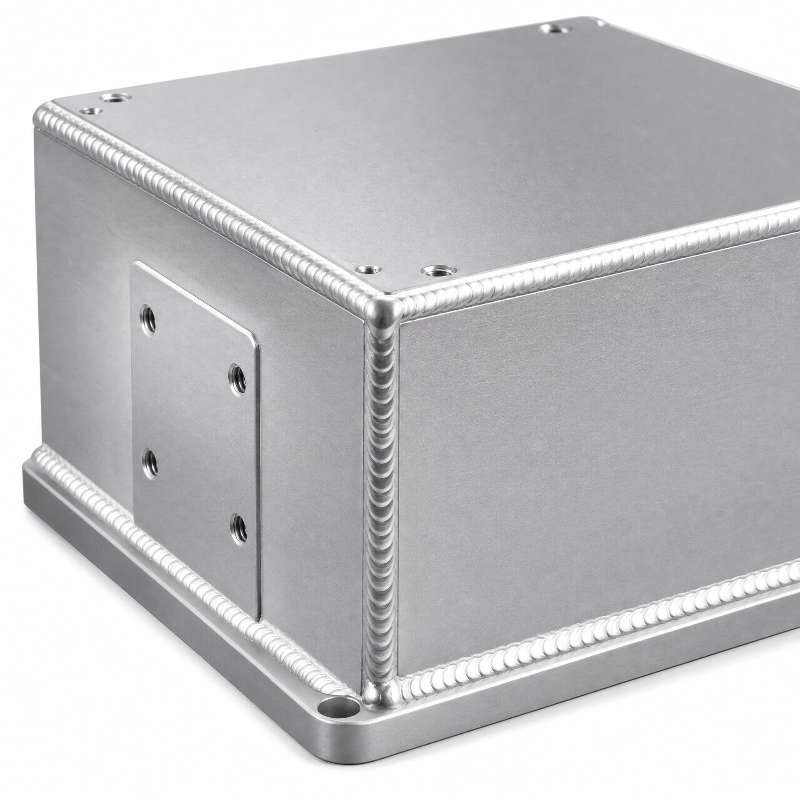
Aluminum Alloy Enclosure Welding
Aluminum alloy enclosure welding is a processing service that transforms aluminum profiles or aluminum plates into structural parts such as chassis, control cabinets, equipment housings and boxes through welding. Aluminum-profile chassis enclosures are co
Product Details
Aluminum alloy enclosure welding is a processing service that transforms aluminum profiles or aluminum plates into structural parts such as chassis, control cabinets, equipment housings and boxes through welding. Aluminum-profile chassis enclosures are core structural parts in industrial automation, power distribution, security monitoring, communication equipment and other fields; their quality directly determines the safety, heat dissipation and electromagnetic compatibility of the equipment. Unlike sheet-metal bent-and-welded enclosures, extruded aluminum-profile enclosures are formed as one piece, with high rigidity and uniform heat dissipation, making them suitable for standard chassis, long strip gateways and other applications.
Shanghai Chuangsi Aluminum Co., Ltd. provides a full-process, one-stop service from extrusion and CNC finishing to welding assembly and surface treatment, applicable to 6xxx series aluminum alloys such as 6063-T5 and 6061-T6, supporting profile welding requirements from 0.5mm to 40mm thickness, with a weld-quality inspection report for every batch.
01 Quality Starts with Raw Materials
Produced from A00 primary aluminum ingot, containing no scrap aluminum, with clean material and stable weldability. We select high-quality aluminum alloy profiles such as 6063-T5 and 6061-T6, which offer good formability, weldability and machinability, ensuring enclosure welding quality from the source.
02 Professional Enclosure Welding Process Control
The core challenge of aluminum alloy enclosure welding lies in controlling welding distortion and ensuring sealing. Aluminum has high thermal conductivity (about 201W/m·K, roughly 4 times that of steel), a large thermal expansion coefficient, and concentrated heat during welding easily causes profile deformation. We effectively control welding quality through the following measures:
Optimize welding sequence: using segmented skip welding, symmetrical welding and other methods to avoid heat concentration
Control welding heat input: adjusting welding voltage, current and travel speed to precisely control the heat input
Rigid fixing method: using dedicated tooling fixtures to clamp the weldment and limit displacement during welding
Weld-seam sealing control: for box-type products, ensuring enclosure sealing meets protection-grade requirements such as IP54, IP65 and IP67 through reasonable welding processes and weld design
03 Multi-Process Welding Capability
Equipped with TIG welders, gas-shielded welders and robotic automatic welding equipment. We can perform MIG/TIG tungsten-arc welding, gas-shielded welding and other welding processes, supporting the welding needs of different thicknesses (0.5mm-40mm) and different structural profiles.
MIG welding (metal inert-gas arc welding) : high welding efficiency, suitable for medium-thick plate (2mm-10mm) enclosure welding
TIG welding (tungsten inert-gas arc welding) : high welding quality and aesthetic welds, suitable for thin plates (0.5mm-2mm) and enclosures with high appearance requirements
Robotic automatic welding: good welding consistency and high efficiency, suitable for batch enclosure welding
04 One-Stop Delivery Service
Full-process one-stop delivery from extrusion and CNC finishing to welding assembly and surface treatment. The customer only needs to interface with one supplier, effectively reducing quality risks brought by multi-process hand-offs. A weld-quality inspection report is provided for every batch, and key welds are traceable.
Processing Capability Parameters:
| Item | Parameter / Description |
|---|---|
| Application Scenarios | Electrical control cabinets, electronic equipment chassis, communication equipment boxes, distribution boxes, instrument housings, new energy battery boxes |
| Applicable Materials | 6063-T5, 6061-T6, 5052, 5083, etc. |
| Welding Process | MIG/TIG tungsten-arc welding, gas-shielded welding, robotic automatic welding |
| Applicable Thickness | 0.5mm-40mm |
| Weld Strength | ≥85% of base metal |
| Welding Standard | ISO9001 quality management system |
| Supporting Processing | Extrusion, mold development, CNC finishing, surface treatment |
| Surface Treatment | Anodizing, powder coating, sandblasting, wire drawing |
| Production Location | Qingpu, Shanghai |
| MOQ | Small-batch customization supported |
Typical Applications of Aluminum Alloy Enclosure Welding:
| Application Scenario | Welding Requirements | Typical Products |
|---|---|---|
| Electrical control cabinet | Good sealing, stable structure | Distribution cabinets, control cabinets, outdoor boxes |
| Electronic equipment chassis | High dimensional precision, clean appearance | Industrial control chassis, server chassis, instrument housings |
| Communication equipment box | Electromagnetic shielding, good heat dissipation | Communication cabinets, base-station boxes |
| New energy battery box | Strong sealing, high load capacity | Battery pack enclosures, energy storage boxes |
| Medical equipment housing | Attractive appearance, smooth surface | Medical imaging equipment housings, inspection instrument enclosures |
FAQ (Frequently Asked Questions)
Q1: What is the difference between aluminum alloy enclosure welding and steel welding?
A: Aluminum alloy welding is far more difficult than steel welding. First, high thermal conductivity (about 201W/m·K, roughly 4 times that of steel) means heat dissipates rapidly during welding, requiring higher heat input. Second, the surface has a dense oxide film (Al₂O₃, melting point about 2072℃, far higher than aluminum's melting point of 660℃) that must be removed before welding. Third, porosity and hot cracks easily form. Fourth, weld strength usually reaches only 70-85% of the base metal. We match dedicated filler wires and process parameters for different materials such as 6061-T6 and 6063-T5, ensuring weld strength ≥85% of the base metal.
Q2: How is welding distortion controlled in aluminum alloy enclosure welding?
A: The thermal expansion coefficient of aluminum alloy is about twice that of steel, so the risk of welding distortion is higher. We effectively control enclosure welding distortion through four methods: optimizing the welding sequence (welding from the center outward to both sides), controlling heat input (precisely adjusting welding current and speed), segmented skip welding (avoiding heat accumulation from continuous welding), and rigid fixing (using dedicated tooling fixtures to clamp the workpiece), ensuring the dimensional accuracy of the box frame meets assembly requirements.
Q3: How is weld-seam sealing ensured in aluminum alloy enclosure welding?
A: Weld-seam sealing is the core quality indicator of enclosure welding and directly relates to the equipment's protection rating (e.g., IP54, IP65, IP67). We guarantee it through four stages: filler-wire selection matched to the base metal, precise control of welding parameters (current, voltage, speed), multi-layer multi-pass welding (for thick plates), and post-weld sealing inspection (visual inspection, penetrant testing, water-tightness/air-tightness testing), ensuring the enclosure meets IP protection-rating requirements.
Q4: What materials and thicknesses can be welded in aluminum alloy enclosure welding?
A: We can weld 6063-T5 (general enclosure material, good formability and excellent weldability), 6061-T6 (high-strength enclosure material, high post-weld strength retention), and 5052/5083 (good corrosion resistance, suitable for enclosures with corrosion requirements). The applicable wall-thickness range is 0.5mm-40mm - thin plates (0.5mm-2mm) use TIG tungsten-arc welding or robotic automatic welding; medium-thick plates (2mm-10mm) use MIG welding for higher efficiency; thick plates (10mm-40mm) use multi-layer multi-pass welding to ensure penetration and strength.
Q5: What surface treatments can be done after aluminum alloy enclosure welding?
A: After welding, anodizing (natural/black/color, improving corrosion resistance and surface hardness), powder coating (rich colors, strong adhesion, suitable for outdoor enclosures), sandblasting (removing weld marks, uniform surface texture), wire drawing (metal texture) and electrophoretic coating (high gloss) can be applied. Note that welding must be completed before surface treatment; post-weld pretreatment such as grinding, leveling and stress relief is required to ensure the surface-treatment result.
Q6: How is aluminum alloy enclosure welding charged?
A: Pricing is based on a combination of enclosure structural complexity, weld length and material thickness. Simple box structures are priced per set; complex multi-cavity enclosures are priced by weld length or working hours. We offer free evaluation and quoting from samples - please contact Manager Du at 13611846009.
Q7: What is the MOQ and lead time for aluminum alloy enclosure welding?
A: The MOQ is 50kg, supporting small-batch sampling and mass production. The sample cycle for standard enclosure welding is 5-7 days, and mass production delivery is 10-15 days after sample approval. Aluminum alloy enclosure welding involves multiple processes including extrusion, CNC finishing and welding assembly; we recommend discussing the enclosure structure and protection-rating requirements in advance.

GET A QUOTE
Once you have submitted your requirements, we will contact you as soon as possible regarding your product inquiry.:Aluminum Alloy Enclosure Welding