
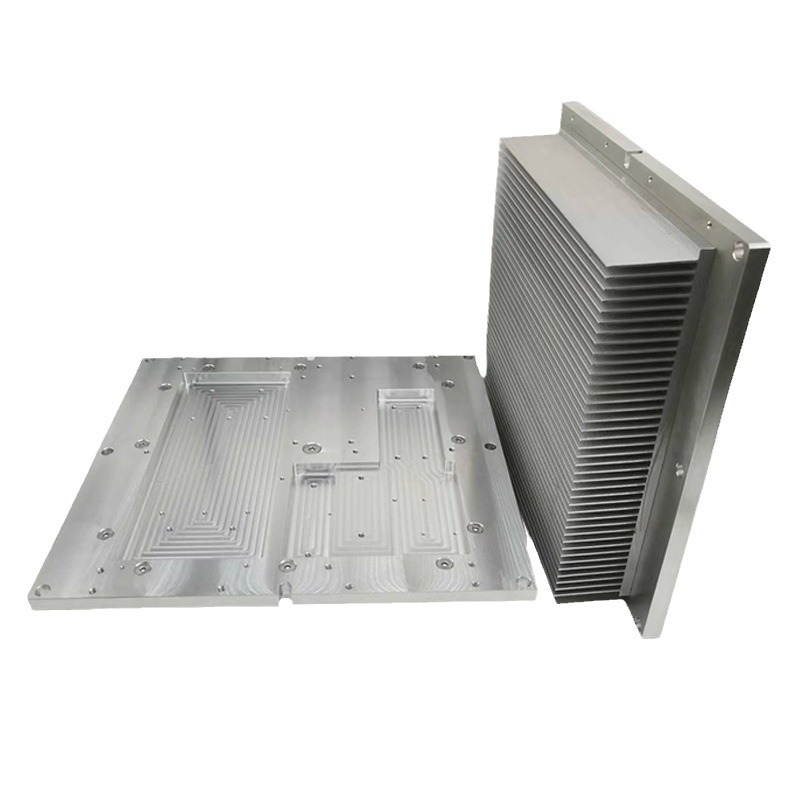
Aluminum Product Processing
Custom Mold Development for Liquid Cooling Plate Aluminum Profiles
Liquid cooling plate aluminum profile, a core liquid-cooling heat dissipation component developed for high-power AI servers and GPU computing equipment. The penetration rate of liquid cooling solutions in data centers keeps rising and is expected to enter
Product Details
Liquid cooling plate aluminum profile, a core liquid-cooling heat dissipation component developed for high-power AI servers and GPU computing equipment. The penetration rate of liquid cooling solutions in data centers keeps rising and is expected to enter an explosive period after 2026. Compared with copper, aluminum offers clear advantages in cost, weight and large-scale machining capability, and its share in rack-level and server-level cold plate systems keeps growing. It adopts a multi-channel integrated extrusion process, formed in one piece without spliced welds, delivering high heat exchange efficiency, strong sealing reliability and eliminating leakage risks at the source.
01 Quality Starts with Raw Materials
Produced from A00 primary aluminum ingot with no scrap aluminum, ensuring uniform material and stable mechanical properties of the aluminum profiles.
02 Integrated Extruded Flow Channels
Flow channel topology is optimized with CFD fluid simulation and formed in one piece through precision dies, producing smooth seamless channels with low coolant flow resistance and uniform heat exchange. Compared with welded cold plates, the integrally extruded profile has no weld leakage risk and improves heat exchange efficiency by more than 15%.
03 High-Precision Quality Control
Machined by precision slow-wire EDM, the cavity accuracy is controlled within ±0.02mm. Base plate flatness is ≤0.03mm/100mm, perfectly matching chip packaging and seal compression. Finished parts can be equipped with helium mass spectrometer leak testing, with a leak rate below 1×10⁻⁶Pa·m³/s.
04 Corrosion-Resistant Enhancement Process
For common coolants such as ethylene glycol aqueous solution, the internal channels can receive dedicated passivation or anodizing corrosion protection, improving electrochemical corrosion resistance by more than 3 times. The service life of the cold plate is extended to over 8 years.
05 Fully In-House Process Control
Mold development, hot extrusion, aging treatment and CNC finishing are all controlled in-house. Multiple imported machine tools and extra-long aluminum profile machining centers offer a travel up to 6.5 meters, with machining precision reaching ±0.01-0.005mm.
06 Local Supply in the Yangtze River Delta
The factory is located in Qingpu, Shanghai, deeply serving computing industry clusters such as Lingang, Zhangjiang and Suzhou. Engineers can be arranged on-site within 24 hours to address technical needs, and local delivery reduces transport damage.
Machining capability parameters:
| Item | Parameter / Description |
|---|---|
| Available Materials | 6061-T6 high-strength aluminum alloy, 3003 anti-rust aluminum alloy, dedicated high-thermal-conductivity aluminum alloy |
| Executive Standard | GB/T 6892-2023 high-precision grade, "Technical Specification for Microchannel Water-Cooled Plates for AI Servers" |
| Cross-Section Range | Width 50mm-600mm |
| Flow Channel Structure | Single/multi-channel, serpentine channel, split-cavity integrated cross-section |
| Minimum Channel Width | 3mm |
| Wall Thickness Uniformity | ±0.1mm |
| Channel Dimension Tolerance | ±0.05mm |
| Mounting Reference Surface Tolerance | ±0.03mm |
| Base Plate Flatness | ≤0.03mm/100mm |
| Overall Warpage | ≤0.05mm |
| Surface Treatment | Hard anodizing, internal channel anti-corrosion passivation, conductive oxidation, dedicated coolant-resistant coating |
| Deep Processing Support | Five-axis CNC precision milling of channels, sealing surface lapping, drilling and tapping, helium mass spectrometer leak testing, deburring and cleaning |
| Mold Development Lead Time | Samples in 7-10 days for standard structures |
| Bulk Lead Time | 12-20 days after sample confirmation |
| MOQ | Supports 10-piece R&D prototyping |
| Production Location | Qingpu, Shanghai |
Typical Applications:
-
Liquid-cooled cold plates for GPU training servers
-
Cold plates for AI inference servers
-
Liquid cooling heat dissipation modules for computing clusters
-
Liquid cooling components for edge computing nodes
-
Server cold plates for intelligent computing centers
-
Data center liquid cooling heat dissipation systems
-
Liquid cooling heat dissipation for energy storage converters
FAQ (Frequently Asked Questions)
Q1: What is the difference between an integrally extruded liquid cold plate and a welded one?
A: The flow channels of an integrally extruded liquid cold plate are formed in one die operation without spliced welds, eliminating leakage risk at the source. The smooth seamless channels offer low coolant flow resistance and uniform heat exchange, improving heat exchange efficiency by more than 15% over welded cold plates. Welded cold plates carry weld leakage risk, and the channels are discontinuous at the weld, increasing local flow resistance. Integrally extruded liquid cold plates are suitable for liquid cooling systems of AI computing clusters with per-rack power above 20kW.
Q2: What flow channel structures can be customized for liquid cooling plate aluminum profiles?
A: Customizable internal channel structures include serpentine channels (for uniform cooling), split channels (for large-flow, low-flow-resistance needs) and microchannel channels (for high heat flux density scenarios). Flow channel topology is optimized with CFD fluid simulation to meet cooling needs while keeping flow resistance within a reasonable range. Minimum channel width is 3mm.
Q3: Why is the base plate flatness requirement so high for liquid cooling plate aluminum profiles?
A: A liquid cold plate must fit tightly against the chip or heat source surface, and flatness directly determines contact thermal resistance. Base plate flatness ≤0.03mm/100mm ensures gap-free contact between the cold plate and the chip, minimizing contact thermal resistance. Insufficient flatness causes local poor contact, heat buildup and seriously impairs cooling efficiency, and may even lead to chip overheating, throttling or damage.
Q4: How do liquid cooling plate aluminum profiles prevent coolant leakage?
A: Three lines of defense prevent leakage: at the design stage, integrally extruded forming eliminates spliced welds and weld leakage at the source; at the machining stage, precision slow-wire EDM keeps cavity accuracy within ±0.02mm; at the inspection stage, finished parts undergo helium mass spectrometer leak testing with a leak rate below 1×10⁻⁶Pa·m³/s. These three lines of defense ensure zero leakage over long-term operation.
Q5: What materials are available for liquid cooling plate aluminum profiles?
A: Available materials include 6061-T6 high-strength aluminum alloy (excellent overall performance, suitable for most cold plate applications), 3003 anti-rust aluminum alloy (good corrosion resistance, suitable for long-term water cooling cycles) and dedicated high-thermal-conductivity aluminum alloy (better thermal conductivity). We recommend the most suitable material based on your thermal design power, coolant type and operating environment.
Q6: What is the MOQ and lead time for liquid cooling plate aluminum profiles?
A: We support 10-piece R&D prototyping, ideal for early verification and testing of AI server liquid cooling solutions. Standard structures take 7-10 days for mold development and samples, and bulk delivery is 12-20 days after sample confirmation. Liquid cooling projects usually have tight lead times, and we support expedited scheduling.

GET A QUOTE
Once you have submitted your requirements, we will contact you as soon as possible regarding your product inquiry.:Custom Mold Development for Liquid Cooling Plate Aluminum Profiles