
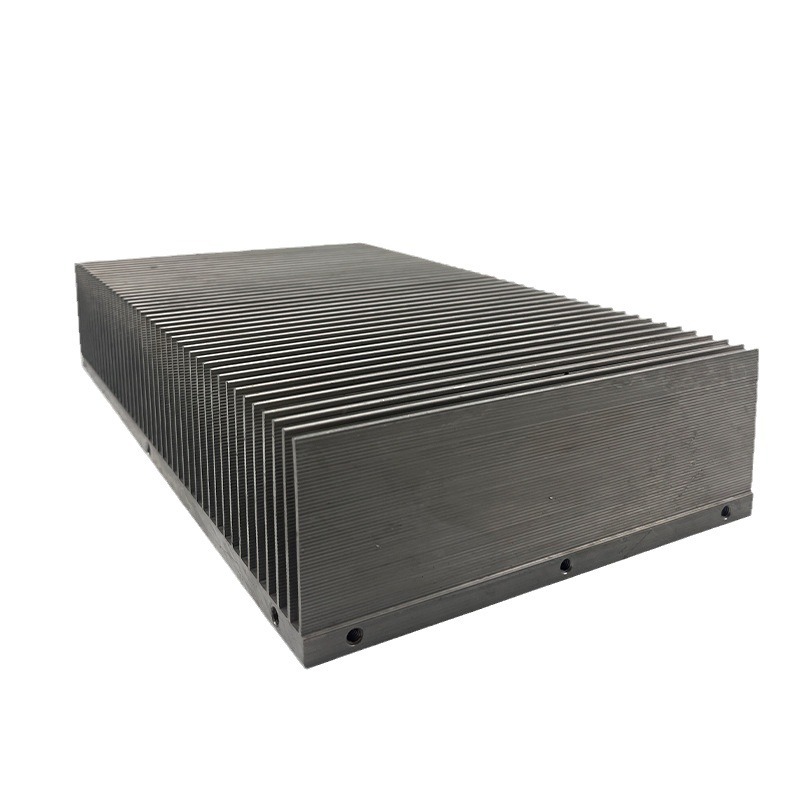
Aluminum profiles for radiators
High-Fin Air-Cooled Heat Sink Aluminum Profile
High-fin air-cooled heat sink aluminum profile - in AI inference servers and edge-computing workstations, air cooling remains the mainstream thermal solution. As chip power keeps rising, ordinary heat sinks can no longer meet heat dissipation needs, makin
Product Details
High-fin air-cooled heat sink aluminum profile - in AI inference servers and edge-computing workstations, air cooling remains the mainstream thermal solution. As chip power keeps rising, ordinary heat sinks can no longer meet heat dissipation needs, making high-fin aluminum heat sinks the key technical path for air cooling.
Shanghai Chuangsi Aluminum focuses on the core requirements air cooling places on profiles - "high heat-dissipation density, low air resistance, high forming precision" - and provides one-stop custom mold development from fin topology optimization, mold development, and one-piece extrusion to precision deep-processing. By optimizing the fin topology, we maximize heat-dissipation area within the limited installation space and, paired with precise airflow-channel design, achieve efficient convective heat transfer that effectively covers the hundreds-of-watts dissipation needs of single chips.
Core advantages at a glance:
| Advantage dimension | Technical metric | Customer value |
|---|---|---|
| High heat-dissipation density | Min. fin thickness 0.5mm, fin-height ratio up to 15:1 | Heat-dissipation area 40%+ higher than ordinary profiles |
| Low air-resistance design | Staggered / split / inclined fins customizable | Matches server fan pressure characteristics |
| High-precision fin shape | Fin thickness deviation ±0.03mm | Uniform fins, no broken or tilted teeth |
| Low-stress stability | Two-stage constant-temperature aging process | Minimal base warpage after machining |
| High flatness | Base flatness ≤0.05mm/100mm | Tight contact with chips and heat pipes, lowering contact thermal resistance |
| Multiple alloys available | 6063-T5 / 1070 pure aluminum / 6061-T6 | Suits different power levels and installation scenarios |
| Fast delivery | Samples in 7-10 days for standard structures, MOQ 50kg | Predictable project timeline |
01 Quality Starts from Raw Materials
Produced from A00 primary aluminum ingot with no scrap aluminum, giving stable thermal conductivity and consistent heat-dissipation performance within a batch.
02 High-Fin Precision Forming
Using high-precision dies and isothermal extrusion, we achieve ultra-thin fins and high aspect-ratio complex fin geometry, with min. fin thickness 0.5mm, max. fin height 60mm, and fin-height ratio up to 15:1. Fins are uniform with no broken or tilted teeth, keeping airflow channels even and clear. Fin thickness deviation is held within ±0.03mm, with no collapsed or starved fins.
03 Low Air-Resistance Optimized Design
Using thermal-simulation data to optimize fin spacing, fin thickness, and airflow-channel angle, we can customize staggered, split, and inclined fin geometries, controlling air resistance reasonably while preserving heat-dissipation area and matching server fan pressure characteristics.
04 Low-Stress Stabilizing Process
We strictly apply a two-stage constant-temperature aging process to fully release residual stress in the profile, giving minimal base warpage after machining. Base flatness ≤0.05mm/100mm and fin straightness ≤0.3mm/m ensure tight contact between the heat sink, chip, and heat pipes, effectively lowering contact thermal resistance.
05 Multiple Alloy Options
For standard air cooling, 6063-T5 alloy offers good formability and cost performance; for high power, 1070 pure aluminum offers better thermal conductivity and 10%+ higher dissipation; for heavy installation, 6061-T6 high-strength alloy offers strong rigidity and resistance to deformation.
06 In-House Process Control
With 3800 sqm of factory floor, mold development, hot extrusion, aging, and CNC finishing are all controlled in-house with no outsourcing. The mold R&D stage uses CAE metal-flow simulation to optimize the feeder design, tuning fin height and spacing for the high-power dissipation conditions of AI servers.
Machining capability parameters:
| Item | Parameter/Description |
|---|---|
| Application | AI inference servers, edge-computing workstations, GPU servers, 5G base-station AAU |
| Available alloys | 6063-T5 high-thermal-conductivity alloy, 1070 pure aluminum, 6061-T6 high-strength alloy |
| Executive standard | GB/T 6892-2023 high-precision grade |
| Cross-section range | Width 30mm-400mm |
| Fin geometry | Comb, staggered, pin-fin, and inclined fins |
| Min. fin thickness | 0.5mm |
| Max. fin height | 60mm |
| Fin-height ratio | Up to 15:1 |
| Fin thickness tolerance | ±0.03mm |
| Fin spacing tolerance | ±0.05mm |
| Base flatness | ≤0.05mm/100mm |
| Fin straightness | ≤0.3mm/m |
| Surface treatment | Natural anodizing, black anodizing, high-radiation thermal coating, chromate conversion coating |
| Deep-processing support | CNC precision cutting, drilling/tapping, base grinding, deburring, heat-pipe slot machining |
| Mold development lead time | Samples in 7-10 days for standard structures |
| Batch lead time | 10-15 days after sample confirmation |
| MOQ | R&D prototyping from 50kg supported |
| Production location | Qingpu, Shanghai |
High-fin air-cooled heat sink vs. ordinary heat sink:
| Comparison dimension | High-fin air-cooled heat sink | Ordinary heat sink |
|---|---|---|
| Min. fin thickness | 0.5mm | 1.0-1.5mm |
| Fin-height ratio | Up to 15:1 | Typically 5:1-8:1 |
| Heat-dissipation area gain | 40%+ higher | Baseline |
| Chip temperature | 5-8 °C lower at equal power | Baseline |
| Fin precision | ±0.03mm, no broken/tilted teeth | General |
| Application | AI inference servers, GPU servers | Ordinary electronic equipment |
Alloy selection for high-fin air-cooled heat sinks:
| Alloy | Thermal conductivity | Features | Recommended scenario |
|---|---|---|---|
| 6063-T5 | About 201W/(m·K) | Good formability, cost-effective | Standard air cooling |
| 1070 pure aluminum | About 226W/(m·K) | Dissipation performance 10%+ higher | High-power scenarios |
| 6061-T6 | About 180W/(m·K) | Strong rigidity, deformation-resistant | Heavy installation / vibration conditions |
Typical applications:
Air-cooled heat sinks for AI inference servers
Heat sinks for edge-computing workstations
Air-cooled modules for GPU servers
Dissipation profiles for small-to-medium compute stations
Dissipation for AI industrial vision equipment
Heat sinks for 5G base-station AAU
FAQ (Frequently Asked Questions)
Q1: What is the difference between high-fin air-cooled heat sinks and ordinary heat sinks?
A: High-fin air-cooled heat sinks maximize heat-dissipation area within the limited installation space by optimizing the fin topology, with min. fin thickness 0.5mm, max. fin height 60mm, and fin-height ratio up to 15:1. Using high-precision dies and isothermal extrusion, fins are uniform with no broken or tilted teeth, keeping airflow channels even and clear. Heat-dissipation area is 40%+ higher than ordinary profiles, and chip operating temperature can drop 5-8 °C at equal power, suiting high-heat-flux air-cooled scenarios such as AI inference and GPU servers.
Q2: What fin-height ratio can high-fin air-cooled heat sinks reach?
A: The fin-height ratio can reach up to 15:1 (fin height 60mm / fin thickness 0.5mm). A high ratio means more heat-dissipation area on a limited base and higher efficiency. But the higher the ratio, the longer and thinner the die cantilever, and the harder the extrusion. Through CAE metal-flow simulation and isothermal extrusion, we ensure forming quality for high-ratio fins, holding fin thickness deviation within ±0.03mm with no collapsed or starved fins.
Q3: Which alloys can be used for high-fin air-cooled heat sinks?
A: For standard air cooling, 6063-T5 high-thermal-conductivity alloy (about 201W/(m·K)) offers good formability and cost performance; for high power, 1070 pure aluminum (about 226W/(m·K)) offers 10%+ higher dissipation; for heavy installation or vibration, 6061-T6 high-strength alloy offers strong rigidity and deformation resistance. Produced from A00 primary aluminum ingot with no scrap aluminum, giving stable thermal conductivity.
Q4: How much more heat-dissipation area do high-fin air-cooled heat sinks offer than ordinary profiles?
A: Heat-dissipation area is 40%+ higher than ordinary profiles. By optimizing the fin topology - thinner fins (min. 0.5mm), tighter spacing, and taller fins (max. 60mm) - we pack more fins onto a limited base and, paired with precise airflow-channel design, achieve efficient convective heat transfer. Chip operating temperature can drop 5-8 °C at equal power.
Q5: What are the MOQ and lead time for high-fin air-cooled heat sinks?
A: MOQ supports R&D prototyping at the 50kg level. Mold development for standard structures takes 7-10 days for samples, and batch delivery is 10-15 days after sample confirmation. With 3800 sqm of factory floor, mold development, hot extrusion, aging, and CNC finishing are all controlled in-house with no outsourcing.
Get a solution now
Call Manager Du: 13611846009
Provide drawings or technical requirements, and our engineering team gives a feasibility assessment and mold plan within 2 hours.
Free technical consultation | Complex cross-section evaluation | Direct from source factory
GET A QUOTE
Once you have submitted your requirements, we will contact you as soon as possible regarding your product inquiry.:High-Fin Air-Cooled Heat Sink Aluminum Profile