
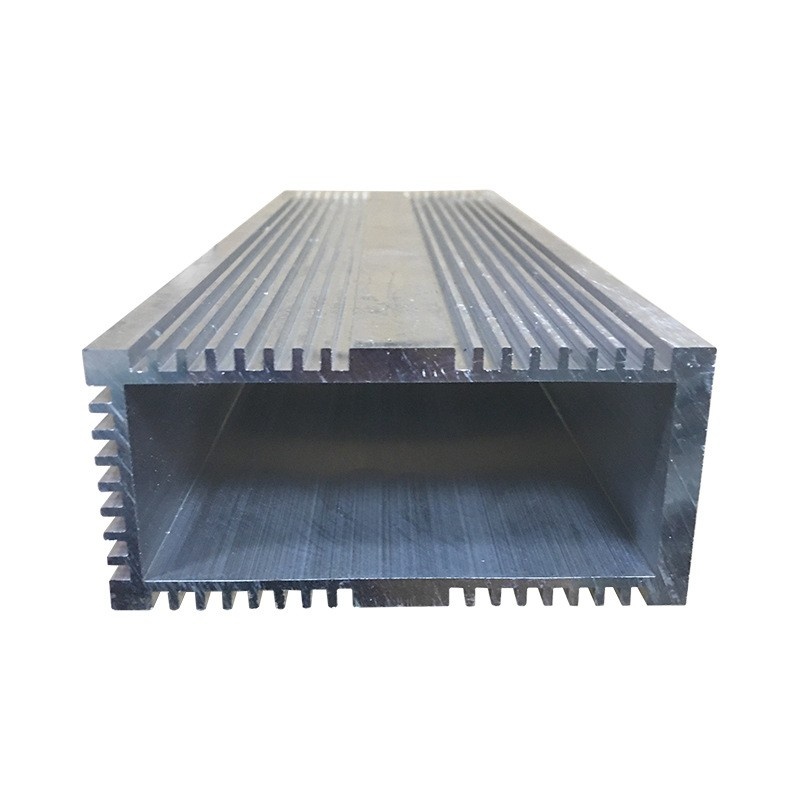
Aluminum profiles for radiators
Energy Storage Equipment Heat Sink Aluminum Profile
Energy storage equipment heat sink aluminum profile: as the global energy storage market continues rapid growth, demand for heat sinks in core power devices such as energy storage converters (PCS) and photovoltaic inverters is rising accordingly. In 2025,
Product Details
Energy storage equipment heat sink aluminum profile: as the global energy storage market continues rapid growth, demand for heat sinks in core power devices such as energy storage converters (PCS) and photovoltaic inverters is rising accordingly. In 2025, aluminum consumption in China's energy storage battery cabinets reached 800,000 tons, and aluminum profiles are playing a key structural-functional integrated role in energy storage. Energy storage equipment usually operates in harsh outdoor environments, so heat sinks must not only dissipate heat efficiently but also offer good weather resistance and structural strength.
Shanghai Chuangsi Aluminum Co., Ltd. develops energy storage equipment heat sink aluminum profiles specifically for energy storage cooling needs, focusing on the dual requirements of heat dissipation and protection for the high power density and harsh outdoor operating conditions of energy storage equipment. Aluminum profile heat sinks are directly formed by extrusion with cooling fins or channel structures, achieving a thermal conductivity of about 200W/m·K, far higher than steel (about 50W/m·K), allowing heat to be quickly conducted to the cooling surface and dissipated.
Core Advantages at a Glance:
| Advantage Dimension | Technical Indicator | Customer Value |
|---|---|---|
| High-Thermal-Conductivity Material | 6063-T5 aluminum alloy, thermal conductivity about 200W/m·K | High cooling efficiency, suited to high power density |
| Differentiated Cooling Solutions | 5kW-100kW power coverage, multiple fin profiles available | Precisely matched to different power levels |
| High-Precision Fin Profile | Fin thickness deviation ±0.03mm, flatness ≤0.05mm/100mm | Tight contact with heat source, reduced contact thermal resistance |
| Radiation Cooling Enhancement | Black anodizing, emissivity 0.1 to 0.8 | Radiation cooling contribution rises from 5% to 23% |
| Outdoor Weather Resistance | Anodizing / outdoor powder coating | UV aging resistance, salt spray corrosion resistance |
| Fully In-House Process Control | Extrusion + CNC + surface treatment | No external transfers, quality controllable |
| Fast Delivery | Samples in 7-10 days for standard structures, MOQ 50kg | Controllable project schedule |
01 Quality Starts with Raw Materials
Produced from A00 primary aluminum ingot with no scrap aluminum, the material is uniform with stable mechanical properties. We select 6063-T5 high-thermal-conductivity aluminum alloy with a thermal conductivity of about 200W/m·K and good extrusion formability to meet the precision forming needs of complex cooling structures.
02 Cooling Structure Design for Energy Storage Conditions
Energy storage equipment cooling features high power density, long operating hours and wide ambient temperature range. Fin design balances natural convection cooling (widely spaced fins optimized for thermal radiation) and forced air cooling (high-density/multi-fin structures paired with air duct design). Base plate thickness matches the flatness needs of the heat source contact surface to ensure efficient heat conduction. The surface can receive black anodizing, raising emissivity from 0.1 to 0.8 and lifting radiation cooling contribution from under 5% to 23%.
03 Outdoor Weather Resistance Enhancement
The surface can receive anodizing or outdoor powder coating for corrosion resistance, UV aging resistance and salt spray resistance, suiting harsh environments such as outdoor PV plants and wind farms. The powder coating has strong adhesion and will not peel or flake over long-term outdoor use.
04 Multi-Material and Structure Adaptation
Standard scenarios use 6063-T5 high-thermal-conductivity aluminum alloy; high thermal conductivity needs can use the 1070 pure aluminum series; high-strength mounting scenarios use 6061-T6 aluminum alloy. We support custom non-standard cross-section mold development to suit the installation space and cooling needs of different energy storage equipment.
05 Fully In-House Process Control
The full process from extrusion and CNC finishing to surface treatment is completed in-house without external transfers. Supporting deep processing such as CNC precision milling of base plates, drilling and tapping, precision cut-to-length, chamfering and deburring allows finished parts to go straight into equipment installation.
Machining capability parameters:
| Item | Parameter / Description |
|---|---|
| Applicable Scenarios | Energy storage converters, PV inverters, energy storage system power modules |
| Available Materials | 6063-T5 high-thermal-conductivity aluminum alloy, 1070 pure aluminum series, 6061-T6 high-strength aluminum alloy |
| Thermal Conductivity | About 200W/m·K (6063-T5) |
| Executive Standard | GB/T 6892-2023 high-precision grade |
| Power Coverage | 5kW-100kW class |
| Cooling Structure | Widely spaced comb fins, dense multi-fins, staggered fins, irregular cooling structures |
| Fin Thickness Deviation | ±0.03mm |
| Base Plate Flatness | ≤0.05mm/100mm |
| Surface Treatment | Anodizing, black anodizing, outdoor powder coating |
| Deep Processing Support | CNC precision milling, drilling and tapping, precision cut-to-length, chamfering and deburring |
| Mold Development Lead Time | Samples in 7-10 days for standard structures |
| Bulk Lead Time | 7-12 days |
| MOQ | 50kg |
| Production Location | Qingpu, Shanghai |
Energy Storage Equipment Heat Sink Selection Recommendations:
| Equipment Type | Recommended Cooling Solution | Material Recommendation |
|---|---|---|
| Energy storage converter (PCS) | Widely spaced comb fins + forced air cooling | 6063-T5 / 1070 pure aluminum series |
| PV inverter | Dense multi-fins + natural convection | 6063-T5 |
| Power module (IGBT/SiC) | High-density fins + forced air cooling | 6063-T5 |
| Outdoor energy storage cabinet | Powder coating + weather-resistant fin structure | 6061-T6 |
Typical Applications:
Energy storage converter (PCS) heat sinks
PV inverter cooling profiles
Energy storage system power module cooling components
Commercial and industrial energy storage cabinet cooling structural parts
Residential energy storage heat sinks
New energy charging pile cooling profiles
New energy power station energy storage cooling systems
FAQ (Frequently Asked Questions)
Q1: What is the difference between an energy storage converter heat sink and an ordinary industrial VFD heat sink?
A: Energy storage converters (PCS) and PV inverters are usually deployed in harsh outdoor environments (such as PV plants and wind farms), so the heat sink must not only dissipate heat efficiently but also offer good weather resistance and structural strength to withstand UV, salt spray and wind-blown sand. Industrial VFD heat sinks are mainly used in indoor industrial environments with relatively low weather resistance requirements. Energy storage equipment usually runs 24/7 continuously, placing higher demands on long-term reliability and cooling consistency of the heat sink.
Q2: How is the cooling structure of an energy storage equipment heat sink designed?
A: Energy storage equipment cooling features high power density, long operating hours and wide ambient temperature range. Fin design balances natural convection cooling (widely spaced fins optimized for thermal radiation) and forced air cooling (high-density/multi-fin structures paired with air duct design). Base plate thickness matches the flatness needs of the heat source contact surface to ensure efficient heat conduction. Power coverage is 5kW-100kW; low-to-medium power (<50kW) commonly uses widely spaced comb fin cooling structures, while high power (>50kW) uses multi-channel/compound cross-section designs to meet high heat flux extraction needs.
Q3: How can radiation cooling efficiency of an energy storage converter heat sink be improved?
A: The natural aluminum surface has low thermal emissivity (about 0.1), and radiation cooling contributes under 5%. After black anodizing, emissivity rises to 0.8, lifting radiation cooling contribution to 23%. For energy storage equipment relying mainly on outdoor natural convection cooling, black anodizing significantly improves cooling efficiency.
Q4: What outdoor protection treatment does an energy storage converter heat sink need?
A: The surface can receive anodizing (corrosion resistance, UV aging resistance, suitable for general outdoor environments) or outdoor powder coating (strong coating adhesion, no peeling or flaking over long-term outdoor use, suitable for harsh environments with high salt spray and strong UV). Powder coating enhances weather resistance, suiting harsh outdoor environments such as PV plants and wind farms.
Q5: What is the MOQ and lead time for energy storage converter heat sinks?
A: MOQ is 50kg. Standard structures take 7-10 days for mold development and samples, and bulk lead time is 7-12 days. Energy storage projects usually have tight lead times, and we support expedited scheduling, determined by project needs.
Get Your Solution Now
Contact Manager Du: 13611846009
Provide drawings or technical requirements, and our engineering department will deliver feasibility assessment and mold development plan within 2 hours.
Free Technical Consultation | Complex Cross-Section Evaluation | Direct from Source Factory
GET A QUOTE
Once you have submitted your requirements, we will contact you as soon as possible regarding your product inquiry.:Energy Storage Equipment Heat Sink Aluminum Profile