
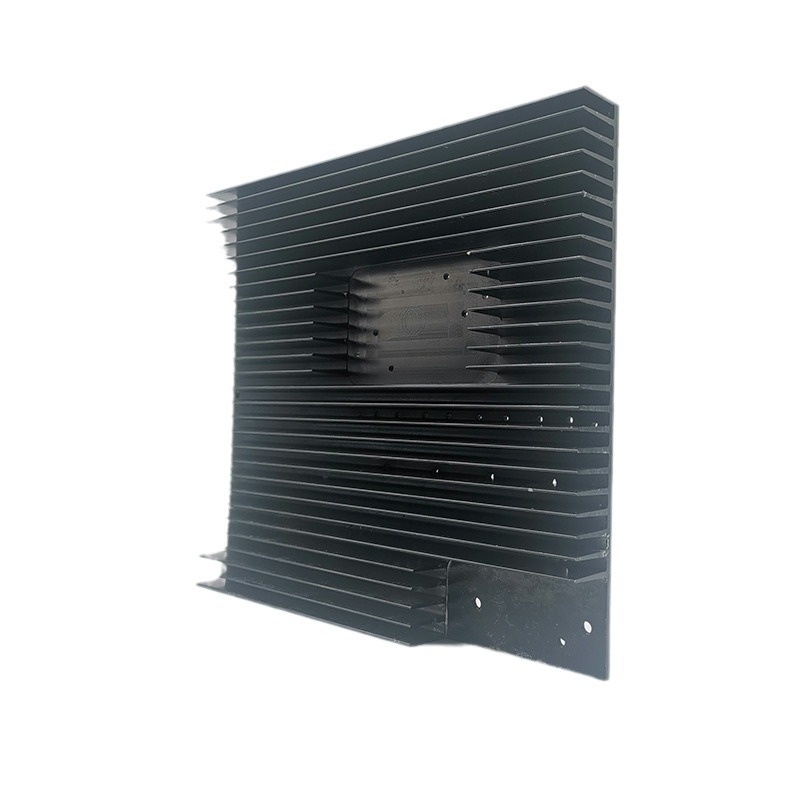
Aluminum profiles for radiators
Laser Heat Sink Aluminum Profiles
Laser heat sink aluminum profiles — lasers generate a large amount of heat during operation, especially high-power semiconductor lasers and fiber lasers. Thermal management directly relates to laser output power stability, wavelength accuracy, and service
Product Details
Laser heat sink aluminum profiles — lasers generate a large amount of heat during operation, especially high-power semiconductor lasers and fiber lasers. Thermal management directly relates to laser output power stability, wavelength accuracy, and service life. Inadequate heat dissipation leads to wavelength drift, output power degradation, and even device failure. Aluminum profile heat sinks, with their high thermal conductivity, lightweight construction, and flexible cross-section design capability, have become one of the mainstream solutions for laser cooling.
Shanghai Chuangsi Aluminum Co., Ltd. develops laser heat sink aluminum profiles specifically for high-power laser scenarios including semiconductor lasers, fiber lasers, and laser processing equipment, focusing on the core requirements of high thermal conductivity, high flatness, and precision forming. Using aluminum profile extrusion to directly form dense-fin, star-shaped, and skived-fin structures, integrated extrusion forming eliminates contact thermal resistance loss and delivers heat dissipation efficiency far higher than assembled heat sinks.
Core advantages at a glance:
| Advantage dimension | Technical specification | Customer value |
|---|---|---|
| High thermal conductivity material | 6063-T5 aluminum alloy, thermal conductivity approximately 201W/m·K | Fast heat extraction, stable laser output |
| Multiple heat dissipation structures | Dense-fin / star-shaped / skived-fin integrated forming | Adapted to different power and installation space |
| High-precision fin geometry | Fin thickness deviation ±0.03mm | Ensures tight fit between heat sink and laser housing |
| High base plate flatness | ≤0.05mm/100mm | Reduces contact thermal resistance, prevents wavelength drift |
| Precision forming | High-precision die extrusion | Flexible design of complex cross-sections |
| Production per drawings | Customer provides cross-section drawings | Fully matches laser structure |
| Fast delivery | 7-10 days for conventional structure samples, 50kg minimum order | Controllable project timeline |
01 Quality Starts From Raw Materials
Produced using A00 primary aluminum ingot, containing no scrap aluminum, with stable thermal conductivity. For conventional scenarios, 6063-T5 high-thermal-conductivity aluminum alloy (thermal conductivity approximately 201W/m·K) is used; for high thermal conductivity requirements, 1060 or 1070 industrial pure aluminum is available for superior heat dissipation.
02 Precision Heat Dissipation Structure Forming
Using high-precision die extrusion to directly form dense-fin, star-shaped, and skived-fin structures. Fin thickness deviation is controlled within ±0.03mm, and base plate flatness is ≤0.05mm/100mm, ensuring tight fit between heat sink and laser housing and effectively reducing contact thermal resistance. Aluminum extrusion can produce complex shapes and high-precision profiles for efficient thermal design.
03 Multi-Scenario Adaptation
Suitable for semiconductor laser cooling, fiber laser cooling, laser marking machines, laser cutting machines, laser welding equipment, and other high-power laser scenarios. Supports custom mold development for non-standard cross-sections; fin height, fin thickness, fin pitch, and base plate structure can be customized according to laser power, installation space, and cooling requirements.
04 Independent Control of All Processes
From extrusion and CNC precision machining to surface treatment, all processes are completed in-house with no outsourcing. Supporting deep processing includes CNC precision milling of base plates, drilling and tapping, precision cut-to-length, chamfering and deburring — finished products are ready for direct installation.
Machining capability parameters:
| Item | Parameter / Description |
|---|---|
| Applicable scenarios | Semiconductor lasers, fiber lasers, laser processing equipment |
| Optional material | 6063-T5 high-thermal-conductivity aluminum alloy, 1060/1070 industrial pure aluminum, 6061-T6 high-strength aluminum alloy |
| Thermal conductivity | Approximately 201W/m·K (6063-T5) |
| Execution standard | GB/T 6892-2023 high-precision grade |
| Heat dissipation structure | Dense fins, star-shaped, skived fins, customized heat dissipation structures |
| Minimum fin thickness | 0.5mm |
| Maximum fin height | 60mm |
| Fin thickness tolerance | ±0.03mm |
| Base plate flatness | ≤0.05mm/100mm |
| Surface treatment | Anodizing, natural-color anodizing, black anodizing, sandblasting |
| Deep processing support | CNC precision milling of base plate, drilling and tapping, precision cut-to-length |
| Mold development lead time | 7-10 days for conventional structure samples |
| Batch delivery lead time | 7-12 days |
| Minimum order quantity | 50kg |
| Production location | Qingpu, Shanghai |
Laser heat sink vs. standard electronic equipment heat sink:
| Comparison dimension | Laser heat sink | Standard electronic equipment heat sink |
|---|---|---|
| Power density | Extremely high (semiconductor / fiber lasers) | Standard |
| Temperature sensitivity | Extremely high (wavelength drift approximately 0.1-0.3nm/°C) | Relatively low |
| Long-term stability | Requires long-term continuous operation | Intermittent operation |
| Base plate flatness | ≤0.05mm/100mm | Standard requirement |
| Material selection | 6063-T5/1060/1070/6061-T6 | Primarily 6063-T5 |
| Heat dissipation structure | Dense fins / star-shaped / skived fins | Conventional fin geometry |
Material thermal conductivity comparison:
| Material | Thermal conductivity (W/m·K) | Features |
|---|---|---|
| 1070 pure aluminum series | 226 | High thermal conductivity, excellent heat dissipation |
| 1060 pure aluminum series | Approximately 220 | High thermal conductivity, good extrusion formability |
| 6063-T5 aluminum alloy | Approximately 201 | Good formability, cost-effective |
| 6061-T6 aluminum alloy | Approximately 180 | High strength, suitable for heavy-duty mounting |
Typical application scenarios:
Semiconductor laser heat sinks
Fiber laser cooling structural parts
Laser marking machine cooling profiles
Laser cutting machine cooling components
Laser welding equipment cooling base plates
Medical laser equipment cooling structural parts
LiDAR cooling profiles
FAQ (Frequently Asked Questions)
Q1: What is the difference between laser heat sinks and standard electronic equipment heat sinks?
A: Laser cooling faces three special challenges: first, extremely high power density — high-power semiconductor lasers and fiber lasers generate a large amount of heat during operation, and thermal management directly relates to output power stability, wavelength accuracy, and service life; second, extremely high temperature sensitivity — inadequate heat dissipation leads to wavelength drift (typically approximately 0.1-0.3nm per 1°C rise), output power degradation, and even device failure; third, high long-term stability requirements — lasers typically require long-term continuous operation, imposing strict requirements on heat sink long-term reliability and cooling consistency, far exceeding standard electronic equipment heat sinks.
Q2: Which materials are available for laser heat sinks?
A: For conventional scenarios, 6063-T5 high-thermal-conductivity aluminum alloy (thermal conductivity approximately 201W/m·K) is used, offering good cost-effectiveness and extrusion formability; for high thermal conductivity requirements, 1060 or 1070 industrial pure aluminum is available for superior heat dissipation; for heavy-duty mounting or vibrating conditions, 6061-T6 high-strength aluminum alloy is available. The semiconductor laser heat sink market is projected to reach USD 787 million by 2032, with a CAGR of 7.09%, and demand for high-performance cooling aluminum profiles continues to grow.
Q3: What types of heat dissipation structures are available for laser heat sinks?
A: Using high-precision die extrusion, we support dense-fin structures (suitable for air cooling of most semiconductor and fiber lasers), star-shaped structures (360° omnidirectional heat dissipation, suitable for natural convection cooling of high-power lasers), and skived-fin structures (ultra-thin dense fins, suitable for space-constrained high-power-density lasers). Aluminum extrusion can produce complex shapes and high-precision profiles for efficient thermal design.
Q4: Why does laser heat sink base plate flatness require ≤0.05mm/100mm?
A: Laser heat sinks typically need to fit tightly against the laser housing or heat sink base, and base plate flatness directly determines contact thermal resistance. Flatness ≤0.05mm/100mm ensures gap-free contact between the heat sink and laser, minimizing contact thermal resistance. Insufficient flatness causes local poor contact, heat accumulation, and may lead to laser wavelength drift, output power degradation, and even device failure.
Q5: What is the minimum order quantity and lead time for laser heat sinks?
A: The minimum order quantity is 50kg, supporting small-batch R&D prototyping for new products. Mold development for conventional structures takes 7-10 days for samples, and batch delivery is 7-12 days. The factory is located in Qingpu, Shanghai, serving the Yangtze River Delta laser equipment industrial cluster; engineering staff can visit on-site to assess equipment cooling conditions and support rapid iterative design modifications.
Get a solution now
📞 Contact Manager Du: 13611846009
Provide drawings or technical requirements; the engineering department will provide feasibility assessment and mold development plan within 2 hours.
Free technical consultation | Complex cross-section evaluation | Direct from source factory
GET A QUOTE
Once you have submitted your requirements, we will contact you as soon as possible regarding your product inquiry.:Laser Heat Sink Aluminum Profiles