
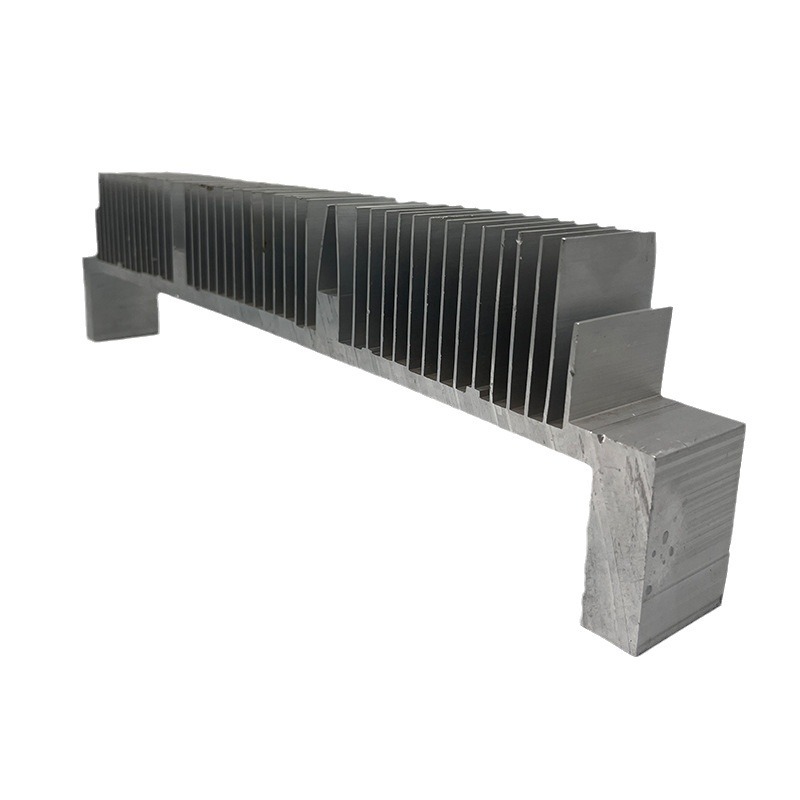
Aluminum profiles for radiators
5G Communication Heat Sink Aluminum Profile
5G communication heat sink aluminum profile: 5G base stations consume far more power than 4G. The AAU (Active Antenna Unit) integrates large-scale antenna arrays and RF front-ends, consuming 2.5-4 times the power of a 4G RRU. Higher power consumption mean
Product Details
5G communication heat sink aluminum profile: 5G base stations consume far more power than 4G. The AAU (Active Antenna Unit) integrates large-scale antenna arrays and RF front-ends, consuming 2.5-4 times the power of a 4G RRU. Higher power consumption means more heat generation; peak power consumption of a 5G base station AAU can exceed 1000W. At the same time, 5G base stations are usually deployed in harsh outdoor environments and must operate stably in the temperature range of -40°C to 55°C, placing extremely demanding requirements on heat dissipation efficiency, structural strength and weather resistance of the heat sink.
Aluminum profile heat sinks are the mainstream solution for 5G base station cooling. 6063 aluminum alloy has a thermal conductivity of about 201W/m·K, and extrusion can directly form complex cooling structures such as high-density fins and sunflower shapes, maximizing heat dissipation area. Surface anodizing enhances corrosion and wear resistance, suiting long-term outdoor operation.
Shanghai Chuangsi Aluminum Co., Ltd. develops 5G communication heat sink aluminum profiles specifically for communication equipment such as 5G base station AAUs, RRUs and communication cabinets, focusing on the cooling needs of high power consumption, harsh outdoor environments and long service life. High-density fins or sunflower cooling structures are directly formed by aluminum profile extrusion, in one piece without contact thermal resistance loss, delivering far higher cooling efficiency than assembled heat sinks. The material is anodized for high surface hardness, corrosion resistance and UV aging resistance, suiting long-term outdoor operation. We support custom non-standard cooling cross-sections and fin structures from drawings.
Core Advantages at a Glance:
| Advantage Dimension | Technical Indicator | Customer Value |
|---|---|---|
| High-Thermal-Conductivity Material | 6063-T5 aluminum alloy, thermal conductivity about 201W/m·K | High cooling efficiency, suited to high power above 1000W |
| Multiple Cooling Structures | High-density fins / sunflower / skived fins, one-piece formed | Maximized heat dissipation area |
| High-Precision Fin Profile | Fin thickness deviation ±0.03mm | Ensures tight contact between fins and heat-generating devices |
| High Base Plate Flatness | ≤0.05mm/100mm | Reduces contact thermal resistance, improves cooling efficiency |
| Outdoor Weather Resistance | Anodizing, UV aging resistance, salt spray resistance | Suited to extreme climates from -40 to 55°C |
| Flexible Structure Design | Supports custom non-standard cross-sections from drawings | Suited to AAU/RRU equipment layouts |
| Fully In-House Process Control | Extrusion + CNC + surface treatment | No external transfers, quality controllable |
01 Quality Starts with Raw Materials
Produced from A00 primary aluminum ingot with no scrap aluminum, ensuring stable thermal conductivity. Standard scenarios use 6063-T5 high-thermal-conductivity aluminum alloy (thermal conductivity about 201W/m·K); high thermal conductivity needs can use 1060 or 1070 industrial pure aluminum for better heat dissipation.
02 High-Thermal-Conductivity Precision Forming
High-precision die extrusion directly forms multiple cooling structures such as high-density fins, sunflower shapes and skived fins. Fin thickness deviation is controlled within ±0.03mm, and base plate flatness is ≤0.05mm/100mm, ensuring tight contact between fins and heat-generating devices and effectively reducing contact thermal resistance.
03 Outdoor Weather Resistance Enhancement
The surface is anodized for corrosion resistance, UV aging resistance and salt spray resistance, enabling long-term stable operation in extreme climates from -40 to 55°C. Aluminum profile heat sinks are attractive, lightweight, offer good heat dissipation and save energy.
04 Flexible Structure Design
Supports custom non-standard cooling cross-sections from drawings; fin height, fin thickness, fin spacing and base plate structure can be customized based on AAU/RRU equipment layout, installation space and power parameters. Functional structures such as mounting slots and sealing grooves can be integrated in one-piece extrusion.
05 Fully In-House Process Control
The full process from extrusion and CNC finishing to surface treatment is completed in-house without external transfers. Supporting deep processing such as CNC precision milling of base plates, drilling and tapping, precision cut-to-length, chamfering and deburring allows finished parts to go straight into equipment installation.
Machining capability parameters:
| Item | Parameter / Description |
|---|---|
| Applicable Scenarios | 5G base station AAU heat sinks, RRU cooling fins, communication cabinet cooling |
| Available Materials | 6063-T5 high-thermal-conductivity aluminum alloy, 1050/1060/1070 industrial pure aluminum |
| Thermal Conductivity | About 201W/m·K (6063-T5) |
| Executive Standard | GB/T 6892-2023 high-precision grade |
| Cooling Structure | High-density fins, sunflower, skived fins, custom cooling structures |
| Minimum Fin Thickness | 0.5mm |
| Maximum Fin Height | 60mm |
| Fin Thickness Tolerance | ±0.03mm |
| Base Plate Flatness | ≤0.05mm/100mm |
| Temperature Adaptation Range | -40 to 55°C |
| Surface Treatment | Anodizing, natural-color anodizing, black anodizing |
| Deep Processing Support | CNC precision milling of base plates, drilling and tapping, precision cut-to-length |
| Mold Development Lead Time | Samples in 7-10 days for standard structures |
| Bulk Lead Time | 7-12 days |
| MOQ | 50kg |
| Production Location | Qingpu, Shanghai |
5G Communication Heat Sink vs. Ordinary Electronic Equipment Heat Sink:
| Comparison Dimension | 5G Communication Heat Sink | Ordinary Electronic Equipment Heat Sink |
|---|---|---|
| Power Consumption | AAU peak power >1000W | Generally <300W |
| Operating Environment | Outdoor, -40 to 55°C | Indoor, room temperature |
| Life Requirement | Over 10 years | 3-5 years |
| Weather Resistance | UV resistant, salt spray resistant, corrosion resistant | No special requirements |
| Material | 6063-T5/1060/1070 | 6063-T5 |
| Surface Treatment | Anodizing (weather-resistant enhanced) | Ordinary anodizing |
5G Base Station Heat Sink Selection Reference:
| Equipment Type | Recommended Material | Recommended Structure |
|---|---|---|
| 5G base station AAU | 6063-T5 / 1060 pure aluminum | High-density fin / sunflower cooling structure |
| 5G base station RRU | 6063-T5 | High-density fin heat sink |
| Communication cabinets | 6063-T5 | Large cross-section cooling profiles |
| Micro base stations | 1070 pure aluminum series | Precision thin-fin cooling structure |
Typical Applications:
5G base station AAU cooling fins
5G base station RRU heat sinks
Communication cabinet cooling profiles
Base station power supply heat dissipation modules
Edge computing node heat sinks
5G micro base station cooling structural parts
FAQ (Frequently Asked Questions)
Q1: What is the difference between a 5G communication heat sink and an ordinary electronic equipment heat sink?
A: 5G communication heat sinks face three special challenges: first, extremely high power consumption, as 5G base station AAU peak power can exceed 1000W, 2.5-4 times that of a 4G RRU; second, harsh outdoor environments, since 5G base stations are usually deployed outdoors and must operate stably from -40 to 55°C; third, long life requirements, as communication equipment design life is usually over 10 years. These place far higher demands on heat dissipation efficiency, structural strength, corrosion resistance and UV aging resistance than indoor electronic equipment heat sinks.
Q2: What thermal conductivity can a 5G communication heat sink achieve?
A: Standard scenarios use 6063-T5 high-thermal-conductivity aluminum alloy with a thermal conductivity of about 201W/m·K. High thermal conductivity needs can use 1060 or 1070 industrial pure aluminum for better heat dissipation. Aluminum profile heat sinks are the mainstream 5G base station cooling solution; extrusion directly forms complex cooling structures such as high-density fins and sunflower shapes, maximizing heat dissipation area.
Q3: Why does a 5G communication heat sink need anodizing?
A: 5G base stations are deployed outdoors, exposed long-term to UV, rain, wind and salt spray. Surface anodizing enhances corrosion resistance, UV aging resistance and salt spray resistance, with high surface hardness, enabling long-term stable operation from -40 to 55°C and protecting the heat sink from corrosion, fading or powdering over long-term use.
Q4: What is the MOQ and lead time for 5G communication heat sinks?
A: MOQ is 50kg. Standard structures take 7-10 days for mold development and samples, and bulk lead time is 7-12 days. Since AAU/RRU equipment models are diverse, we recommend discussing the equipment model and power parameters in advance to quickly match the optimal cross-section solution.
Q5: How large is the demand in the 5G communication heat sink market?
A: Global 5G base station heat sink sales are expected to reach about 46 million units in 2025, with a market size of USD 1.748 billion, projected to reach USD 2.948 billion by 2032 at a CAGR of 8.2%. The global communication heat sink market reached RMB 19.2 billion in sales in 2025 and is projected to reach RMB 29.68 billion by 2032. A typical 5G base station AAU has a heat sink area of about 0.3-0.6m2, using about 1.5-3kg of aluminum per unit.
Get Your Solution Now
Contact Manager Du: 13611846009
Provide drawings or technical requirements, and our engineering department will deliver feasibility assessment and mold development plan within 2 hours.
Free Technical Consultation | Complex Cross-Section Evaluation | Direct from Source Factory
GET A QUOTE
Once you have submitted your requirements, we will contact you as soon as possible regarding your product inquiry.:5G Communication Heat Sink Aluminum Profile