
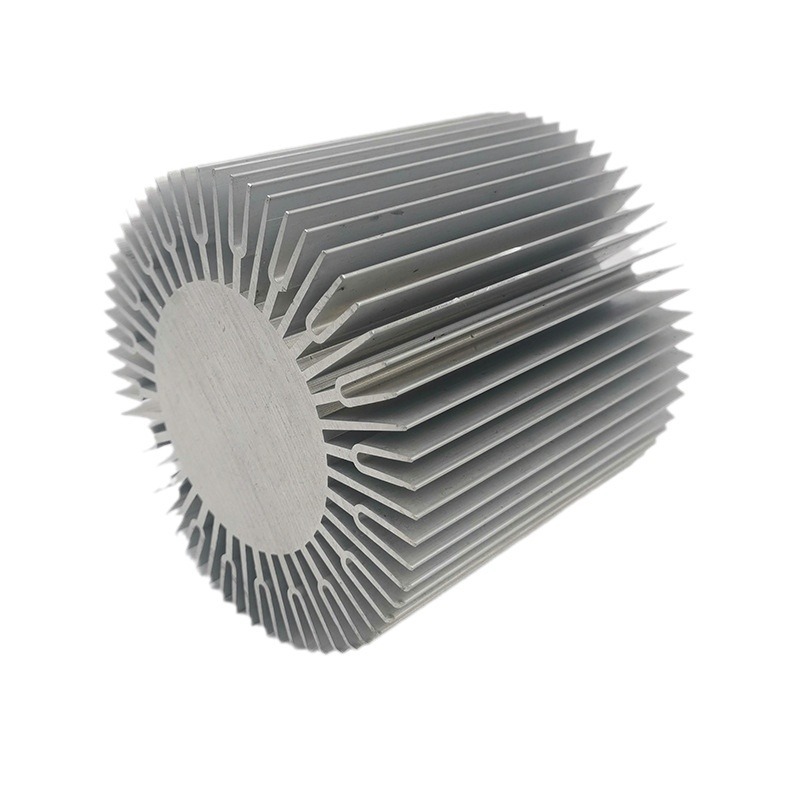
Aluminum profiles for radiators
LED Lighting Heat Sink Aluminum Profile
LED lighting heat sink aluminum profiles—LEDs have high luminous efficiency, but overheating seriously affects their life and luminous efficacy. Therefore, heat sink design and material are critical. Aluminum is the most commonly used heat dissipation mat
Product Details
LED lighting heat sink aluminum profiles—LEDs have high luminous efficiency, but overheating seriously affects their life and luminous efficacy. Therefore, heat sink design and material are critical. Aluminum is the most commonly used heat dissipation material because of its good thermal conductivity and low cost. At present, aluminum heat sinks account for over 65% of the LED lighting heat sink market. China's LED lighting heat sink market has exceeded 17 billion yuan, and aluminum heat sinks dominate thanks to their excellent thermal conductivity, low density, and ease of processing.
Shanghai Chuangsi Aluminum develops LED lighting heat sink aluminum profiles specifically for high-power LED street lights, high-bay lights, flood lights, track lights, and other lighting scenarios, focusing on the core requirements of LED heat dissipation profiles: "high thermal conductivity, lightweight, and maximized heat dissipation area." Through the aluminum profile extrusion process, we directly form sunflower, high-density fin, comb, and mountain-shaped heat dissipation structures in one piece, eliminating contact thermal resistance losses and delivering heat dissipation efficiency far higher than assembled heat sinks.
Core advantages at a glance:
| Advantage dimension | Technical index | Customer value |
|---|---|---|
| High thermal conductivity material | 6063-T5 aluminum alloy, thermal conductivity approx. 201W/m·K | High heat dissipation efficiency, extends LED life |
| Multiple heat dissipation structures | Sunflower / high-density fin / comb / mountain shape, integrally formed | Fits different luminaire types |
| High-precision fin profile | Fin thickness deviation ±0.03mm | Ensures tight contact between heat sink and LED light source |
| High base-plate flatness | ≤0.05mm/100mm | Reduces contact thermal resistance, improves heat dissipation efficiency |
| Lightweight | Low-density aluminum profiles | Reduces overall luminaire weight |
| Diverse surface treatments | Anodizing / brushing / sandblasting | Balances heat dissipation efficiency with appearance quality |
| Functional integration | Card slots / lens guide rails / diffuse reflection cavities | Optimizes light output, modular splicing, IP65 protection |
01 Quality starts with the raw material
Produced from A00 primary aluminum ingot, containing no scrap aluminum, with stable thermal conductivity. For conventional scenarios we select 6063-T5 high-thermal-conductivity aluminum alloy (thermal conductivity approx. 201W/m·K), which combines good thermal performance with extrudability and is the mainstream material choice for LED heat sinks. Using high-purity 6063-T5 aluminum profiles can significantly improve heat exchange efficiency.
02 Precision forming of multiple heat dissipation structures
Extrusion forming with high-precision dies supports many common aluminum profile shapes such as sunflower heat sinks, high-density fin heat sinks, comb-type heat sinks, and mountain-type heat sinks. Specifications can be custom-made to customer drawings and samples. Fin thickness deviation is controlled within ±0.03mm, and base-plate flatness ≤0.05mm/100mm, ensuring tight contact between the heat sink and the LED light source.
03 Balanced lightweight and appearance
Low-density aluminum profiles effectively reduce overall luminaire weight. The surface is anodized to balance heat dissipation efficiency with appearance quality, and brushing, sandblasting, and other surface treatments can enhance product grade. LED profiles are extruded from 6063-T5 aluminum alloy, offering high thermal conductivity, lightweight, and good surface treatment compatibility.
04 Modular and protective design
LED profiles can integrate card slots, lens guide rails, or diffuse reflection cavities to optimize light output; high-end models support modular splicing and IP65 protection. The aluminum profile provides mechanical support for the LED strip, protects electronic components from dust and mechanical damage, and acts as an efficient heat sink.
05 Fully in-house process control
The entire process from extrusion, CNC finish machining to surface finishing is completed in-house, with no external transfers. Supported deep processing includes CNC precision milling of base plates, drilling and tapping, fixed-length precision cutting, and chamfering/deburring, so finished products can be directly assembled.
Machining capability parameters:
| Item | Parameter / Description |
|---|---|
| Applicable scenarios | LED street lights, high-bay lights, flood lights, track lights, panel lights, automotive lights |
| Available materials | 6063-T5 high-thermal-conductivity aluminum alloy |
| Thermal conductivity | Approx. 201W/m·K |
| Executive standard | GB/T 6892-2023 high-precision grade |
| Heat dissipation structure | Sunflower, high-density fin, comb, mountain shape, custom structures |
| Minimum fin thickness | 0.5mm |
| Maximum fin height | 60mm |
| Fin thickness tolerance | ±0.03mm |
| Base-plate flatness | ≤0.05mm/100mm |
| Surface treatment | Anodizing, brushing, sandblasting |
| Deep processing support | CNC precision milling of base plate, drilling and tapping, fixed-length precision cutting |
| Functional integration | Card slots, lens guide rails, diffuse reflection cavities, modular splicing |
| Protection class compatibility | IP65 (sealed structure can be designed) |
| Mold development lead time | Samples in 7-10 days for conventional structures |
| Batch lead time | 7-12 days |
| MOQ | 50kg |
| Production location | Qingpu, Shanghai |
LED heat dissipation structure selection reference:
| Luminaire type | Recommended heat dissipation structure | Features |
|---|---|---|
| LED street light | Sunflower heat sink | 360° heat dissipation, suitable for outdoor high power |
| LED high-bay light | High-density fin heat sink | Large heat dissipation area, suitable for high-power scenarios |
| LED flood light | Comb-type heat sink | Directional heat dissipation, compact structure |
| LED track light | Mountain-type heat sink | Small volume, suits track mounting |
| LED panel light | Heat dissipation back-plate profile | Large-area flat heat dissipation, suitable for indoor lighting |
LED lighting heat sink vs die-cast aluminum heat sink:
| Comparison dimension | Extruded aluminum profile heat sink | Die-cast aluminum heat sink |
|---|---|---|
| Thermal conductivity | Approx. 201W/m·K | Approx. 96W/m·K |
| Heat dissipation structure | High-density fins, sunflower, etc., integrally formed | Limited by die, coarser fin shape |
| Heat dissipation efficiency | High (no contact thermal resistance loss) | General (contact thermal resistance exists) |
| Die cost | Lower | Higher |
| Suitable batch volume | Small-to-medium batches, multi-variety | Large batches |
| Surface treatment | Anodizing / brushing / sandblasting | Mainly coating |
Typical application scenarios:
High-power LED street light heat sinks
LED high-bay light heat dissipation profiles
LED flood light heat sinks
LED track light heat dissipation structural parts
LED panel light heat dissipation back-plates
LED automotive light heat sinks
UV LED curing equipment heat dissipation profiles
FAQ (Frequently Asked Questions)
Q1: Why is 6063-T5 aluminum alloy mainly chosen for LED lighting heat sinks?
A: 6063-T5 high-thermal-conductivity aluminum alloy has a thermal conductivity of about 201W/m·K, combining good thermal performance and extrudability, and is currently the mainstream material choice for LED heat sinks. Aluminum heat sinks, thanks to good thermal conductivity and low cost, account for over 65% of the LED lighting heat sink market. Using high-purity 6063-T5 aluminum profiles can significantly improve heat exchange efficiency, while offering low density and easy processing, making it the ideal material for LED lighting heat sinks.
Q2: How much does overheating affect LED luminaires?
A: Overheating seriously affects LED life and luminous efficacy, accelerating the lumen depreciation of the LED chip, causing brightness drop, and in severe cases leading to permanent LED damage. Aluminum heat sinks, thanks to good thermal conductivity and low cost, currently account for over 65% of the LED lighting heat sink market. China's LED lighting heat sink market has exceeded 17 billion yuan, and as LED lighting penetration continues to rise, demand for high-performance heat dissipation aluminum profiles keeps growing.
Q3: What heat dissipation structures can be machined on LED lighting heat sinks?
A: Extrusion forming with high-precision dies supports many common aluminum profile shapes such as sunflower heat sinks (360° heat dissipation, suitable for outdoor high-power LED street lights), high-density fin heat sinks (large heat dissipation area, suitable for high-power scenarios like high-bay lights), comb-type heat sinks (directional heat dissipation, compact, suitable for flood lights), mountain-type heat sinks (small volume, suits track lights), and heat dissipation back-plate profiles (large-area flat heat dissipation, suitable for LED panel lights). Specifications can be custom-made to customer drawings and samples.
Q4: How is heat dissipation efficiency ensured for LED lighting heat sinks?
A: Multiple heat dissipation structures are directly formed through the aluminum profile extrusion process, integrally extruded without contact thermal resistance loss, delivering heat dissipation efficiency far higher than assembled heat sinks. Fin thickness deviation is controlled within ±0.03mm, and base-plate flatness ≤0.05mm/100mm, ensuring tight contact between the heat sink and the LED light source and effectively reducing contact thermal resistance. We select 6063-T5 high-thermal-conductivity aluminum alloy (thermal conductivity approx. 201W/m·K) to comprehensively ensure heat dissipation efficiency from material to structure.
Q5: What functional structures can be integrated into LED lighting heat sinks?
A: LED profiles can integrate card slots, lens guide rails, or diffuse reflection cavities to optimize light output; high-end models support modular splicing and IP65 protection. The aluminum profile provides mechanical support for the LED strip, protects electronic components from dust and mechanical damage, and acts as an efficient heat sink. The heat sink manufacturing industry is evolving from simple profile cutting toward high-precision CNC machining and functional integration.
Q6: What is the MOQ and lead time for LED lighting heat sinks?
A: The MOQ is 50kg. For conventional structures, mold development takes 7-10 days to samples, and batch lead time is 7-12 days. Since LED lighting heat sinks cover many luminaire types (street lights, high-bay lights, flood lights, track lights, panel lights, etc.), we recommend communicating luminaire power and mounting dimensions in advance to quickly match the optimal cross-section solution.
Get a solution now
📞 Contact Manager Du: 13611846009
Provide drawings or technical requirements, and the engineering department will give a feasibility assessment and mold development solution within 2 hours.
Free technical consultation | Complex cross-section evaluation | Direct from source factory
GET A QUOTE
Once you have submitted your requirements, we will contact you as soon as possible regarding your product inquiry.:LED Lighting Heat Sink Aluminum Profile